




Disclaimer: This article provides general information only and is not tax or financial advice. Tax obligations vary by business type and circumstance. We recommend consulting a registered tax agent or visiting ato.gov.au for guidance specific to your situation.
This guide covers seven of the most widely used bookkeeping platforms in Australia. Each entry covers what the platform does, who it suits, and where it falls short, so you can match the right tool to your actual situation. One distinction worth noting upfront: bookkeeping software handles your general ledger, invoicing, GST, and financial reports. It does not manage spend before it happens, issue corporate cards, or enforce approval workflows. We cover how those two pieces connect near the end.
What to look for in bookkeeping software

Before comparing platforms, it helps to be clear about what your business actually needs. For Australian businesses, these five criteria matter most.
GST and BAS compliance
Any bookkeeping software you use in Australia needs to handle GST correctly and generate a pre-filled Business Activity Statement. The Australian Taxation Office sets out digital record-keeping requirements for registered businesses, and your software should make ATO-compliant reporting automatic rather than manual. The ATO's guidance on business record-keeping obligations is worth a read before you choose.
Single Touch Payroll (STP)
If you pay wages, STP Phase 2 is mandatory. Your bookkeeping software must report payroll data, including wages, superannuation, and tax withheld, directly to the ATO each pay cycle.
Bank feeds
Live connections to your Australian bank accounts cut reconciliation time dramatically. Check which banks your chosen platform supports before committing.
Scalability
Sole trader needs look very different from a business with ten people and multiple revenue streams. Pick a platform with tiered plans that grow with you without forcing a full migration.
Integration support
Your bookkeeping software sits at the centre of your finance stack. It needs to connect cleanly with your payment processor, point-of-sale system, and any spend management tools your team uses.
Seven bookkeeping platforms for Australian businesses

1. Xero
Xero is among the most widely adopted cloud bookkeeping platforms in Australia and New Zealand. It covers GST tracking, BAS preparation, bank reconciliation, invoicing, payroll, and financial reporting in one interface. The dashboard gives a real-time view of cash flow, outstanding invoices, and bank balances, and the mobile app makes receipt capture straightforward for teams on the move.
Who it suits: Most small and medium Australian businesses, particularly those working with an accountant or bookkeeper. Xero's advisor network in Australia is large, which makes finding local support straightforward.
Limitations: The entry-level Starter plan caps the number of invoices and bank reconciliations per month, which can catch growing businesses off guard. Upgrading to Standard removes those limits.
2. MYOB
MYOB is an Australian-founded company with a long track record in small business accounting. Its cloud product, MYOB Business, covers invoicing, expense tracking, payroll, BAS lodgements, and inventory management. MYOB also offers AccountRight, a desktop option for businesses that prefer not to operate entirely in the cloud, which sets it apart from most competitors.
Who it suits: Established Australian businesses with more complex inventory or payroll needs, and those that want locally headquartered support.
Limitations: The interface takes more time to learn than some newer platforms. Some accountants default to Xero, which can create friction when sharing files with your advisor.
3. QuickBooks Online
QuickBooks Online handles GST, BAS, invoicing, expense tracking, and bank reconciliation, with a reporting library that goes deeper than most entry-level platforms. The mobile app is well regarded for on-the-go receipt capture, and the interface is generally easy to navigate for first-time users.
Who it suits: Small businesses that need strong reporting without the complexity of a full accounting suite, and those that already use other Intuit products.
Limitations: QuickBooks has a smaller Australian market presence than Xero or MYOB, which means finding a local accountant familiar with the platform requires more effort.
4. Reckon
Reckon is an Australian-owned bookkeeping company, which makes it a popular choice for businesses that want local ownership and local support. Reckon One, its cloud product, uses a modular pricing structure: you pay only for the features you actually use. This makes it one of the more cost-effective options for sole traders and micro businesses.
Who it suits: Sole traders, freelancers, and micro businesses that want to keep software costs low while staying ATO-compliant.
Limitations: Reckon's integration ecosystem is narrower than Xero or QuickBooks, which limits how well it connects with specialist tools your team might already be using.
5. Sage Business Cloud Accounting
Sage is a global accounting software company with a growing presence in Australia. Its cloud product covers invoicing, expense tracking, bank reconciliation, and GST reporting. Sage tends to attract businesses that have grown beyond entry-level bookkeeping tools but are not yet large enough to need an ERP system.
Who it suits: Growing Australian SMBs that need more depth than starter plans offer, without the cost and complexity of enterprise-grade software.
Limitations: Sage's Australian user base is smaller than Xero or MYOB, which can affect the availability of local support and the familiarity of accountants with the platform.
6. FreshBooks
FreshBooks is built primarily for service businesses, freelancers, and sole traders. It makes client invoicing fast, tracks time and project expenses, and handles GST calculations. The interface is one of the cleanest available and requires very little prior accounting knowledge to operate.
Who it suits: Consultants, creatives, tradespeople, and anyone who invoices clients and needs to track project costs without a full accounting suite.
Limitations: FreshBooks is weaker on inventory management, payroll, and detailed financial reporting. It is best understood as invoicing software with bookkeeping features rather than a full bookkeeping platform, and most businesses outgrow it as soon as payroll becomes a regular requirement.
7. Wave Accounting
Wave is a free bookkeeping platform that covers invoicing, bank connections, and basic income and expense tracking. Its core accounting features carry no monthly charge, making it the most accessible starting point for brand-new businesses.
Who it suits: Micro businesses and sole traders at the very beginning of their operations, who need a no-cost way to track income and expenses while keeping things simple.
Limitations: Wave's Australian-specific compliance features are limited compared to locally built platforms. BAS lodgements and STP Phase 2 payroll are not native features, which means most Australian businesses will outgrow Wave quickly once GST reporting or payroll become regular tasks. Payment processing and payroll are paid add-ons.
How to choose the right platform for your business
For most Australian small businesses, Xero is the default-safe starting point: widely supported by local accountants, covering everything from sole trader invoicing to multi-employee payroll. If you have complex inventory needs or prefer a desktop option, MYOB is the closest alternative. If you are a sole trader watching every dollar of overhead, Reckon's modular pricing is worth a closer look. FreshBooks suits service businesses that invoice clients but do not yet need payroll. Sage gives more headroom for businesses scaling past the SMB bracket.
Most major providers offer a 30-day free trial. Running the real product for a month alongside your accountant is the fastest way to know whether the interface and feature set match how your business actually operates.
How Weel fits alongside your bookkeeping software

Bookkeeping software records what has happened. Weel controls what happens before it does.
That distinction matters because bookkeeping platforms are built to classify and report transactions, not to stop a policy breach before a card is swiped, capture receipts at the point of purchase, or route a supplier invoice through a multi-level approval before payment goes out.
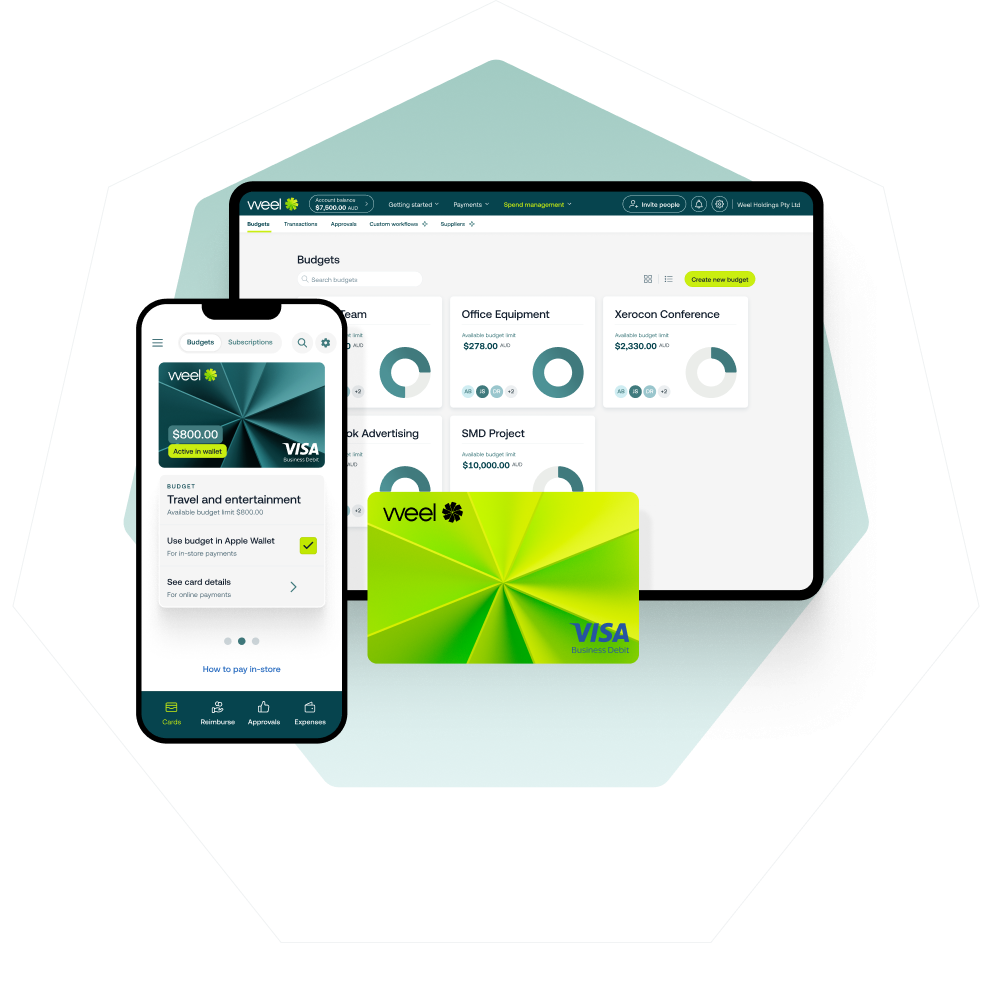
Weel's corporate cards give every team member a card with built-in spend limits, category controls, and merchant restrictions. When a purchase is made, Weel prompts for a receipt immediately, auto-fills the expense category, and routes it through your approval workflow. By the time the transaction lands in your bookkeeping software, it already carries a receipt, a coding, and a manager sign-off.
For supplier invoices, Weel's accounts payable automation captures invoices, extracts line-item data, matches against purchase orders, and routes for approval before scheduling payment. No manual data entry at month-end, no chasing approvals after the fact.
Based on Weel platform data across 3.9 million card transactions, over 90% of card expenses reach full manager approval, and 50% are fully approved within 24 hours. That means your bookkeeping software receives clean, complete data rather than partial records that need correction after the fact.
Weel integrates directly with Xero, MYOB, and QuickBooks, syncing approved transactions automatically. Your books close on current data, not a month-end backlog.
To learn more about how automation sits across your full finance stack, see our guide to small business accounting automation software.
Whichever bookkeeping platform you choose, Weel closes the loop on spend control, receipt capture, and AP automation. Take the product tour to see how the two work together.