




Disclaimer: This article provides general information only and is not tax or financial advice. Tax obligations vary by business type and circumstance. We recommend consulting a registered tax agent or visiting ato.gov.au for guidance specific to your situation.
Finance automation in Australia is no longer a future-state conversation. Australian CFOs are acting now, automating accounts payable, expense reporting, and month-end reconciliation to close the books faster and with more confidence. This guide covers which processes to prioritise, which tools lead the market, and what a phased automation roadmap looks like for a mid-market finance team.
What is finance automation?
Finance automation is the use of software to complete financial tasks that would otherwise require manual effort. That includes capturing receipts, routing invoices for approval, matching transactions to general ledger codes, reconciling accounts, and producing reports.
At the simpler end, finance process automation means replacing spreadsheets and email approvals with software-driven workflows. At the more advanced end, AI in finance applies machine learning to categorise transactions, detect anomalies, and pre-fill coding with no human input.
For Australian finance teams, the stakes are practical. The ATO's record-keeping requirements mandate that businesses retain financial records for five years, correctly account for GST, and demonstrate a clear audit trail. Manual processes make this harder and riskier. Automated finance workflows make compliance a by-product of normal operations, not a separate project.
The shift is already under way. Across the mid-market, businesses with 100 to 1,000 employees, finance teams that once managed spend through shared cards, email approvals, and end-of-month reconciliation are replacing those processes one layer at a time.
Why Australian CFOs are prioritising automation now

Several forces have converged to make finance workflow automation a near-term priority for Australian finance leaders.
Volume has outgrown manual capacity
As organisations grow, transaction volumes increase faster than finance team headcount. Reconciliation backlogs compound month-on-month. Approval chains slow down because more managers are involved. The manual model that worked at 50 people breaks at 200.
Real-time visibility is now expected
Boards and executive teams expect real-time spend data, not end-of-month summaries. Finance leaders who rely on manual processes are always reporting on the past. Automated finance workflows produce live data as a default.
Month-end close speed is a competitive signal
A fast close is a sign of a well-controlled business. Finance teams that close in three days rather than ten have more time for forecasting, analysis, and strategic support. Finance team efficiency at the close is directly linked to how much of the process is automated.
The ANZ software ecosystem has matured
Xero, MYOB, and NetSuite are now deeply integrated with a generation of spend management and accounts payable tools. The friction of connecting systems has dropped significantly, making the case for automation easier to make and faster to implement.
Which finance processes should Australian businesses automate first?
Not every process is equal. The best starting points are high-volume, rules-based, and currently causing the most pain. Here are the four processes Australian CFOs automate first.
Accounts payable automation
Accounts payable is the highest-ROI target for most mid-market finance teams. AP automation replaces manual invoice processing, opening emails, checking amounts, routing for approval, coding to GL, scheduling payment, with a software-driven workflow.
Key capabilities to look for: duplicate invoice detection, multi-level approvals, GL code mapping, and direct integration with Xero or MYOB. Automated invoicing removes the risk of missed invoices, double payments, and approval bottlenecks. For teams processing 200 or more invoices per month, the time saving is immediate.
Complete AP platforms capture invoice details automatically, approve invoices in bulk (up to 100 at a time), and pay via BPAY or batch payments in one flow, with a full audit trail from capture through payment. The best platforms sync directly with Xero and MYOB AccountRight in all plans, with Business Central integration available on Enterprise plans. Weel's accounts payable automation combines these capabilities so finance teams move from invoice-to-payment without manual data entry or approval delays.
Expense management automation
Automated expense reporting closes one of the most persistent loops in finance: receipts that never arrive, expense reports submitted days after month-end, and reimbursements that take weeks to process.
Modern expense management software captures receipts at point of spend via mobile app, uses AI-powered OCR to extract merchant, amount, and GST, and routes the expense through an approval workflow automatically. The result is that expenses are coded, approved, and ready for accounting export within hours of the transaction, not weeks.
Month-end close and automated reconciliation
Automated reconciliation matches card transactions to receipts, invoices to payments, and bank feed entries to GL codes continuously, rather than in a manual end-of-month batch. Cloud-based finance software with real-time bank feed sync means reconciliation is mostly done before the month ends.
For Australian businesses on Xero or MYOB, this is the most visible ROI of any automation investment: the close moves from a multi-day manual exercise to a review-and-confirm process.
Financial reporting automation
Automated financial reporting pulls data from the accounting system, expense platform, and AP tool to produce board packs, department spend summaries, and budget variance reports without manual spreadsheet assembly. Real-time reporting replaces the end-of-month scramble with on-demand visibility.
Cost centre tracking and drill-down reporting become standard features rather than special projects. Budget controls and spend analytics give CFOs the view they need to make decisions in-period, not after the fact.
The Australian finance automation landscape: which tools are leading
The Australian market has a distinct ecosystem. Most mid-market finance teams run Xero or MYOB as their core accounting system, with a growing number of larger businesses on NetSuite or SAP. The best finance automation tools are those that integrate directly with these systems and are designed for the ANZ compliance environment.
Spend management and expense automation
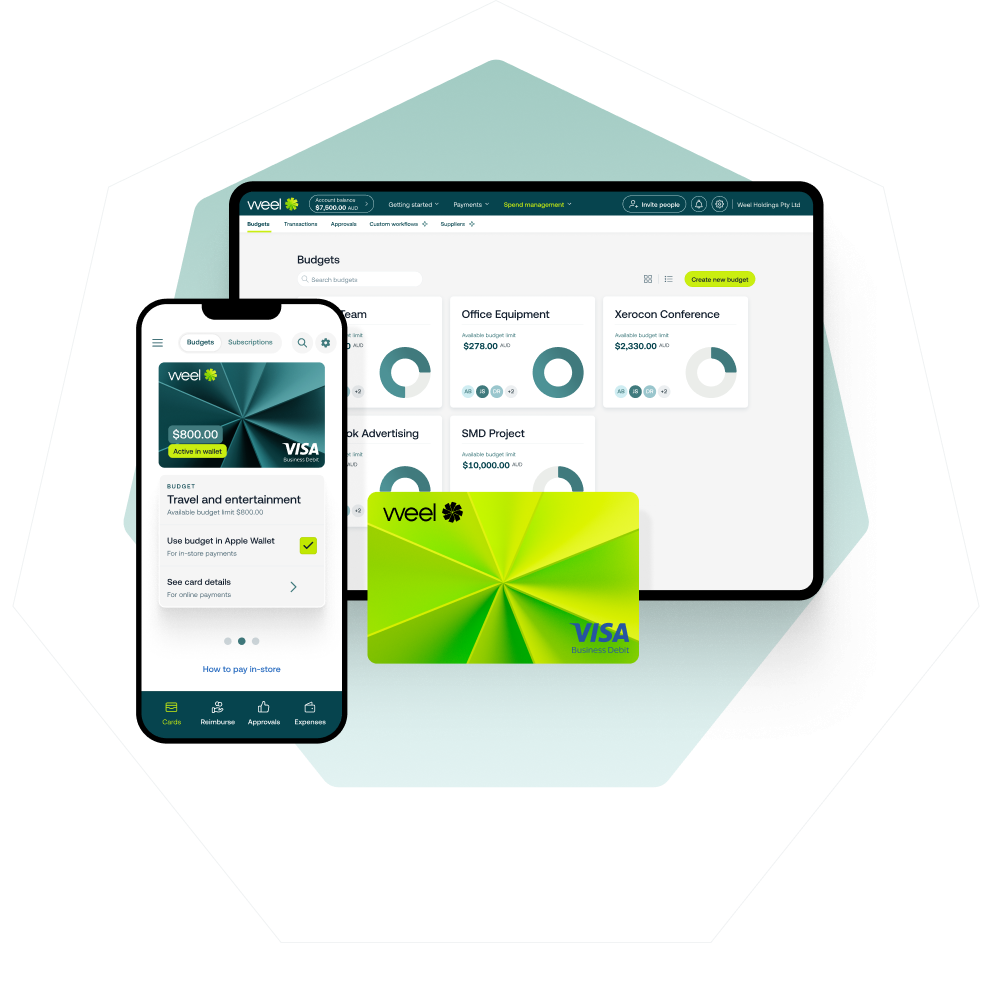
Weel is built for Australian mid-market businesses managing decentralised spend. It combines corporate cards (virtual and physical), expense management, reimbursements, accounts payable automation, and approval workflows in one platform. Card transactions are captured automatically, routed through approval workflows, and synced to Xero, MYOB, or NetSuite.
The results across the Weel platform are verified and published: over 90% of card expenses reach full manager approval, half are fully approved within 24 hours, and the median time from spend to accounting sync is 2 days. For a mid-market finance team, that means the close is largely done before the end of the month.
Other tools in the Australian market serve specific parts of the stack, such as FX and global payments, enterprise travel and expense, and public sector AP. The strongest finance automation stacks combine a core accounting platform with a dedicated spend management layer.
Accounting platform integrations
For Australian businesses, Xero integration is table stakes. Any spend management or AP automation tool that does not offer two-way sync with Xero is effectively not in the running for most mid-market buyers. Bank feed sync, GL code mapping, and credit card reconciliation must all work natively.
MYOB integration is the second-tier requirement. NetSuite ERP integration matters increasingly as businesses scale toward 500 employees and above.
RPA and AI in finance
Robotic process automation (RPA) has been in use in large Australian enterprises for a decade, primarily for rules-based tasks: downloading bank statements, populating spreadsheets, extracting invoice data. It is effective but brittle, it breaks when formats change.
AI in finance is replacing RPA for most new automation investments. Where RPA executes fixed rules, AI learns from patterns. Auto-categorisation, anomaly detection, and intelligent receipt matching are now standard features in modern expense management and AP automation tools, not premium add-ons.
A phased automation roadmap for Australian mid-market finance teams

Most mid-market finance teams cannot automate everything at once. The practical approach is a phased roadmap that delivers ROI at each stage and builds toward a fully automated finance function.
Phase 1: Capture and compliance (months 1 to 3)
The first priority is getting every transaction captured correctly and in real time.
Deploy corporate cards with built-in spend controls. Replace shared cards and petty cash with individual virtual cards or physical cards with pre-set limits. Issue a mobile app to every cardholder with AI-powered receipt scanning built in.
Set up approval workflows for card spend. Route out-of-policy transactions for manager review automatically.
Connect to Xero or MYOB via bank feed sync. Every transaction should be visible in the accounting system within 24 hours of spend.
What Phase 1 solves
Missing receipts, shared card risk, no real-time visibility, GST coding gaps.
Phase 2: AP automation and reimbursements (months 3 to 6)
With card spend under control, automate the invoice and reimbursement stack.
Deploy accounts payable automation with duplicate invoice detection, multi-level approvals, and GL code mapping. Set up reimbursement processing with direct entry payments so employees are paid into their bank accounts within 24 hours of approval.
Establish expense policies in the system. Policy enforcement becomes automatic: out-of-policy flagging happens at the point of submission, not at the point of audit.
What Phase 2 solves
Manual invoice processing, delayed reimbursements, policy breaches that surface at month-end, AP aging backlogs.
Phase 3: Close automation and financial reporting (months 6 to 12)
With transactions captured and AP automated, the focus shifts to close speed and visibility.
Enable automated reconciliation so bank feed entries are matched to receipts and GL codes continuously. Set up real-time reporting dashboards with budget tracking, cost centre tracking, and spend analytics. Build automated financial reporting outputs for board packs and departmental summaries.
What Phase 3 solves
Manual close process, end-of-month reconciliation backlog, delayed board reporting, lack of in-period visibility.
Phase 4: AI and continuous optimisation (12 months+)
The final phase is activating AI agents to handle the residual manual tasks: auto-categorisation of uncoded transactions, anomaly detection across spend patterns, and intelligent approval routing that learns from historical decisions.
At this stage, finance team efficiency reaches its peak. Manual intervention is reserved for exceptions and strategic decisions. The rest is automatic.
How Australian finance teams use Weel for finance automation
Australian mid-market businesses use Weel's expense management platform to close every expense loop automatically, from the moment a card is swiped to the moment it hits the accounting system.
The Weel platform covers the full automation stack in one place: corporate cards with spend controls, AI-powered receipt scanning, approval workflows, reimbursements, and accounts payable automation with direct accounting integrations.
The data behind these claims is real and published. Weel platform data on card expenses shows:
- Over 90% of card expenses reach full manager approval
- 50% are fully coded, approved, and ready for accounting export within 24 hours
- The median time from spend to accounting sync is 2 days
When Weel AI agents are active, AI-powered expenses are 13% more likely to be fully approved within a week.
For a mid-market CFO running month-end close, the practical outcome is that most of the reconciliation work is already done before the month ends. The close becomes a review, not a rebuild.
Weel syncs card transactions and expenses to Xero, MYOB, and NetSuite, and syncs accounts payable bills and payments with Xero and MYOB AccountRight. Weel AI pre-fills the category, description and GST code at the point of capture.
"Every Expense Complete." is the outcome Weel is built around: 90% of expenses completed before month-end.
Conclusion
Finance automation in Australia has moved from a strategic aspiration to a practical deployment project for mid-market CFOs. The processes to prioritise are clear: AP automation first, then expense management, then close automation, then AI optimisation. The tools to evaluate are those built for the ANZ ecosystem, with native Xero and MYOB integration and compliance-first architecture.
The CFOs who act in the next 12 months will close faster, report in real time, and free their teams for higher-value work. The ones who wait will find that the gap widens.
To stay across the latest thinking for Australian finance leaders, sign up for the Weel newsletter. And if you're looking to automate and better control your organisation's expense management, book a demo with us today.