




Disclaimer: This article provides general information only and is not tax or financial advice. Tax obligations vary by business type and circumstance. We recommend consulting a registered tax agent or visiting ato.gov.au for guidance specific to your situation.
Fringe benefits tax catches out more employers through poor record-keeping than through the tax rules themselves. If your business provides cars, entertainment, loans, or pays private expenses on behalf of your team, fringe benefits tax (FBT) applies, and the ATO expects a clean, dated record of every benefit provided. This guide covers the current FBT rate, how Type 1 and Type 2 benefits are calculated, what's exempt, and what your records need to hold up to scrutiny.
What is fringe benefits tax?
Fringe benefits tax is a tax employers pay on certain non-cash benefits provided to team members or their associates, in addition to or instead of salary and wages. It's separate from income tax: the employer pays FBT, not the person who received the benefit.
The FBT year runs from 1 April to 31 March, not the July to June financial year. Businesses are currently in the FBT year that runs from 1 April 2026 to 31 March 2027. For that year, the FBT rate is 47%, applied to the grossed-up taxable value of benefits provided.
Common fringe benefits include a work car available for private use, entertainment (meals, event tickets, venue hire), low-interest or interest-free loans, paying or reimbursing a private expense on someone's behalf, and giving property or goods at a discount. If a benefit isn't salary, wages, or a superannuation contribution, and it isn't specifically exempt, it's worth checking whether FBT applies.
Why FBT compliance matters beyond the tax bill
Getting FBT wrong costs more than the tax itself. Under-reporting triggers ATO penalties and interest on top of the FBT owed, and the ATO has flagged fringe benefits as a recurring audit focus area for small and mid-sized employers. Reportable fringe benefits amounts over the relevant threshold also show up on team members' income statements, which means a mistake in your records becomes their problem at tax time too.
The businesses that get caught out aren't usually confused about the rules. They're missing the underlying data: no record of who used a car and when, no GST coding on an expense payment benefit, no note of whether a benefit was genuinely infrequent enough to qualify for the minor benefits exemption. FBT compliance is a record-keeping problem wearing a tax problem's clothes.
The ATO also increasingly cross-checks fringe benefits information against other data it already holds, including motor vehicle registrations and payroll data reported through Single Touch Payroll. That makes an undeclared car fringe benefit or an unreported entertainment spend easier to flag than it once was, which raises the cost of treating FBT record-keeping as an afterthought.
Step 1: identify every fringe benefit you're providing
Start with a benefit audit, not a tax calculation. Walk through every non-cash benefit your business provides across the FBT year:
- Car fringe benefits: any work vehicle available for private use, including trips between home and work in most cases
- Entertainment fringe benefits: client and team meals, event tickets, venue hire, and entertainment facility leasing
- Loan fringe benefits: loans provided at less than the ATO's benchmark interest rate
- Expense payment fringe benefits: paying or reimbursing a private expense, such as a personal phone bill or gym membership
- Property fringe benefits: goods given to an employee free or at a discount, whether it's stock the business already sells or something bought in especially for them
- Housing and living-away-from-home benefits: relevant if your business relocates people for work
Every one of these needs a taxable value calculated, so the audit step determines how much work Step 2 and Step 3 actually involve.
Car fringe benefits deserve extra attention because most employers get to choose how the taxable value is worked out. The statutory formula method applies a flat percentage to the car's base value, regardless of how many kilometres were genuinely private. The operating cost method instead applies the business-use percentage to the car's actual running costs (fuel, insurance, servicing, depreciation), which usually means keeping a logbook for a representative period. Businesses with high private use and low running costs often come out ahead on the statutory formula; businesses with mostly business use and a logbook to prove it usually do better under the operating cost method. Run both where the numbers are close.
Step 2: classify each benefit as Type 1 or Type 2
Once you know what you're providing, classify each benefit by its GST treatment. Type 1 applies where the business is entitled to claim a GST credit on the benefit; Type 2 applies where it isn't. This classification changes which gross-up rate applies in Step 3, so it has to happen before any calculation starts.
Most benefits paid to a GST-registered supplier (a car lease, an entertainment venue, a phone plan) are Type 1. Benefits where no GST credit is available, such as certain loan benefits, are Type 2.
Step 3: calculate the grossed-up taxable value
FBT isn't calculated on the raw value of the benefit. It's calculated on a grossed-up value that represents what the team member would have had to earn in pre-tax salary to buy the benefit themselves.
For the 2026-27 FBT year, the Type 1 gross-up rate is 2.0802 and the Type 2 gross-up rate is 1.8868. Multiply the taxable value of each Type 1 benefit by 2.0802 and each Type 2 benefit by 1.8868, add the two totals together, then apply the 47% FBT rate to the combined grossed-up amount.
As a worked example: say a business provides a Type 1 entertainment benefit with a taxable value of $2,000 and a Type 2 loan benefit with a taxable value of $1,000 across the FBT year. The Type 1 benefit grosses up to $4,160.40 ($2,000 x 2.0802), and the Type 2 benefit grosses up to $1,886.80 ($1,000 x 1.8868). Add those together for a combined grossed-up value of $6,047.20, then apply the 47% FBT rate for an FBT liability of $2,842.18. The gross-up step is what most manual calculations get wrong, since it's tempting to apply the tax rate straight to the raw benefit value instead.
Step 4: check for exemptions before you lodge
Not everything you provide is taxable. The two exemptions that cover the most ground for small and mid-sized employers:
- Minor benefits exemption: benefits valued under $300 that are provided infrequently and irregularly can be exempt. A one-off client dinner is more likely to qualify than a benefit provided every payroll cycle.
- Work-related items exemption: items primarily used for work, such as a laptop, phone, or protective clothing, can be exempt even where some private use occurs. For most employers, the exemption is capped at one such device per employee per FBT year where two items serve a substantially identical function. Small business entities (aggregated turnover under $50 million) aren't subject to that one-device cap and can provide multiple functionally similar work devices to the same employee in one FBT year exempt.
Employee contributions also reduce the taxable value: if a team member pays something toward the cost of a benefit (for example, part of the running cost of a car), that contribution comes off the taxable value before the gross-up is applied.
Step 5: lodge, pay, and report correctly
Self-preparing employers generally need to lodge the FBT return and pay by 21 May following the end of the FBT year; a registered tax agent lodging electronically on your behalf may have access to a later deadline, so confirm the applicable date with your agent. Reportable fringe benefits amounts above the ATO's threshold must also appear on the affected team member's income statement for the relevant income year, even though the employer, not the team member, pays the FBT itself.
Common FBT mistakes employers make
- Treating "infrequent" as a fixed number of times a year. The minor benefits exemption looks at frequency and irregularity together, not a hard count. A benefit repeated on a predictable schedule is a harder case to argue as exempt, regardless of value.
- Missing the GST classification step. Applying the wrong gross-up rate because Type 1 and Type 2 weren't separated properly is one of the most common calculation errors.
- No record of business versus private use. Car fringe benefits in particular need a clear basis for the private-use portion, not an assumption.
- Losing the paper trail for expense payment benefits. If the business reimburses or pays a private expense, the receipt, the GST code, and the reason for payment all need to be retrievable, not just the bank transaction.
- Applying the tax rate before the gross-up step. As the worked example above shows, applying 47% straight to the raw benefit value instead of the grossed-up value understates the liability significantly, and understating FBT carries the same penalty exposure as any other tax shortfall.
Best practices for staying FBT-ready year-round

Treat FBT as a running record, not a once-a-year scramble in April. Tag benefits as they're provided rather than reconstructing a year of car use or entertainment spend from memory in May. Keep GST coding consistent at the point of expense, since that's what determines Type 1 versus Type 2 later. Where your business offers salary packaging or novated leases, keep those arrangements documented separately, since they interact with FBT differently to a standard employer-provided car.
Review your fringe benefits register at least quarterly rather than waiting for the FBT year to close. A quarterly check catches a missing logbook or an uncoded entertainment expense while it's still fixable, instead of turning up as a gap in April when the paper trail is harder to reconstruct. If your business runs a novated lease program or offers salary packaging more broadly, loop your payroll provider into the same quarterly check, since those arrangements often sit outside the standard expense and card data your finance team already reviews.
How Australian businesses use Weel for FBT record-keeping
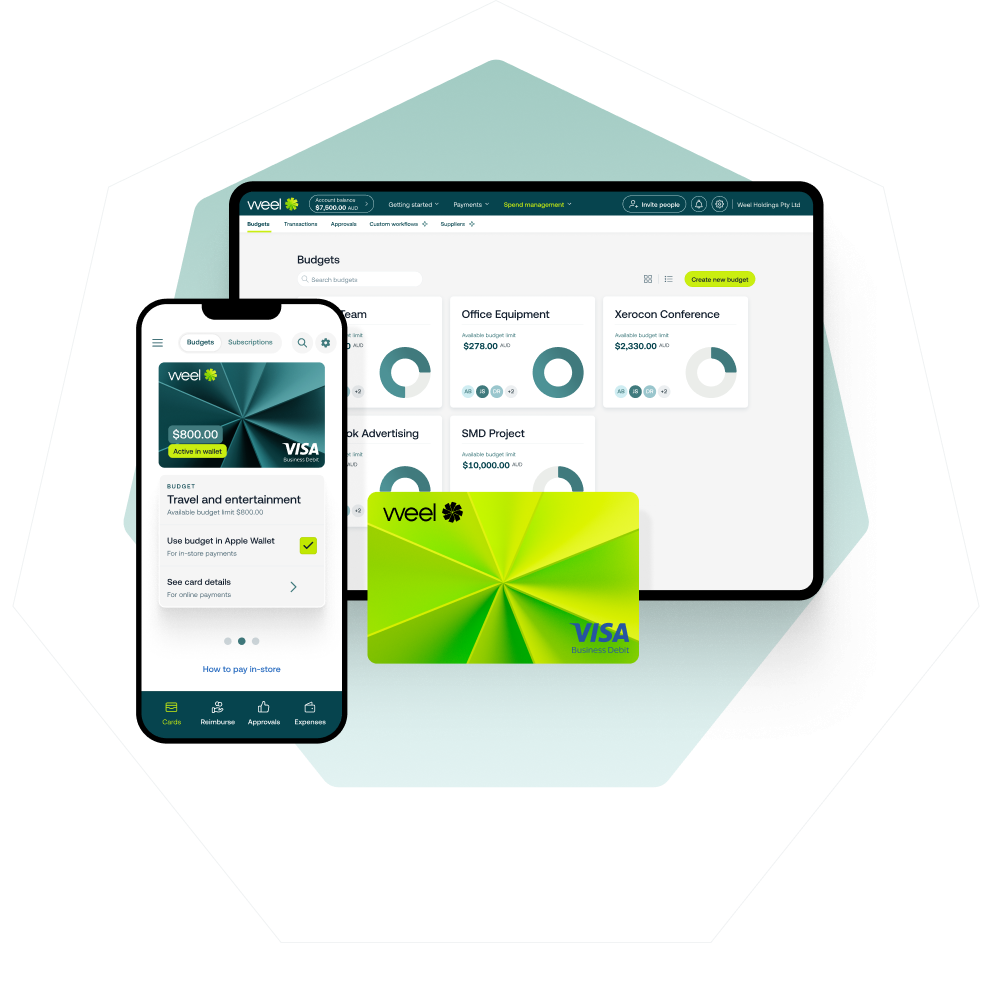
FBT record-keeping depends on the same data every fringe benefit calculation needs: what was spent, on whom, coded correctly, with the receipt attached. Weel's expense management closes that loop at the point of spend instead of leaving it for the FBT return.
Every card transaction routes through Weel with the receipt captured through the receipt keeping app, GST code, and approval attached automatically, so entertainment, loans, and expense payment benefits are already documented by the time your FBT year ends. Across 3.9 million transactions on the platform, over 90% of card expenses reach full manager approval, and 64% of receipts are captured within 24 hours of the spend, which means the audit trail an FBT calculation depends on already exists rather than needing to be rebuilt from bank statements. The same closed loop applies to reimbursements for any private expense a team member pays and claims back, so an expense payment fringe benefit is coded and documented the moment it's reimbursed. When your accountant asks which benefits were provided and when, the record is already complete.
Conclusion
Fringe benefits tax rewards businesses that treat record-keeping as a year-round habit, not an April deadline. Know the current rate and gross-up figures, classify benefits correctly as Type 1 or Type 2, check exemptions before you lodge, and keep the underlying expense data clean from the moment it's spent. Get that right and the FBT return becomes a formality instead of a scramble.
Book a free demo at to see how Weel keeps every FBT-relevant expense coded and audit-ready automatically.