





An order of purchase, more commonly known as a purchase order or PO, is the document that turns a spending decision into an approved, trackable commitment. Get the process right and every purchase order closes cleanly: matched to the right invoice, approved on time, and posted to your accounts with nothing left to chase.
This guide covers what a purchase order actually is, and how the wider purchase-to-pay process runs from request to payment. It also covers where manual steps, such as data entry, invoice matching, and chasing approvals, disappear once Weel takes over the cycle.
What is an order of purchase?
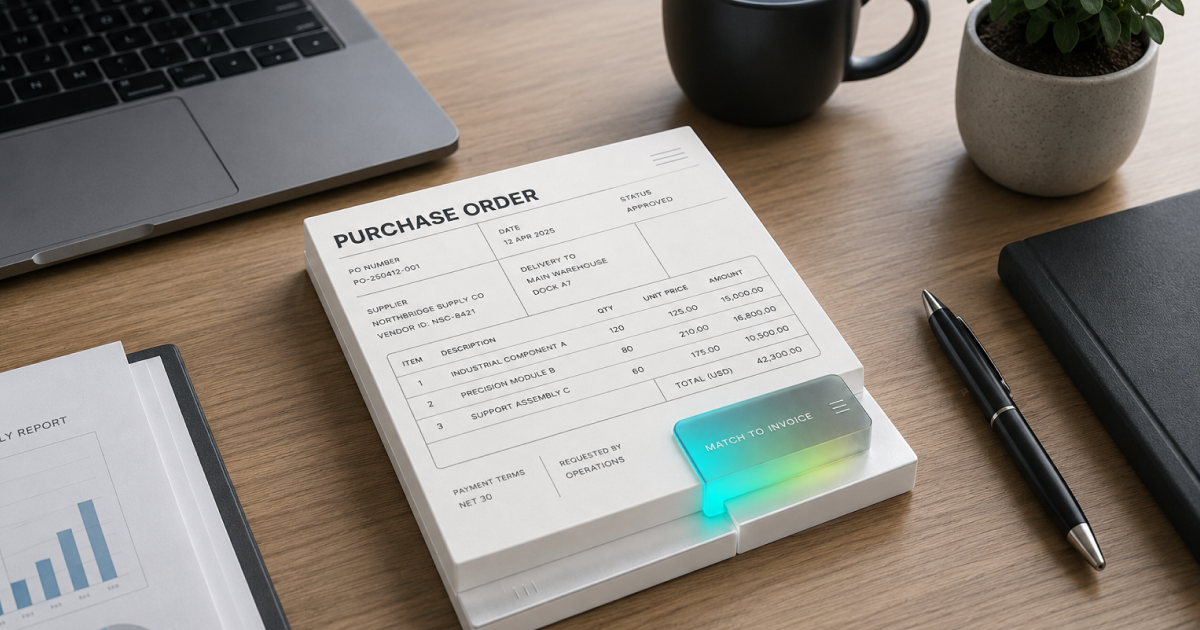
An order of purchase, or purchase order, is a formal document a buyer sends a supplier to confirm an order before goods or services are delivered. It sets out what's being bought, the quantity, the agreed price, delivery terms, and a unique PO number that ties every later document (delivery note, invoice, payment) back to that original commitment.
Once a supplier accepts a purchase order, it becomes a binding contract. That's the real meaning of a purchase order: not just paperwork, but the point where a spending decision becomes an obligation both sides can be held to.
A typical purchase order includes a unique PO number, buyer and supplier details, item description, quantity, and unit price, delivery date and address, payment terms and total value, and an authorised signatory or approval reference.
Small businesses sometimes raise purchase orders informally, over email or in a spreadsheet. Larger organisations, and any business handling government, NDIS, or grant-funded spend, usually need a formal, numbered purchase order for every commitment, because the audit trail matters as much as the order itself.
Purchase order vs invoice vs purchase requisition
A purchase order is often confused with two other documents in the purchase-to-pay chain: the purchase requisition and the invoice. Each belongs to a different stage of the same commitment.
Purchase requisition
Raised by the employee or requester, before spend is approved. It's the internal request asking for approval to buy.
Purchase order
Raised by the buyer, once approved, after approval but before delivery. It's the formal, numbered commitment sent to the supplier.
Invoice
Raised by the supplier, after goods or services are delivered. It's the supplier's request for payment, matched against the PO.
The purchase requisition starts the conversation internally. The purchase order turns that request into a supplier-facing commitment. The invoice closes the loop. It's the three-way match between purchase order, delivery record, and invoice that most procurement and accounts payable teams treat as proof a purchase happened as agreed, not the purchase order alone.
Why the purchase order process matters for Australian finance teams
A purchase order process matters long before anyone worries about paying a bill. Every PO sets a spend limit against a budget, records who authorised it, and gives your procurement and finance teams a paper trail before money leaves the business, not after.
For Australian businesses, that paper trail carries real compliance weight. The ATO requires a valid tax invoice to claim a GST credit for purchases over $82.50, and matching that invoice back to a purchase order gives your finance team the internal audit trail to back it up. Not-for-profits and government suppliers often need a numbered purchase order for every commitment to satisfy grant or programme audits.
Skip the process, and the risks are familiar to anyone who's worked in accounts payable: duplicate orders, spend that never touched a budget, and invoices nobody can match to an approval. A purchase order fixes the sequence so approval happens before spend, not after the invoice lands.
Types of purchase orders
Standard purchase order
A one-off order for a specific quantity, price, and delivery date. Most day-to-day business purchases, from office supplies to a one-off service, use a standard PO.
Blanket purchase order
An agreement to buy from the same supplier repeatedly over a set period, without raising a new PO every time. Useful for recurring spend like subscriptions, freight, or consumables, where the price and terms are fixed but individual orders vary.
Contract purchase order
Tied to a formal supplier contract, usually for larger or longer-term commitments. Terms, pricing, and volume are locked in over the life of the contract, and individual purchase orders draw down against it.
Planned purchase order
Covers a known future need, with quantities and delivery dates estimated in advance and confirmed closer to the date. Common in construction and manufacturing, where materials need to be scheduled ahead of the job.
The purchase order process, step by step
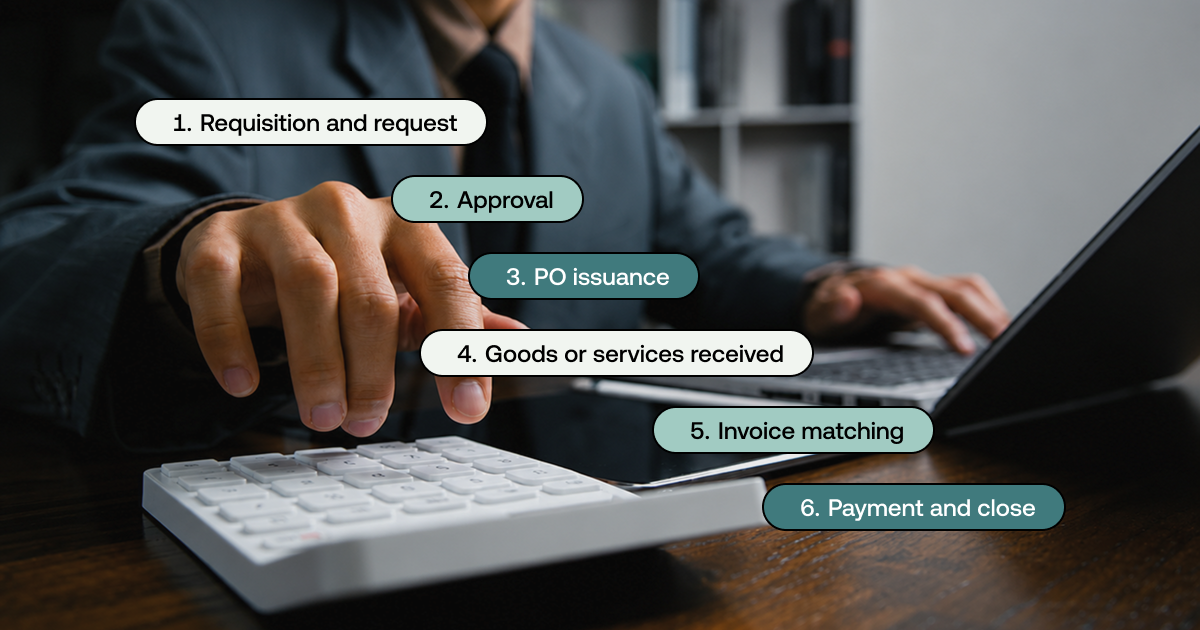
Step 1: Requisition and request
Someone in the business identifies a need (a new laptop, a marketing subscription, a delivery of raw materials) and raises a purchase requisition. This is the internal ask before any commitment exists.
Step 2: Approval
The requisition goes to whoever holds budget authority. Approval confirms the spend fits an existing budget and follows company policy, before a supplier is ever contacted.
Step 3: PO issuance
Once approved, the buyer issues a formal purchase order to the supplier, setting out the item, quantity, price, and delivery terms, along with a unique PO number the supplier must reference on every later document.
Step 4: Goods or services received
The supplier delivers, and whoever receives the order checks it against the purchase order for the right item, quantity, and condition, then records that it arrived.
Step 5: Invoice matching
The supplier's invoice arrives and gets matched against the purchase order and the delivery record. This three-way match is what confirms the business actually owes what the invoice says it owes.
Step 6: Payment and close
Once the match is confirmed, the invoice is approved for payment and the purchase order is closed. In a lot of finance teams, this is where the process breaks down: invoices sit waiting for someone to check them against a PO that's buried in an inbox or a spreadsheet.
Common challenges in purchase order and procure-to-pay processing
Even a well-designed purchase order process runs into the same handful of problems in most Australian businesses.
Maverick spend – purchases made without a PO at all, so nothing is tracked against budget until the invoice appears.
Manual matching –someone checking invoices against purchase orders and delivery notes, line by line, in a spreadsheet.
Approval bottlenecks – a PO or invoice sitting in someone's inbox because the approver is travelling or hasn't seen it.
Duplicate and late invoices – the same invoice submitted twice, or one that arrives weeks after goods were delivered.
Disconnected systems – purchase orders raised in one tool, invoices processed in another, and the accounting platform reconciled separately at month-end.
Any one of these on its own is a minor irritation. Together, across dozens of purchase orders a month, they add up to the exact backlog most AP Managers spend their Friday afternoons clearing: invoices to chase, approvals to follow up, and a purchase order register that never quite matches the accounting platform.
Every one of these problems shares a root cause: someone has to manually move information between the purchase order, the invoice, and the accounting system. Remove that manual handoff, and most of the list disappears with it.
How modern procure-to-pay actually closes the loop
Modern procure-to-pay software (often shortened to P2P) closes the gaps in that list. It connects every stage of the cycle, requisition, approval, purchase order, receipt, invoice, and payment, so nothing depends on a person remembering to check a spreadsheet.
Some businesses use the broader term "source-to-pay" to describe an even wider cycle that starts with supplier sourcing and contract negotiation, before procurement or a single purchase order is raised. Procure-to-pay picks up from there, once a supplier is chosen and a purchase order is ready to be issued.
The purchase order becomes the anchor. Once it exists, everything downstream (the receipt, the invoice, the payment) gets matched against it automatically, and your finance team only steps in when something genuinely doesn't line up. That's the shift from a manual purchase order process to a closed procure-to-pay loop: fewer spreadsheets, fewer emails asking "did we approve this?", and a purchase order register that actually reflects what's been spent.
How Australian businesses use Weel for purchase orders and accounts payable
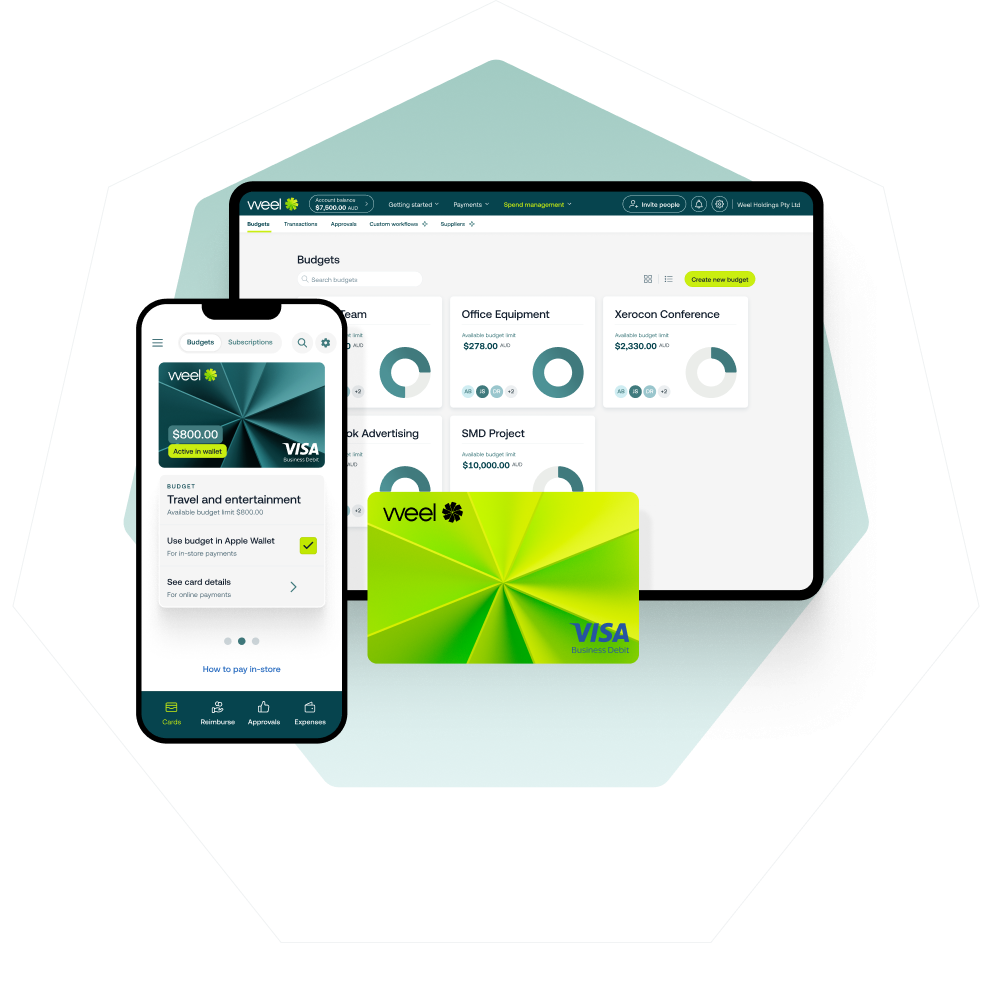
Weel connects the purchase order directly to how the money actually moves. A purchase order raised in Weel links straight to a virtual or physical card or a bill payment. The spend against it is visible in real time, not reconstructed from a bank statement three weeks later.
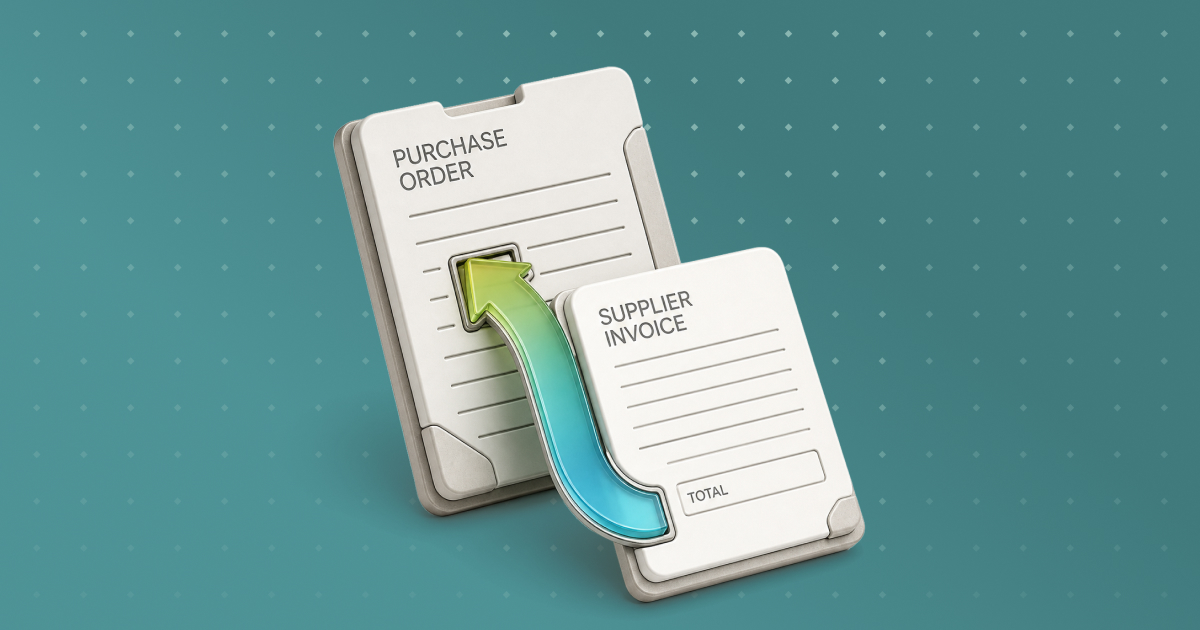
When the supplier's invoice arrives, Weel's Accounts Payable automation matches it against the original purchase order and receipt automatically. It flags anything that doesn't line up and routes the rest straight to the right manager for approval, so nothing sits in an inbox waiting to be remembered.
Across Weel platform data, half of all card transactions are fully manager-approved within 24 hours, and 44% are verified within an hour, with over 90% of expenses reaching full manager approval overall. Applied to purchase order and invoice matching, that's the difference between an AP Manager chasing a dozen approvals every Friday and a purchase order cycle that closes itself.
More than 4,000 Australian businesses run their spend through Weel, including accounts payable. For a purchase order process, that means every commitment made is a commitment closed: tracked from requisition to payment, matched without manual entry, and ready for your books the moment it's approved.
The AP Manager's job changes shape as a result. Instead of spending the week chasing signatures and re-keying invoice data against a spreadsheet of open purchase orders, the job becomes reviewing the small number of exceptions Weel actually flags, and trusting that everything else has already matched, approved, and closed itself.
Conclusion
A purchase order is a small document that carries a lot of weight. It's the point where a spending decision becomes a tracked, accountable commitment, and it sets up everything that follows in the purchase-to-pay process. Get the purchase order right, and invoice matching, approvals, and month-end close all get easier by default.
See how Weel closes the purchase order and accounts payable cycle for Australian businesses by booking a demo with Weel today.