





Supplier management software is the system your finance team uses to onboard, pay, and track every vendor your business relies on. If you're evaluating one, the real question isn't which platform has the longest feature list. It's which one closes the loop between "we owe this supplier money" and "this supplier has been paid, coded, and reconciled" without your team chasing it manually.
Most buyer's guides for this category are written for procurement teams. This one is written for the finance team that also owns the payment. Here's what to look for, what to skip, and where supplier management software ends and accounts payable (AP) automation begins.
What is supplier management software?
Supplier management software is a system for organising and controlling every relationship your business has with the vendors it buys from. It onboards new suppliers, stores their details and compliance documents, routes approvals for what they're owed, and tracks spend against them over time.
For a small business, this often means a shared spreadsheet and a folder of invoices. For a growing business, it means a purpose-built supplier management system that replaces that spreadsheet with structured data. Who your suppliers are, what they're owed, who approved it, and when it was paid: all in one place.
The category overlaps with several adjacent terms, including supplier management platform, supplier management system, supplier management tools, and vendor management software, and most vendors use them interchangeably. What matters more than the label is what the system actually does. Look at three layers: the relationship (onboarding, compliance, contact details), the approval (who signs off on what), and the payment (how and when the supplier gets paid).
Why supplier management matters for Australian finance teams

Every business has suppliers. Not every business has visibility over them. As supplier count grows past a handful, finance teams lose track of who's owed what. Whose bank details changed last quarter. Which supplier still hasn't sent a compliant tax invoice.
That gap creates three real costs. Late payments strain supplier relationships and can forfeit early-payment discounts, and a supplier who's been paid late twice starts asking for terms that cost your business more. Manual onboarding means new suppliers wait days for a bank detail to be checked and entered by hand, which slows down every project or purchase that depends on them.
And duplicate or incorrect payments happen more often than most finance teams admit. That risk grows when supplier data lives across email threads and spreadsheets, instead of one system of record.
For Australian businesses, there's a compliance layer too. The Australian Taxation Office (ATO) requires a valid tax invoice to claim a GST credit for purchases over $82.50, and those records need to be retrievable for five years. A supplier management system that can't produce a clean audit trail on demand puts that compliance burden back on your team. And it does so at the exact moment you have the least time to deal with it.
The criteria that matter when evaluating supplier management software
Ignore the feature checklist for a moment. These are the six criteria that actually separate a system that closes the loop from one that just holds data.
1. Supplier onboarding and verification
A new supplier shouldn't need three emails and a spreadsheet update before their first invoice can be paid. Look for structured onboarding: a way to capture ABN, bank details, and compliance documents once, verify them, and have that record available to every approver from day one. This single criterion is where most manual processes lose the most time.
2. Approval workflows tied to spend, not just invoices
Supplier management sits next to two different kinds of spend: recurring bills and one-off purchases. A system worth buying routes both through the same approval logic, whether that spend hits a corporate card, a bill, or a purchase order. If approvals for supplier payments live in a different tool to approvals for everything else your team spends, you've built two systems instead of one.
3. Payment execution and reconciliation
This is where supplier management and accounts payable meet. Once a supplier invoice is approved, the system needs to actually pay it. It should batch that payment with others where useful, then match it back to the invoice and the ledger automatically. A system that stops at "approved" and leaves the payment itself to a separate process hasn't finished the job.
4. Visibility across suppliers, spend and status
At any point, someone should be able to answer "how much do we owe this supplier, and when will it be paid?" without opening three tabs. Look for a live view of supplier spend, not a report that's accurate as of last Tuesday.
5. Compliance and audit trail
Every supplier record and every approval needs a timestamp, an approver, and a retrievable document trail. For Australian businesses, this means GST-compliant tax invoices, ABN validation, and records that survive an ATO audit without your finance team reconstructing history from email.
6. Integration with your accounting system
Supplier management software that doesn't sync cleanly with Xero, MYOB, or NetSuite creates a second source of truth your team has to reconcile by hand. Two-way sync, correct GL coding, and real-time export are non-negotiable, not nice-to-haves.
Common mistakes when choosing supplier management software
Three mistakes come up constantly. The first is buying for procurement complexity you don't have. Enterprise supplier management platforms built for multi-tier supply chains and sourcing negotiations are overkill for a business that just needs suppliers paid on time, correctly coded, and easy to find. Paying for that complexity means paying more, and training your team on features they'll never touch.
The second is treating supplier management and AP automation as the same purchase. Buyers often discover after signing that the system manages the relationship well and does nothing for the actual payment, or the reverse. Confirm before you buy that a single system covers onboarding through to payment. Splitting the two forces your team to keep switching tools mid-process, which is the exact manual work you were trying to remove.
The third is skipping the live demo of onboarding. Every vendor can describe supplier onboarding well in a sales deck. Far fewer can show it working, start to finish, on a supplier that doesn't already exist in their demo environment. If a vendor won't do that, treat it as a signal.
Supplier management software vs accounts payable automation: what's the difference
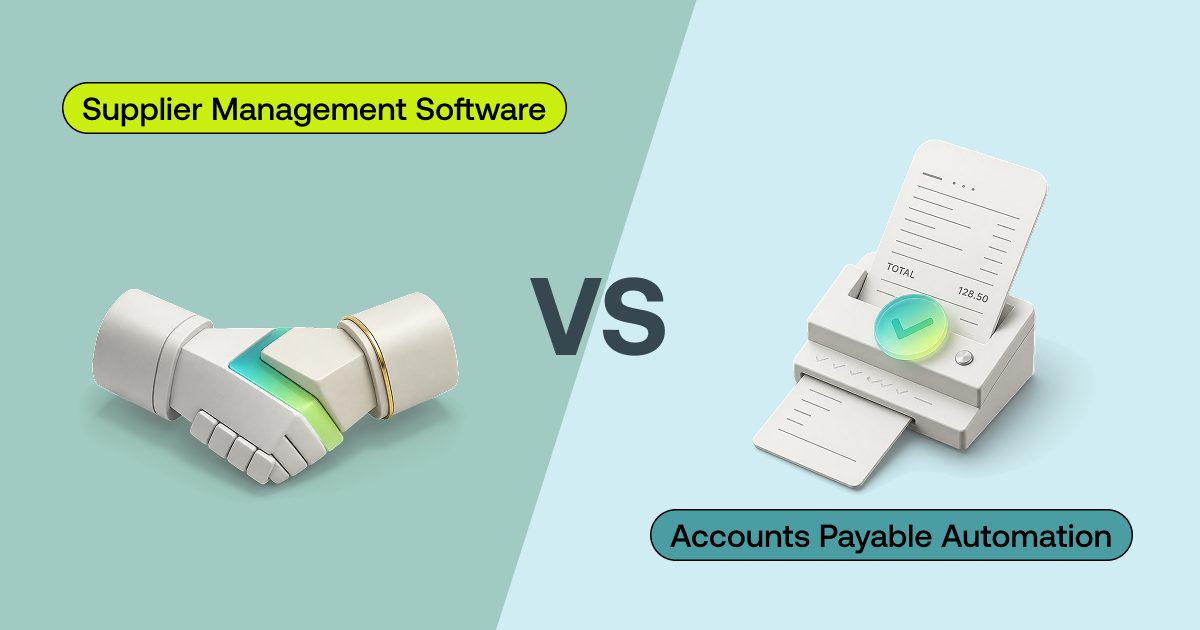
The two terms get used interchangeably, and most vendors don't bother drawing the line. It's worth drawing it yourself before you buy.
Supplier management software
Manages the supplier relationship — onboarding, compliance, records — and answers "Who is this supplier and are they set up correctly?" It typically sits with the Finance Manager, Operations Manager, or procurement, and on its own doesn't guarantee suppliers actually get paid on time.
AP automation software
Manages the payment process — invoice capture, approval, payment — and answers "Has this invoice been approved and paid?" It typically sits with the AP Manager or Finance Ops, and on its own doesn't manage supplier onboarding or compliance history.
In practice, the businesses with the least supplier admin don't buy one or the other. They use a single platform that carries a supplier from onboarding straight through to payment. The relationship layer and the payment layer share the same data, instead of living in two systems kept in sync by hand.
That's the gap most ap automation software guides skip past. Most AP tools were built to automate invoice processing, not to manage the supplier relationship that sits underneath it.
How to choose the right supplier management software for your business
Start with the six criteria above and score each supplier management solution against them, not against a generic feature list. Most supplier management solutions and supplier management software solutions will claim all six on a sales call. Ask each vendor to demonstrate the criteria that matter most to your business, rather than taking the feature list at face value. A short-list exercise that works well in practice: ask each vendor to walk through onboarding a new supplier live, from first contact to a payable invoice, and time it. Confirm whether approvals for supplier bills route through the same workflow as your other spend, or a separate one. Check whether payment and reconciliation happen inside the same system, or hand off to something else. Ask what an ATO-ready audit trail looks like for a single supplier, end to end. And confirm two-way sync with your accounting system, not a CSV export.
The businesses that get this right treat supplier management software as one part of how they manage business spend overall, not a standalone system bolted on beside their expense and card tools.
How Australian finance teams use Weel for supplier management
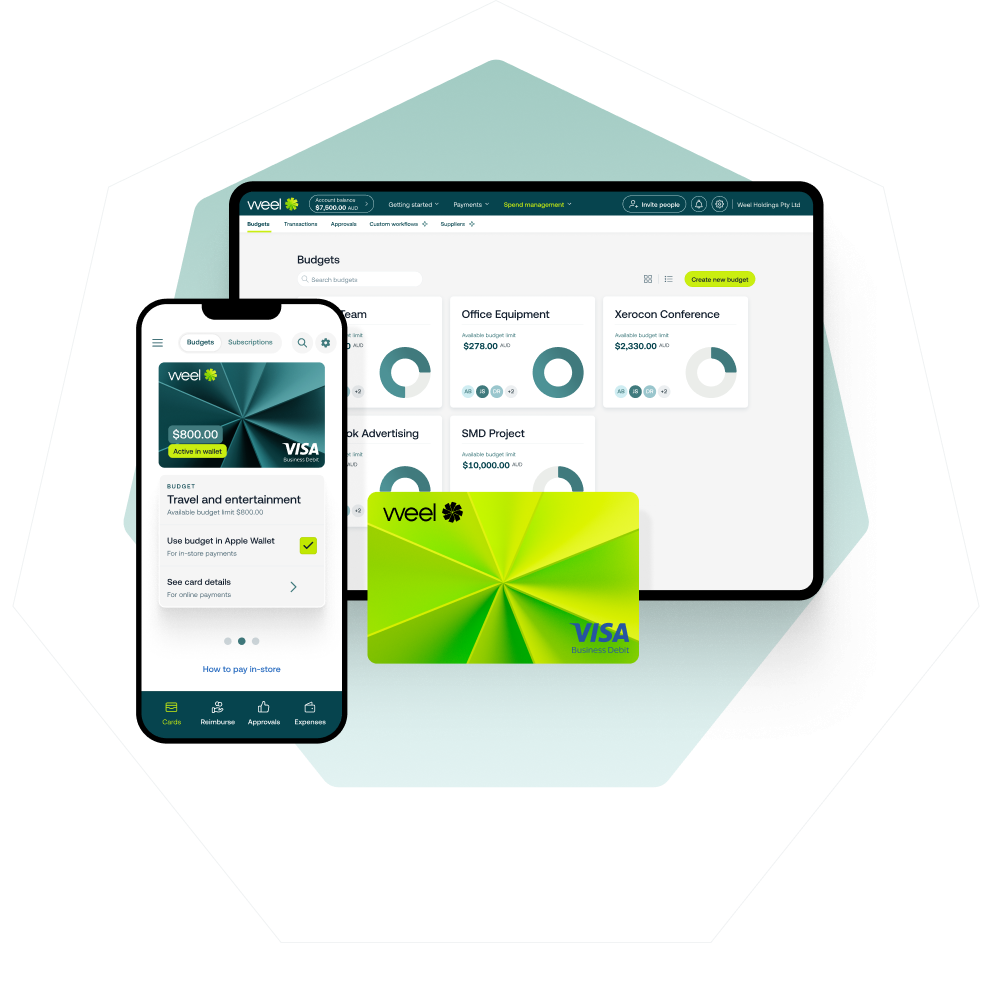
Weel brings the supplier relationship and the supplier payment into one platform, so your finance team isn't reconciling two systems to answer one question. Suppliers are onboarded once, verified, and available to every approver. Bills route through the same approval workflow as corporate card spend, so nothing sits waiting in a separate queue. Payments are executed and matched back to the ledger automatically, with an audit trail on every supplier record — invoice, ABN check, and approval history included.
That approval engine is proven at scale, not just promised. Across 3.9 million cleared transactions, half are fully manager-approved within 24 hours, and 44% are verified within an hour. Over 90% reach full manager approval, meaning almost nothing sits unresolved waiting on a decision. Weel's card-transaction approvals move at that pace today, and supplier bills route through the identical approval workflow, used by 4,000+ businesses.
The result: supplier spend that's visible in expense management alongside every other cost centre, instead of living in a separate system your team checks separately.
Weel means done, for suppliers too.
Choosing supplier management software comes down to one test. Does it close the loop from onboarding to payment, or does it stop halfway and leave your team to finish the job by hand? Score any system against the six criteria above before you sign, and confirm whether it's built for the relationship, the payment, or both.
If your business needs both in one place, take the product tour and see how supplier onboarding, approvals, and payment execution work as a single system.
Do you have suppliers to onboard, bills to pay, and month-end to close on time? Take the product tour at letsweel.com/tour, or book a Weel demo at letsweel.com/demo.