



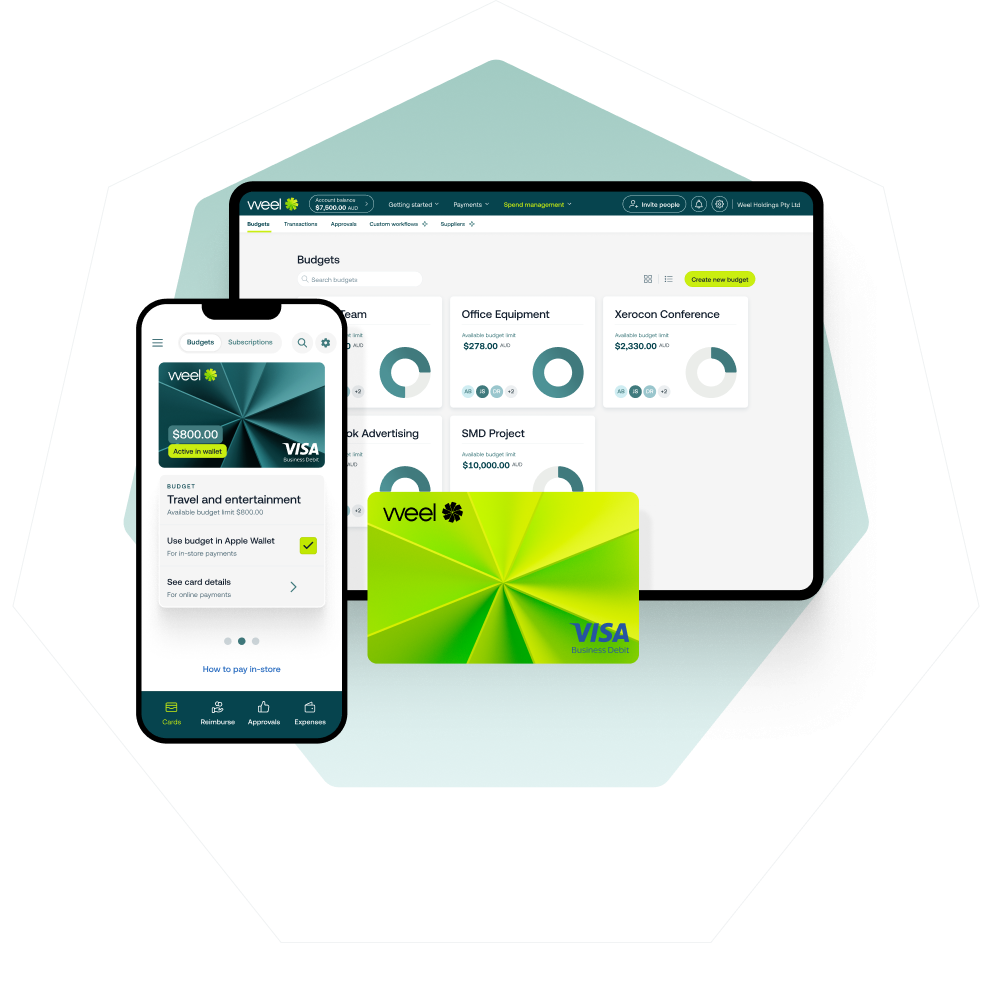



Done well, business spend management gives CFOs and finance managers a complete picture of every dollar committed, spent, and reconciled, with nothing waiting at month-end. Done poorly, it's just another spreadsheet with a new name.
What is business spend management?
Business spend management is the discipline of overseeing, controlling, and analysing every category of company expenditure, from corporate card transactions and reimbursements to supplier invoices, subscriptions, and purchase orders.
Where traditional expense management focuses narrowly on employee-initiated spending, business spending management covers the full organisational spend landscape: what was committed, what was spent, whether it was authorised, and how it reconciles against budget. The discipline is also commonly abbreviated to BSM.
The core components are:
- Spend visibility: A single view of all committed and actual spend across the business, in real time
- Spend controls: Policy rules, approval workflows, and card limits that govern what can be spent and by whom
- Spend data management: Categorised, coded transaction data that flows into accounting software without manual rework
- Spend analysis: Reporting and insights that show where money is going, which budgets are at risk, and where savings are available
For Australian SMBs, the stakes are direct: a business without a clear framework for managing spend is flying blind. Cash flow surprises, budget blowouts, and month-end reconciliation chaos are the predictable results.
Why business spend management matters for Australian SMBs
Visibility is the foundation of financial control. Without it, no framework, however well-designed, produces reliable outcomes. Australian SMBs face specific structural challenges that make spend management particularly important:
Growth outpaces process.
When a business scales from 20 to 80 people, spending authority spreads across more teams. Card limits set for a lean operation become inadequate or inappropriate. Informal approval processes that worked with three managers break down with twelve.
Fragmented spend data.
Corporate cards, reimbursements, supplier invoices, and subscription renewals typically live in separate systems or spreadsheets. Consolidating them manually consumes hours that finance teams don't have, and introduces errors that compound at reconciliation.
Month-end bottlenecks.
When spend data isn't captured at the point of transaction, it accumulates as a backlog. The last week of every month becomes a chase: receipts, approvals, coding corrections, all compressed into the same window as close.
Compliance exposure.
Out-of-policy spending, unapproved purchases, and miscoded transactions create audit risk. Without an active control layer, finance teams are correcting after the fact rather than preventing in the first place.
A business spend management framework addresses all of these. It creates one source of truth for spend, moves controls upstream into the transaction itself, and gives finance the certainty to close confidently.
The four pillars of a spend management framework
Building a practical spend management framework means addressing four interdependent areas. Each pillar supports the others: visibility without controls is just reporting; controls without data are a bottleneck; data without analysis is storage.
1. Spend visibility
Visibility means knowing what's been committed, what's been spent, and where it sits in the approval cycle, across every spend category, at any point in time.
This requires a single platform that captures transactions from all sources: corporate cards, reimbursement requests, supplier invoices, and recurring subscriptions. Dashboards should show real-time budget status by category, team, cost centre, or project, not yesterday's export.
For CFOs and finance managers, this is the control room. It's the difference between managing by exception and managing in the dark.
2. Spend controls
Controls are the rules that govern how money is spent before it's spent. They include:
- Approval workflows: Every spend category routes to the appropriate approver. A $500 software subscription triggers the finance manager; a $15,000 supplier engagement triggers the CFO. Nothing gets through without the right sign-off.
- Spend limits: Corporate cards carry category-specific limits and merchant controls. A team lead card for client entertainment has a different configuration from a finance manager card for supplier payments.
- Policy enforcement: Spend categories are pre-coded with GST, account codes, and project mapping so transactions land correctly in the accounting system without manual intervention.
Businesses using approval workflows reach 95% expense completion, according to Weel data across more than 1.38 million transactions. That's a 7-point lift over businesses without structured workflows, and it's the clearest indicator that controls aren't just governance overhead: they're what makes the numbers close correctly.
3. Spend data management
Data quality is the silent determinant of close speed. Correctly coded, categorised, and reconciled spend data flows into Xero or MYOB in real time. Incorrectly coded, manually entered, or late-captured data creates the backlog that makes month-end painful.
Good spend data management starts at the transaction. Receipt capture at the point of spend, AI-assisted coding based on merchant and category, and automatic GST extraction mean transactions arrive in the accounting system pre-processed. The finance team reviews the exceptions, not every line.
The median time from card transaction to accounting sync across Weel's 4,000+ Australian business customers is 2.3 days, according to Weel data across 2.5 million exported transactions. For context, most businesses relying on manual processes wait until end-of-month. That gap is where spend management technology earns its value.
4. Spend analysis
Analysis is how a business learns from its spend data. Monthly reporting on actual versus budget is the minimum. A mature spend management approach adds:
- Trend analysis: Is spend in a category growing faster than revenue? Is one team consistently over-coded?
- Supplier consolidation: Are you paying twelve vendors for services three could cover?
- Subscription audit: How many recurring charges exist, who owns them, and which are still actively used?
- Budget forecasting: Based on committed and actual spend so far, what's the projected close position?
Weel's Subscription Manager and Budgets products address this directly, giving finance teams a live view of committed spend against budget without exporting a single report.
How to build a spend management framework: five steps
A spend management framework doesn't require a six-month implementation. Most Australian SMBs can reach baseline control in a few weeks if they follow a structured approach.
Step 1: Map your current spend landscape
Before changing anything, document every category of company spend: corporate cards, reimbursements, supplier invoices, recurring subscriptions, petty cash. Note where each category currently lives (bank feed, expense system, spreadsheet, email) and how it currently reaches the accounting system.
This map reveals the gaps: categories with no policy, approvals that happen informally, data that arrives late or incorrectly coded.
Step 2: Define your spend policies
A spend policy doesn't need to be long. It needs to be clear. For each spend category, define:
- Who is authorised to initiate the spend
- What the approval threshold is (and who approves above that threshold)
- What coding and documentation is required
Policies that live in a PDF nobody reads are not policies. They need to be enforced in the platform: built into approval workflows, card limits, and receipt requirements so they're applied at the transaction, not audited after the fact.
Step 3: Implement category-specific controls
Once policies are defined, configure the controls that enforce them. This means:
- Setting card limits by role and category
- Building approval workflows that match your authorisation matrix
- Configuring merchant category restrictions where relevant
- Setting required receipt and coding fields by transaction type
Controls should be proportionate to risk. A team lead card for day-to-day operational purchases needs different settings from a card used for capital purchases or supplier prepayments.
Step 4: Connect your spend data to your accounting system
Every transaction should reach Xero or MYOB pre-coded and reconciled, without manual intervention. This requires a direct integration between your spend management platform and your accounting software.
The ATO's record-keeping guidance covers what businesses are generally required to retain by way of receipts and transaction records. Check ato.gov.au for current requirements. Digital receipt capture and automatic coding aren't just a time-saver: they're what makes your records defensible.
This is general information only and is not tax advice. Consult a registered tax agent for advice specific to your situation.
Step 5: Review and improve regularly
Spend management is not a set-and-forget system. A quarterly spend analysis should review: which categories ran over budget, whether approval thresholds are still appropriate, and whether the data quality is high enough to trust.
Anomalies in spend data are often early signals: a procurement category inflating faster than expected, a subscription that was cancelled on paper but is still billing, an approval workflow nobody uses because it's configured wrong.
How Australian finance teams use Weel for business spend management
Weel brings all four pillars of business spend management into one platform: corporate cards with real-time controls, expense management with AI receipt capture and coding, accounts payable for supplier invoices, and direct integration with Xero and MYOB for continuous reconciliation.
The result is a closed loop: every transaction is captured at the point of spend, coded against policy, routed for approval, and synced to the accounting system without manual intervention. Over 90% of card expenses across Weel's platform reach full manager approval, based on Weel data across 3.9 million transactions. Half of all card expenses are fully approved within 24 hours.
That's not just a speed story. It's a certainty story. Finance teams that know every expense is coded, approved, and on its way to the accounting system don't spend month-end chasing data. They spend it closing.
With approval workflows active, Weel customers reach 95% expense completion, a 7-point lift over businesses without structured workflows. When Weel AI is active, that figure rises to 99%.
For CFOs and finance managers who want total control without the manual work, Weel closes every spend management loop automatically.
Book a free demo to see how Weel gives your finance team the visibility and control to close with confidence.