





Disclaimer: This article provides general information only and is not tax or financial advice. Tax obligations vary by business type and circumstance. We recommend consulting a registered tax agent or visiting ato.gov.au for guidance specific to your situation.
Updated September 2026 - Most spend management software tells you what happened. A closed-loop spend management platform stops the problem before money leaves. That distinction, between visibility and control, is the difference between a finance team that reacts at month-end and one that operates with certainty every day.
For Australian CFOs, the stakes are concrete: GST coding errors, out-of-policy spend discovered after the fact, and a month-end close that drags because receipts, approvals, and accounting entries are all sitting in different places. This guide covers what spend management software actually does, how it differs from expense tracking and budgeting tools, and what to look for when your business needs the full loop closed.
What is spend management software?
Spend management software is a category of finance tooling that covers how a business controls, tracks, and reconciles the money its people spend. That includes corporate card transactions, out-of-pocket reimbursements, supplier invoices, purchase orders, and travel costs: all the outflows that sit between budget approval and accounting entry.
In the Australian context, spend management software has to do more than track transactions. It needs to handle GST coding correctly, produce data that satisfies the Australian Taxation Office's record-keeping requirements, and connect to the accounting platforms Australian finance teams actually use: Xero, MYOB, and NetSuite among them. The Australian record-keeping rules generally require businesses to retain records that substantiate GST claims; spend management software that cannot capture, code, and export that evidence creates compliance exposure. For more on GST record-keeping obligations, see the ATO's GST for business guidance.
Spend management software is related to, but broader than, two adjacent categories:
How expense management differs
Expense management focuses on the reimbursement cycle: capturing receipts, routing approvals, and paying people back. It is one module inside a full spend management platform, not a substitute for it. Weel's expense management capability sits within a broader spend control layer.
How budget management software differs
Budget management software covers planning and allocation: setting budgets by team, project, or cost centre. Without spend management, a budget is a plan with no enforcement mechanism. Spend management software is what turns that plan into a real constraint.
The defining feature of genuine spend management software is the connection between these layers: budget set, spend authorised, transaction captured, receipt matched, approval confirmed, accounting synced. Every step closes. Nothing is left open.
Why spend management matters for Australian businesses
The gap between budget and actuals
A budget approved in July means little if finance cannot see, in real time, where each team sits against it in October. Most Australian businesses run this gap on spreadsheets, periodic reports, or end-of-month reconciliations. The result: finance discovers out-of-policy spend weeks after it happened, with no practical ability to reverse it.
The cost is not only the over-spend itself. It is the time required to investigate, code, and reconcile transactions manually. That time compounds every month and peaks at EOFY when the volume of outstanding items is highest.
Compliance risk under Australian tax law
To claim a GST credit, a GST-registered business needs a tax invoice from its supplier for purchases that cost more than $82.50 (including GST), and its records need to include the relevant GST information for each transaction and be available to show the ATO if asked. When spend happens outside a controlled system, on personal cards, through informal approvals, or without receipt capture, the evidentiary trail breaks. Spend management software that captures receipts at the point of transaction, applies GST codes automatically, and retains records in an audit-ready format reduces that exposure.
FBT obligations add a further layer. Where corporate card spend includes entertainment, meals, or benefits to your team, correct classification at the time of transaction is far easier to maintain than reconstructing it at year-end.
Month-end close cost
The month-end close is a direct cost of inadequate spend management. Finance teams that cannot reconcile card transactions in real time spend days at period-end chasing receipts, correcting coding errors, and re-running reports. For a finance function of any size, this is a material labour cost. Spend management software with automatic reconciliation eliminates it.
Types of spend management software
Not every platform addresses the full spend loop. Understanding the categories clarifies what you are actually buying.
Corporate cards with spend controls
The first layer of spend management is controlling what your team can spend before the transaction completes. Corporate cards with embedded controls (category restrictions, transaction limits, single-use virtual cards for online purchases) enforce policy at the point of sale rather than after it. This is not reporting. It is prevention.
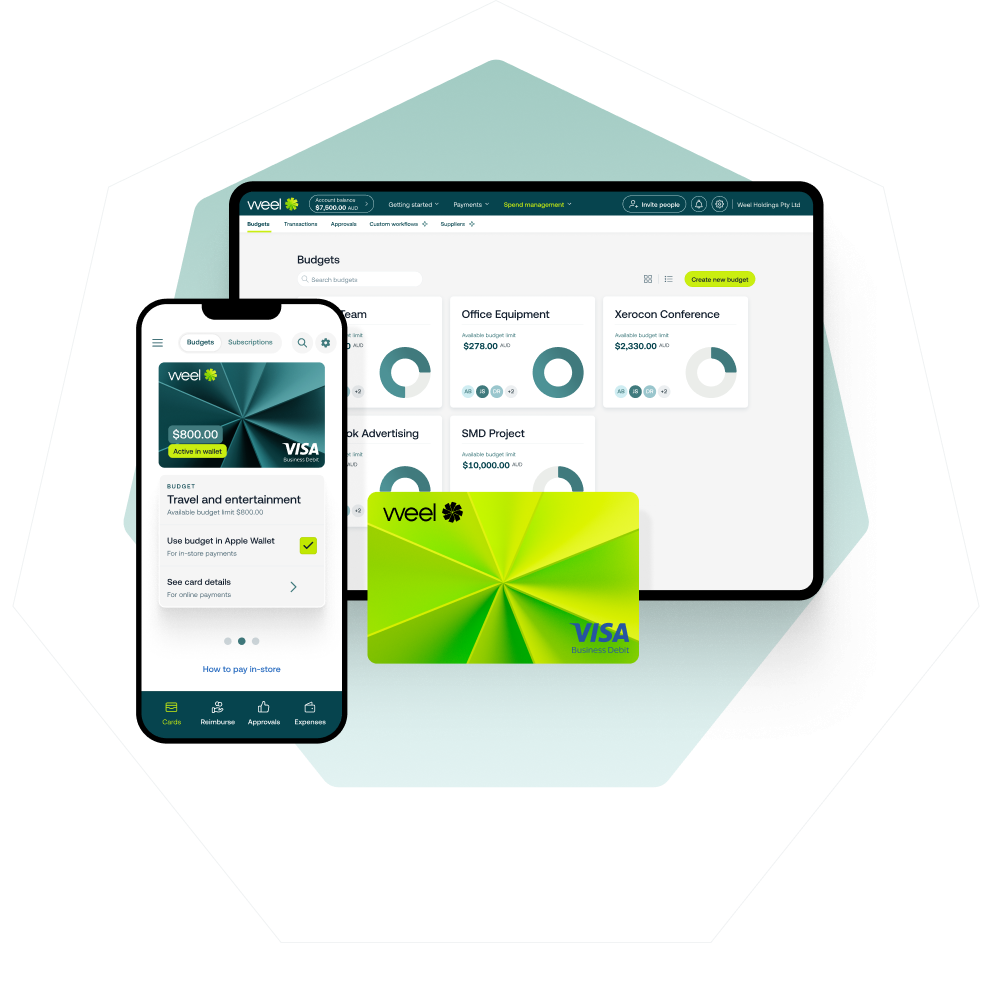
Weel's corporate card product gives finance teams per-card limits and merchant category controls, enforced at the point of purchase, plus instant card deactivation and reissue.
Expense management
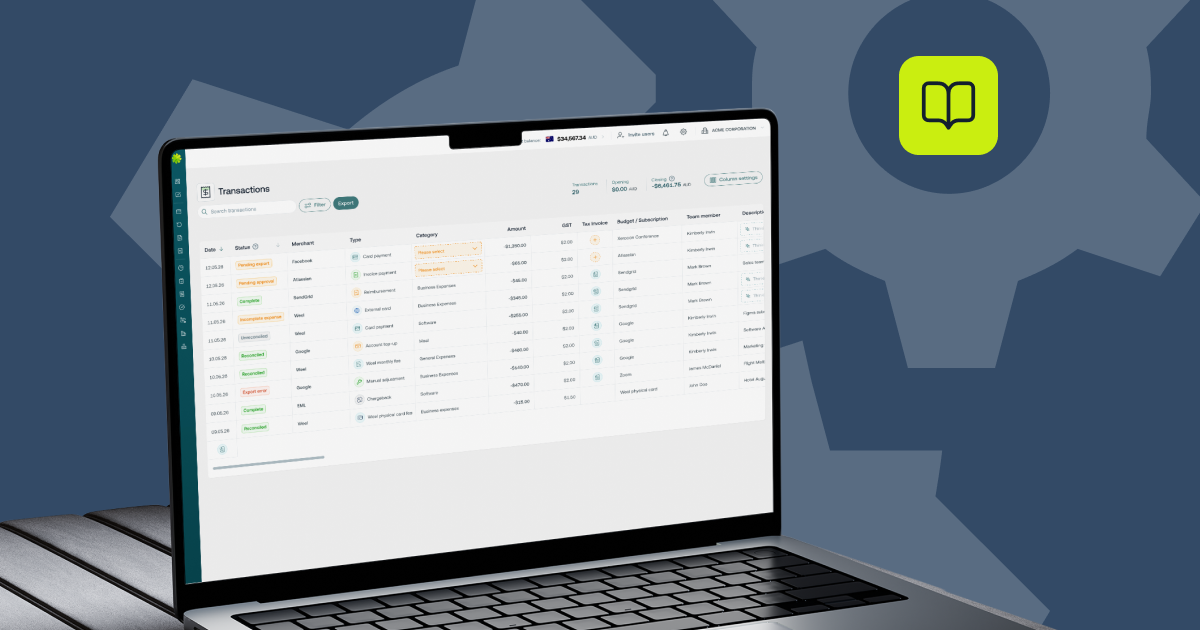
Expense management software handles out-of-pocket spend: the team member who pays for a client lunch, a taxi, or a SaaS subscription on a personal card and submits a reimbursement claim. Core features include receipt capture (OCR-based), coding to expense categories and GST types, approval routing, and payment. A standalone expense management tool addresses this slice only.
For a deeper, expense-management-specific comparison, see our guide to the best expense management software for Australian businesses in 2026.
Accounts payable automation
AP automation covers supplier invoice processing: receipt, coding, approval, and payment of bills from external vendors. For businesses with significant supplier spend, AP automation reduces manual data entry, prevents duplicate payments, and gives finance a clear view of committed spend before it is paid. Weel's AP automation captures invoices, approves them in bulk (up to 100 at once), and pays them via bank transfer or BPAY, with automatic sync to Xero and MYOB AccountRight. It connects invoice approval to the same spend visibility layer as card and reimbursement spend.
Full-suite spend management platforms
A full-suite platform connects all of the above (card controls, expense management, AP automation, and budget visibility) in a single data model. The advantage is completeness: every dollar of outgoing spend, whether on a corporate card, a reimbursement claim, or a supplier invoice, flows through the same approval and coding logic, syncs to the same accounting platform, and appears in the same real-time dashboard.
This is the closed-loop model. Budget is set. Spend is authorised. Transaction is captured. Receipt is matched. Approval is confirmed. Accounting is updated. Every step closes automatically. Finance is never waiting on data.
Common challenges with spend management

Policy enforcement happens after the fact
The default in most Australian businesses is to set a spend policy (per diem limits, approval thresholds, category restrictions) and then check compliance during the expense review process. By that point, the spend has already occurred. Policy violation discovered at review is expensive to reverse and creates friction with the people involved. Spend management software with pre-approval controls and card-level restrictions moves enforcement to before the transaction, not after.
Manual reconciliation at month-end
Without automatic receipt matching and real-time accounting sync, reconciliation is manual. Finance matches card statements to receipts to coding entries, one transaction at a time. For a business with 50 cardholders making multiple transactions per week, this is hundreds of manual matches per month-end cycle.
No real-time visibility into committed spend
Most finance teams know what was spent last month. Fewer know what is committed this week. Purchase orders raised but not yet invoiced, card transactions not yet reconciled, reimbursements awaiting approval - all of these represent real financial exposure that does not appear in standard reports until it is too late to act.
Out-of-policy spend discovered at EOFY
End of financial year is the high-water mark for spend management failure. Transactions coded to wrong categories, missing tax invoices, unapproved spend that slipped through informal approval processes - all of these surface during EOFY close when the volume of outstanding items is highest and the time available to fix them is shortest.
What to look for in a spend management platform for Australian businesses
Real-time spend visibility
The dashboard should show live card balances, outstanding approvals, and committed spend against budget - not a delayed report. Real-time visibility is the difference between managing spend and reviewing it.
GST coding and ATO compliance
Every transaction needs to be coded to the correct GST category (taxable, GST-free, input-taxed, out of scope) at the point of capture, not during reconciliation. The platform should keep each tax invoice with its transaction and export data that feeds into BAS preparation. This matters for any GST-registered Australian business.
Approval workflows
Approval workflows enforce policy automatically. Spend above a threshold routes to the right approver without manual escalation. The workflow is not bureaucracy; it is the mechanism that closes the loop.
Xero, MYOB, and NetSuite integration
Your spend management platform should write directly to your accounting system, not export a CSV that someone re-imports. Direct integration with Xero, MYOB, and NetSuite means coding done in the spend management layer flows automatically to the general ledger, with no re-entry and no synchronisation lag.
Corporate card controls
Card issuance, per-card limits, category restrictions, and virtual card generation should be finance-controlled, not IT-dependent. The ability to issue a single-use virtual card for a specific vendor, set a limit on a team member's card for a specific trip, or freeze a card instantly gives finance real control over the cards layer.
Reimbursement management
For out-of-pocket spend, the platform should handle the full cycle: receipt capture, coding, approval, and payment to the team member's bank account. Speed matters here: based on Weel platform data, 50% of reimbursements are paid within 24 hours, and 95% are fully paid.
How Australian finance teams use Weel for closed-loop spend management
Weel is a closed-loop spend management platform built for Australian businesses. The loop covers the full spend cycle: corporate cards with real-time controls, expense management with automatic receipt capture and coding, accounts payable automation, and direct accounting sync - all in a single platform.
The Weel Loop works like this. A budget is set. Spend is authorised via card controls or pre-approval. A transaction occurs. The receipt is captured - with a median capture time of 4 hours from transaction. The GST code is pre-filled by Weel AI. An approval workflow routes to the right manager. Once approved, the transaction syncs to Xero, MYOB, or NetSuite - with a median of 2 days from spend to accounting sync. The loop closes. Finance does not chase.
Based on Weel platform data, over 90% of card expenses reach full manager approval. 44% of expenses are manager-verified within 1 hour; 50% of card expenses are fully approved within 24 hours.
For CFOs, this means month-end close is not an event - it is a formality. Because expenses are captured, coded and approved through the month, less is left to reconcile at close.
At EOFY, the difference is even sharper. With 90% of expenses completed before month-end, finance teams using Weel enter the close period with most expenses already captured, coded and approved, not an outstanding stack of unmatched receipts.
This is what completeness looks like in practice. Not just visibility. Not just a report of what happened. A closed loop, from budget to reconciliation, with fewer open items at month-end. Every Expense Complete.
To see how Weel's closed-loop platform works for your finance team, book a demo at letsweel.com/demo.
Conclusion
Spend management software ranges from basic expense trackers to full closed-loop platforms. For Australian CFOs who need real-time control - not a monthly report - the relevant question is not whether a tool provides visibility but whether it closes the loop. That means corporate card controls before the transaction, automatic receipt capture and GST coding at the point of spend, approval workflows that enforce policy without manual escalation, and accounting sync that keeps the ledger current without re-entry.
Weel covers all of it in a single platform built for Australian businesses. Book a demo at letsweel.com/demo to see how your finance team closes the loop.