





For most finance teams, the hardest question in the business isn't "how much did we spend?", it's "what are we spending right now?" Spend visibility is the difference between answering that question in real time and answering it three weeks later when the invoices land.
In an environment where Australian businesses are scaling faster, operating across more locations, and managing more complex cost structures, CFOs who lack real-time spend visibility are making financial decisions with incomplete information. This article covers what spend visibility actually means, why it has become a priority for finance leaders, and what achieving it looks like in practice without ripping out your existing systems.
What is spend visibility?
Spend visibility is a finance team's ability to see, in real time, how money is moving through a business. It covers every category of business spend: corporate card transactions, employee reimbursements, accounts payable, subscriptions, and ad-hoc purchases, across every team, location, and cost centre.
True spend visibility is not the same as having good reports at month-end. It means knowing what has been committed and spent at any given moment, before the invoice arrives, before the reconciliation run, and before any surprises appear in the ledger.
There are three layers to it:
- Transaction-level visibility, every individual purchase is captured, coded, and attributed to the right cost centre or project the moment it occurs
- Budget-level visibility, real-time tracking of spend against approved budgets, so overspend is visible while it can still be stopped rather than after it has happened
- Portfolio-level visibility, a consolidated view across all spend categories, all teams, and all entities, giving the CFO a single source of truth rather than fragmented data from multiple systems
The common denominator across all three is timing. Spend visibility is, fundamentally, a timing problem. The data eventually exists in every business. The question is whether it arrives in time to be useful.
Why CFOs are prioritising spend visibility now
The push for real-time spend visibility has accelerated for several reasons specific to the current operating environment in Australia.
Decentralised teams create blind spots. As businesses grow beyond 30 or 40 people, purchasing power spreads across departments, locations, and even individual employees using corporate cards. Finance no longer sits next to every decision-maker. When a support worker buys supplies, a sales rep charges a client dinner, or an office manager orders equipment, that spend may not reach the finance team for days or weeks. By then, the budget period has moved on.
Manual processes don't scale. According to the Australian Bureau of Statistics, the number of mid-sized Australian businesses has grown steadily over the past decade. For growing businesses, the expense management processes that worked at 20 people, shared cards, email approvals, spreadsheet tracking, collapse under volume. What takes one person two hours a week at 20 employees takes a team two days a week at 100.
Month-end close pressure is compressing. Finance teams at scaling businesses are under pressure to close faster, report more frequently, and surface management information in near real time. A CFO who waits until month-end to see where the business has spent money is perpetually reactive. Boards, investors, and operational leaders increasingly expect visibility on a weekly or even daily cadence.
Compliance and audit risk is rising. The ATO has increased scrutiny on business expense claims, GST coding accuracy, and the completeness of expense records. A business that cannot produce a clean, timestamped audit trail of every transaction is exposed, not just at tax time, but whenever the board or an investor asks for substantiation.
What poor spend visibility looks like
The symptoms are usually obvious once a finance team knows what to look for:
- Shared corporate cards with no individual accountability
- Expense reports submitted days or weeks after the purchase, often with missing receipts
- Budget tracking that only happens at month-end, meaning overspends are discovered after the fact
- Multiple systems that don't talk to each other, accounting software on one side, card transactions on another, reimbursements managed separately in spreadsheets
- Finance teams spending disproportionate time chasing down receipts, coding transactions manually, or reconciling discrepancies that should have been caught at the point of spend
- No real-time feed from card transactions to the general ledger, meaning the books are always behind
The cost of poor spend visibility is not just administrative. It is strategic. A CFO who cannot see current spend cannot make confident decisions about headcount, investment, or cost reduction. Every decision carries more risk when the inputs are weeks out of date.
What good spend visibility looks like
Real-time spend visibility has several defining characteristics that distinguish it from simply having better reports:
Every transaction is captured at the point of spend. Whether it is a card swipe, a reimbursement claim, or a bill approval, the transaction enters the system immediately, with the right category, cost centre, and coding attached.
Budgets are enforced before spend occurs. Approval workflows route requests to the right person before money leaves the business. When a purchase is out of policy, it is flagged before it is approved, not discovered at month-end.
Reconciliation is continuous, not periodic. Instead of a manual reconciliation run at the end of each month, transactions sync automatically to the accounting system as they occur. The books are always current.
The CFO has a single dashboard. All spend categories, cards, reimbursements, bills, subscriptions, appear in one view, segmented by team, project, location, or cost centre, with drill-down available on any line item.
Nothing falls through the cracks. Over 90% of card expenses reach full manager approval on well-run platforms. When approval workflows are active, expense completion rates sit at 95%. The gap between what is spent and what is accounted for closes to near zero.
Common challenges in achieving spend visibility
Understanding the goal is straightforward. Getting there involves navigating several real constraints.
Legacy system integration. Most businesses already have an accounting system, whether that is Xero, MYOB, NetSuite, or an ERP. Adding spend visibility without disrupting existing workflows requires a platform that integrates cleanly rather than replacing what is already in place.
Adoption across teams. Spend visibility only works when every person who makes a purchase is part of the process. If the platform is cumbersome for the person submitting the receipt, adoption drops, data quality drops, and visibility collapses. The best finance platforms make submission fast enough that it happens at the moment of purchase, not days later.
Resistance to change. Finance process change is often resisted because it adds perceived friction for people who are not in finance. The framing matters: real-time spend visibility is not surveillance. It is a system that makes it easier for everyone, the employee submitting the receipt, the manager approving it, and the CFO reviewing the books.
Cost and implementation complexity. A full ERP replacement is not necessary to achieve spend visibility. Modern cloud-based platforms layer real-time spend controls on top of existing accounting infrastructure, with integrations that sync automatically. Implementation is measured in days, not months, and the cost is a fraction of enterprise ERP projects.
How modern spend visibility works
The architecture of a modern spend visibility platform has three components:
1. Capture at the point of spend. Corporate cards, both virtual and physical, generate a transaction record the moment they are used. AI-powered receipt scanning matches the receipt to the transaction automatically. Auto-categorisation assigns the right GL code without manual entry. The employee's job is a 10-second confirmation, not a Friday afternoon admin session.
2. Real-time policy enforcement. Approval workflows route transactions to the right manager automatically, based on amount, category, cost centre, or project. Out-of-policy transactions are flagged before they are approved. Budget controls prevent spend from exceeding approved limits at the card level, not just in the report.
3. Continuous accounting sync. Transactions flow to the accounting system in real time, with two-way sync ensuring that what appears in the spend dashboard matches what appears in Xero, MYOB, or NetSuite. Reconciliation is not an event, it is a continuous state.
The result is that the CFO's dashboard is always current. Spend analytics are available any time, not just on the first working day of the following month. Cash flow management decisions are based on data that is hours old, not weeks.
How finance teams use Weel for spend visibility
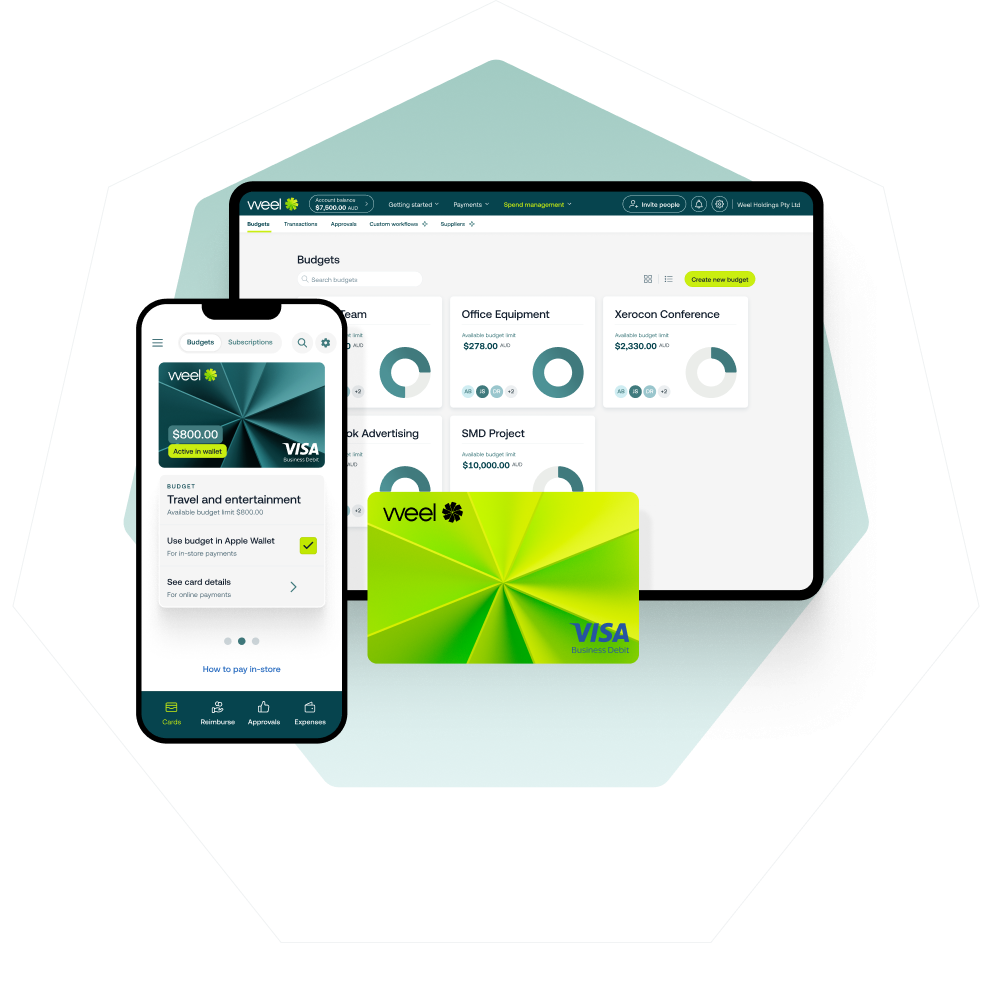
Weel gives finance teams complete real-time visibility across every category of business spend, corporate cards, reimbursements, bills, and subscriptions, from a single dashboard that syncs continuously with Xero, MYOB, and NetSuite.
With real-time transaction tracking, every card swipe appears in the Weel dashboard immediately, attributed to the right person, cost centre, and project. Budget controls enforce spending limits at the card level, so overspend is prevented before it occurs rather than discovered after. Approval workflows route every transaction to the right approver automatically, with policy enforcement built in.
The numbers reflect what this looks like in practice. Across 3.9 million cleared card transactions, over 90% reach full manager approval. Half of all card expenses are fully approved within 24 hours, and the median time from card swipe to accounting sync is 2.3 days. Businesses using approval workflows reach 95% expense completion, a 7-point lift over those managing approvals manually.
For the CFO, the outcome is not just faster reconciliation. It is the confidence to close the books before month-end, report to the board with current data, and make investment decisions based on what the business is actually spending right now, not what it spent last month.
Weel integrates with expense management workflows that cover every spend category, without replacing your existing accounting system. Used by 4,000+ Australian businesses, it is built for the finance teams managing real complexity: multiple locations, decentralised teams, and the compliance requirements of operating in Australia.
Finance on Autopilot. Every Expense Complete.
Conclusion
Spend visibility is not a reporting upgrade. It is a fundamental shift in when and how finance teams access information about business spend. For Australian CFOs managing growing, distributed organisations, the move from reactive month-end reporting to real-time oversight changes what decisions are possible and how confident those decisions can be.
The good news is that getting there does not require a full ERP replacement or a lengthy implementation project. Modern cloud-based spend management platforms layer real-time visibility on top of existing infrastructure, connecting every transaction to the right approval, cost centre, and accounting entry from the moment it occurs.
If you want to stay ahead of the latest thinking on finance operations and spend management, subscribe to the Weel newsletter for updates direct to your inbox. Or visit letsweel.com to see how finance teams across Australia are closing the gap between spending and knowing.