






Disclaimer: This article provides general information only and is not tax or financial advice. Tax obligations vary by business type and circumstance. We recommend consulting a registered tax agent or visiting ato.gov.au for guidance specific to your situation.
Credit card reconciliation: a step-by-step guide for Australian finance teams
Corporate cards move fast. Receipts don't. Credit card reconciliation is the process that closes the gap, matching every card transaction to its receipt, GST code, approval, and general ledger entry before the books close. Done well, it gives your finance team total confidence in the numbers. Done badly, it turns month-end into a chase.
This guide walks through the full reconciliation process, step by step, with the Australian context your finance team actually needs: GST treatment, ATO record-keeping requirements, and the practical workflow that gets every expense complete.
What is credit card reconciliation?
Credit card reconciliation is the process of verifying that every transaction on your corporate credit card statement matches the supporting records in your accounting system, receipts, invoices, GL codes, GST allocations, and approval sign-offs.
It sits at the intersection of two critical finance functions: accounts payable accuracy and month-end close. When a team member spends on a corporate card, that transaction needs a receipt, a business purpose, a correct GL code, and, for Australian businesses , the right GST treatment before it can be posted to the ledger.
Reconciliation confirms all of that is done, catches anything that's missing, and ensures your card balance matches what the bank is reporting. The result is a clean set of books your auditors, your CFO, and the ATO can rely on.
Why credit card reconciliation matters for Australian businesses
Gst accuracy and BAS compliance
Every corporate card transaction with a GST component needs to be captured correctly before your Business Activity Statement is lodged. Miss a GST credit, miscategorise a personal expense, or fail to attach a valid tax invoice and you're either leaving money on the table or creating a BAS liability. The Australian record-keeping rules generally require businesses to hold records for five years, and that includes receipts for every expense claim.
Ato record-keeping obligations
Under the ATO's record-keeping rules, businesses must keep written evidence of all deductible expenses. A bank statement alone is not sufficient. That means every corporate card transaction needs an accompanying receipt or invoice, ideally captured at the point of purchase, not reconstructed at month-end.
Month-end close accuracy
Unreconciled card transactions are one of the most common reasons month-end close drags out. When approvals are missing, receipts are lost, or GL codes are wrong, the reconciliation stalls, and so does the close. Finance teams that reconcile in real-time, rather than in a batch at month-end, close faster and with fewer corrections.
Fbt exposure
Misclassified personal expenses on corporate cards can trigger Fringe Benefits Tax liability. A clean reconciliation process with clear categorisation rules is your first line of defence.
Step-by-step: how to reconcile credit card statements
Step 1: collect all card statements and transaction data
Pull the credit card statement for the period , whether that's weekly, fortnightly, or monthly. If your business uses multiple corporate cards across different cardholders, collect statements for every card. Export the transaction data in a format your accounting system can ingest, or work directly from your card provider's portal.
Check: statement period, opening and closing balance, total spend by cardholder.
Step 2: match receipts to every transaction
For each line item on the statement, locate the corresponding receipt or invoice. This is where most reconciliation pain lives. Receipts get lost, submitted late, or never submitted at all.
Best practice: set a policy that receipts are submitted within 24-48 hours of the transaction. For Australian businesses, a valid tax invoice for GST purposes must include the supplier's ABN, the GST amount (or the statement that the total price includes GST), and the date.
Flag any transactions without a valid receipt immediately, do not proceed to coding until documentation is complete.
Step 3: code GST and allocate to GL accounts
For each transaction with a receipt, apply the correct GST treatment:
Assign each transaction to the correct general ledger account (travel, meals, office supplies, software subscriptions, etc.). If your business uses cost centres or project codes, apply those now.
Accuracy at this step directly affects your BAS, a miscoded transaction means either an incorrect GST claim or a missed one.
Step 4: obtain manager approvals
Every transaction needs sign-off from the relevant approver before it can be posted. This is both a control and a compliance requirement. Approvals confirm:
Chase outstanding approvals now, not at month-end. The earlier an expense is flagged, the easier it is to resolve. Delays here are the single biggest drag on month-end close timelines.
Step 5: post approved transactions to the general ledger
Once receipts are matched, GST is coded, and approvals are confirmed, post the transactions to the GL. Ensure the total of posted transactions matches the statement balance.
For businesses using cloud accounting platforms (Xero, MYOB, QuickBooks), this is typically a journal entry or a direct sync from your expense management system. Confirm the bank feed is reconciled to the statement, the card balance in your accounting system should equal the closing balance on the statement.
Step 6: reconcile to the bank / card provider statement
Run a final check: the sum of all posted transactions in your accounting system must match the closing balance on the credit card statement from your bank or card provider. Any variance, even a small one , needs to be investigated and resolved before you close the period.
Common sources of variance:
- Timing differences (a transaction posted after the statement cut-off)
- Duplicate entries
- Currency conversion differences on international transactions
- Pending credits or refunds not yet processed
Document the reconciliation outcome: who reconciled, what period, the closing balance, and any items carried forward.
Step 7: file and archive supporting documentation
Store all receipts, approval records, and the completed reconciliation in an accessible, organised format. Under Australian tax rules, businesses generally need to ensure these records for five years. Digital storage is acceptable, and far more practical than paper, provided records are complete, legible, and retrievable.
Common mistakes in credit card reconciliation
Waiting until month-end to chase receipts. The longer the gap between a transaction and the receipt request, the lower the recovery rate. Finance teams that chase receipts in real-time, ideally within 24 hours , close faster and with fewer exceptions.
Treating the bank statement as sufficient documentation. A statement shows the amount and merchant. It does not confirm business purpose, GST registration, or the nature of the supply. The ATO is explicit: a valid tax invoice is required for input tax credit claims over $82.50.
Letting approvals pile up. When managers approve expenses in batches at month-end, errors compound. A transaction coded to the wrong account three weeks ago is harder to correct than one flagged the same day.
Mixing personal and business spend. Even incidental personal use on a corporate card creates FBT exposure and complicates reconciliation. Clear policies, enforced at the card level, prevent the problem from arising.
No audit trail. If you cannot demonstrate who approved what and when, you have a compliance gap. Every approval, every amendment, and every override needs to be logged.
Relying on spreadsheets for multi-cardholder programmes. Manual reconciliation across dozens of cardholders is error-prone and slow. The reconciliation process scales with the right tooling, not with more hours.
How Australian finance teams use Weel to reconcile corporate cards
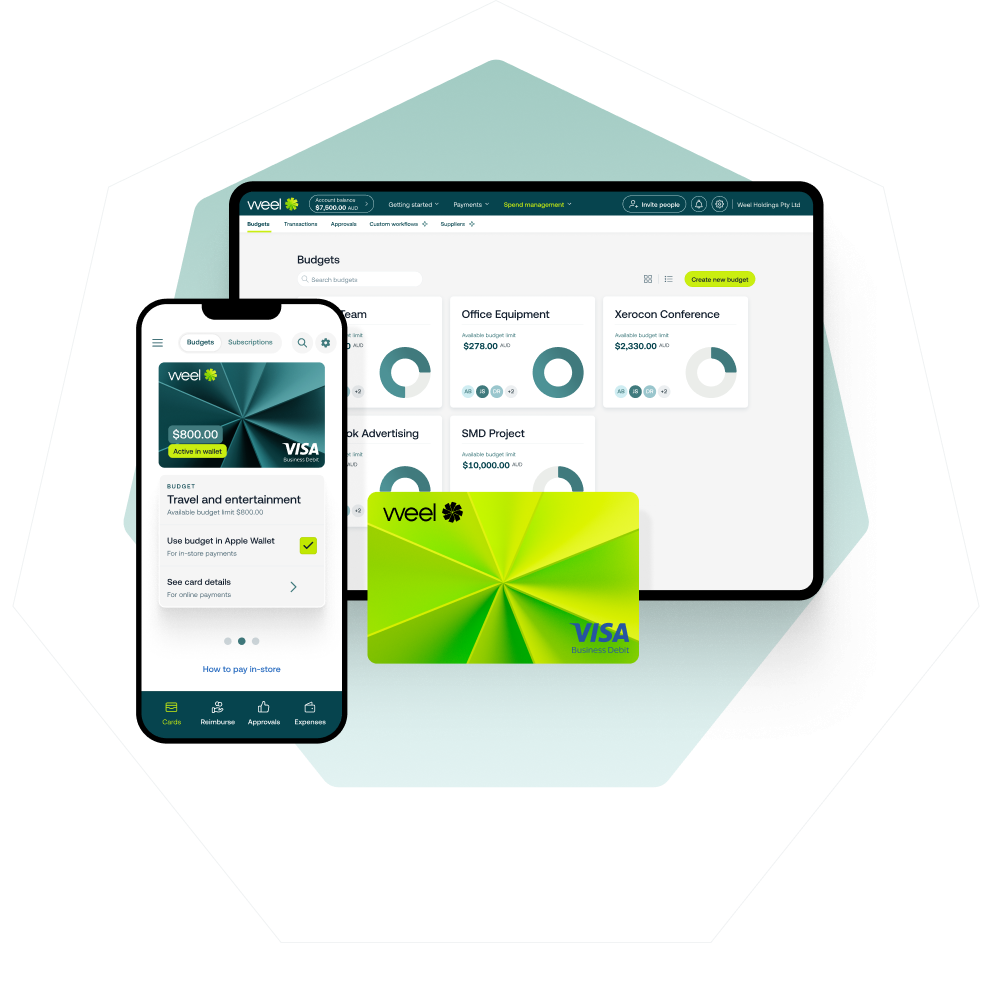
Reconciliation is only painful when the inputs are missing or late. Weel is built so the inputs arrive automatically, receipt, GST code, approval , in the time between the card swipe and the accounting sync.
When a team member pays with a Weel card, they receive an instant push notification to capture the receipt. Weel's OCR reads the receipt, extracts the merchant, amount, and GST, and pre-populates the expense record. The team member confirms or corrects, selects the GL code, and submits, often in under a minute.
That expense then moves through your approval workflow automatically. Managers review and approve from their phone. No chasing. No email threads. No month-end backlog.
The numbers bear this out: over 90% of card expenses on Weel reach full manager approval, across 3.9 million transactions. 44% of expenses are manager-verified within 1 hour of the transaction. The median time from card swipe to accounting sync is 2.3 days.
When it is time to reconcile, the work is already done. Every transaction has a receipt. Every expense has an approval. Every entry has a GST code and GL allocation. The reconciliation becomes a confirmation, not an investigation.
Weel connects directly to Xero, MYOB, and other accounting platforms, posting approved transactions with all coding intact. Your finance team closes the period with complete, audit-ready records, and the confidence that the numbers are right.
Finance on Autopilot. Weel means done.
Conclusion
Credit card reconciliation does not have to be the bottleneck it is in most finance teams. With a clear process, the right policies, and tooling that captures receipts and approvals at the point of spend, every corporate card transaction can be complete, receipted, coded, approved, and posted , well before month-end.
For Australian businesses, the stakes are real: GST credits, ATO compliance, FBT exposure, and audit-ready records all depend on getting reconciliation right.
Ready to see what reconciliation looks like when the work happens automatically? Book a free demo at letsweel.com/demo.
This article is general information only and is not tax advice. We recommend consulting a registered tax agent for advice specific to your business.