





Disclaimer: This article provides general information only and is not tax or financial advice. Tax obligations vary by business type and circumstance. We recommend consulting a registered tax agent or visiting ato.gov.au for guidance specific to your situation.
The complete expense tracker guide for Australian businesses in 2026
Choosing the right expense tracker is one of the most consequential decisions a finance team makes. The wrong one creates more admin than it removes - receipts still go missing, GST codes still need manual correction, and your month-end still runs late.
This guide covers what a real expense tracker does for Australian businesses, what to look for when you're evaluating one, the ATO record-keeping rules your tracker must satisfy, and what complete expense tracking actually looks like in practice.
What is an expense tracker?
An expense tracker is software that records, categorises, and reports on business spending. At its core, it captures every transaction your team makes - card purchases, reimbursement claims, supplier invoices - and organises them by category, project, cost centre, or tax code.
For Australian businesses, expense tracking means more than keeping a tidy spreadsheet. Under Australian tax rules, businesses generally need to ensure they retain records that substantiate every deduction claimed, including the amount, date, nature of the expense, and the supplier's name. Those records must be kept for five years. A credible expense tracker creates and stores this documentation automatically, as the spend happens - not at month-end when receipts are gone and memories are fuzzy.
The term "expense tracker" gets used for everything from a basic budgeting app or free budget planner on your phone to a full expense management platform with approval workflows and accounting integration. Those are very different things, and the gap matters when your business is spending at scale.
Basic trackers vs. real expense tracking software
A basic budgeting app or budgeting spreadsheet records what you spent. That is the start, not the finish.
A real business expense tracker does the full job:
- Captures receipts at the point of spend - via mobile app, email forwarding, or direct card integration - not from a shoebox at month-end
- Applies GST codes automatically, flagging mixed-supply transactions for review
- Routes every expense through an approval workflow before it reaches your accounting software
- Syncs to Xero, MYOB, or NetSuite in real time, with GL codes, tax codes, and cost centre allocations already applied
- Produces an audit trail that satisfies ATO record-keeping requirements without any manual reconstruction
A free budget planner or bills app tracks your household or personal spending. It has no concept of GST, no approval routing, no integration with your general ledger, and no audit-grade record-keeping. Businesses that rely on personal budgeting apps to manage company spending carry real compliance risk - especially at tax time and in the event of an ATO audit.
The distinction also matters for FBT (fringe benefits tax). When your team uses a corporate card for meals, entertainment, or travel, those transactions need to be correctly coded as either business or personal, with appropriate records kept. A basic spending tracker app cannot do this. An expense tracker built for business does it as a matter of course.
What to look for in an expense tracker for Australian businesses
Receipt capture that works in the real world
Receipt capture must happen at the moment of spend, not later. The best expense tracker apps send an automatic prompt the moment a card is swiped - your team photographs the receipt, and it is matched to the transaction instantly. Optical character recognition (OCR) reads the merchant, amount, and date, and pre-populates the expense fields.
Median receipt capture time on Weel is 4 hours - from the moment money is spent to a receipt attached and categorised. Over 60% of receipts are captured within 24 hours across 3.9 million transactions. That is the standard a serious expense tracking tool should meet.
GST coding and tax compliance built in
Every expense tracker for Australian businesses must handle GST. That means distinguishing between taxable, GST-free, and input-taxed supplies, applying the correct tax code, and flagging any transaction where the classification is unclear.
This is not optional. Incorrect GST coding flows directly into your BAS, and errors there can trigger ATO reviews. Look for a tracker that applies tax codes automatically based on category rules, and that produces GST-coded exports your accountant or accounting software can act on directly.
Approval workflows
Tracking an expense is not the same as approving it. Without approval workflows, you know what was spent after the fact - and by then, out-of-policy spending has already happened.
A real expense management system routes every expense through the right approver based on amount, category, cost centre, or team. Businesses using approval workflows on Weel reach 95% expense completion - 7 points higher than businesses without them. Nothing falls through.
Multi-level approvals, delegation for when approvers are out of office, and out-of-policy flagging are the features that give a finance team actual control - not just a record of what happened.
Accounting integration with Xero and MYOB
For Australian businesses, Xero and MYOB are the dominant accounting platforms. Your expense tracker must sync to them directly, not via a manual export or CSV upload.
Two-way sync means expenses coded and approved in your tracker flow into your accounting software with GL codes, tax codes, and cost centre allocations already applied. Bank reconciliation becomes a matching exercise, not a data-entry task. Median time from card spend to accounting sync on Weel is 2.3 days - across 2.5 million exported transactions.
If an expense tracker you are evaluating requires manual CSV export to Xero or MYOB, that is a sign it was built for personal use, not business finance.
Real-time reporting and spend visibility
Budget tracking and real-time reporting are the features that turn an expense tracker into a finance tool. Your team should be able to see, at any moment, how much has been spent against each budget, which cost centres are running hot, and which approvals are still pending.
Drill-down reporting by team, project, or category - not just a monthly export - is what gives finance managers the visibility to act before month-end, not after it.
ATO record-keeping requirements for business expenses
Under Australian tax rules, businesses generally need to ensure they keep records that explain and substantiate every transaction claimed as a tax deduction. For expense tracking, this means:
What records you must keep:
- The amount of the expense
- The date the expense was incurred
- The name of the supplier or payee
- The nature of the expense (what it was for)
- A receipt, invoice, or bank statement as documentary evidence
How long you must keep them:
- Five years from the date you lodge your tax return for the income year the expense relates to
Digital records are accepted, provided they are a true and clear reproduction of the original. An ATO-compliant expense tracker stores digital receipts against each transaction, timestamped and categorised, and makes them retrievable on demand.
FBT implications: If any tracked expense involves providing a benefit to a team member - such as a meal, entertainment, car parking, or a gift - it may be subject to fringe benefits tax. Correct categorisation in your expense tracker from the outset is the only reliable way to know your FBT exposure before the FBT year ends on 31 March.
For ATO guidance on record-keeping obligations, see the ATO's records you need to keep page.
What complete expense tracking looks like with Weel
Most expense trackers stop at collection. Weel closes the loop.
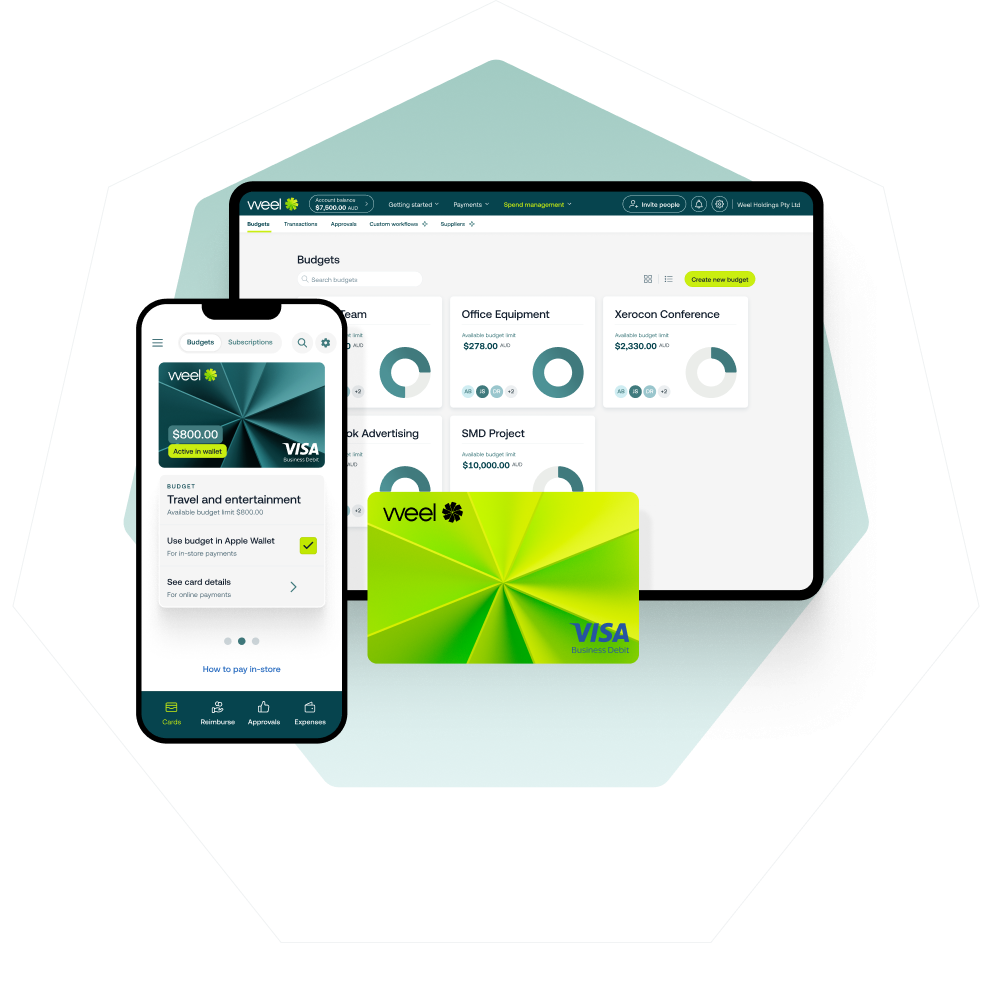
When a team member spends on a Weel corporate card, the receipt prompt goes out the moment the transaction clears. GST coding is applied automatically based on the merchant category. The expense is routed to the right approver without anyone having to send a reminder. Once approved, it syncs directly to Xero or MYOB with all coding already applied.
Over 90% of card expenses on Weel reach full manager approval. Half of all card expenses are fully approved within 24 hours. That is not a target - it is the actual result across 3.9 million transactions from 4,000+ Australian businesses.
For reimbursements, the same loop applies. A team member submits an out-of-pocket claim, attaches the receipt, and the claim routes through approval automatically. Half of all reimbursements are paid within 24 hours. 95% are fully paid.
The difference between an expense tracker and Weel is the difference between knowing an expense was submitted and knowing it is done - receipted, coded, approved, synced, and accounted for.
Ready to close every expense loop?
The right expense tracker does more than collect receipts. It gives your team a complete record of every transaction, automatically coded for GST, approved on time, and synced to your accounting software without a manual step. That is what month-end looks like when nothing is outstanding.
See Weel in action by booking a demo today.
This article is general information only and is not tax advice. We recommend consulting a registered tax agent for advice specific to your business.