






What is expense management and why it matters for Australian businesses
Every Australian business spends money. Whether it is team travel, software subscriptions, client lunches, or office supplies, those costs accumulate fast. Expense management is the process of tracking, approving, and reconciling every one of those costs so nothing falls through the gaps. Without a clear system, finance teams spend more time chasing receipts than closing the books.
What is expense management?
Expense management is the end-to-end process of controlling how a business spends money and ensuring every transaction is recorded, approved, and reconciled accurately.
It covers the full lifecycle of a spend event: a team member makes a purchase, submits a receipt or expense claim, a manager reviews and approves it, and the finance team reconciles it against the correct budget and general ledger code. In larger organisations, this process also includes setting spend policies, issuing corporate cards, and producing reports for the ATO.
In Australia, expense management carries specific regulatory weight. Businesses must keep accurate records to meet GST reporting obligations, manage FBT exposures on benefits like meals and accommodation, and comply with ATO record-keeping rules. The cost of getting this wrong ranges from disallowed deductions to audit risk.
For Australian finance teams, expense management is not just an administrative task. It is a control function. Done well, it gives leadership real-time visibility into where money is going across every team, project, and cost centre.
Why expense management matters for your business
Poor expense management creates two categories of problem: financial risk and operational drag.
On the financial side, uncontrolled spending inflates costs and distorts reporting. If expenses are submitted late, coded incorrectly, or approved without scrutiny, the numbers your CFO relies on for decisions are wrong. GST claims get missed. FBT liabilities go unrecognised. Budget variance reports tell the wrong story.
On the operational side, manual processes slow everything down. Finance ops teams fielding paper receipts, chasing approvals over email, and re-entering data into accounting software are not working on higher-value tasks. That time has a real cost.
There is also a compliance dimension that is easy to underestimate. The ATO requires businesses to retain records of deductible expenses for five years. An expense management system that captures receipts at point of purchase and stores them with the correct transaction record makes that obligation automatic. One that relies on a shoebox of paper receipts does not.
When expense management works, finance teams gain total confidence in their numbers. Month-end close is faster, audits are straightforward, and leadership can make spend decisions with certainty rather than guesswork.
Core components of an expense management system
Expense tracking
Expense tracking is the foundation. Every purchase made by a team member, whether by corporate card, personal card, or cash, needs to be captured and attributed to the right budget. Modern expense tracking uses OCR to extract data from receipts automatically, removing the need for manual entry.
Spend policies and approval workflows
A spend policy defines what the business will and will not reimburse, and at what amounts manager approval is required. Approval workflows enforce those policies automatically: a receipt submitted above a threshold routes to a manager before it is processed. Without this layer, policy exists only on paper.
Corporate card management
Corporate cards give the business direct control over spend before it happens. Rather than waiting for reimbursement claims to surface, card transactions appear in real time. The finance team can see what was spent, by whom, and on what, the moment the card is used.
Reimbursements
Not every business expense goes on a card. When team members pay out of pocket, reimbursement processes need to be fast and accurate. A clear submission path, automatic policy checks, and direct payment integration reduce the lag between spend and repayment.
Reporting and reconciliation
Expense data is only useful if it flows into the right places. Integration with accounting software like Xero or MYOB means transactions are coded and reconciled without duplicate entry. Reporting surfaces spend by category, team, period, or project so finance managers can act on the data rather than compile it.
Common challenges with manual expense management
Most finance teams outgrow manual expense management before they realise it. The signs are familiar: approval bottlenecks at month end, receipts that arrive weeks after the purchase, duplicate submissions, and reconciliation that takes days instead of hours.
Manual processes also create inconsistency. Without automated policy checks, whether an expense gets approved depends on who reviews it and when. That inconsistency exposes the business to audit risk and makes budget forecasting unreliable.
For businesses with a distributed workforce, the problem compounds. Remote teams, travelling sales people, and multiple office locations each add complexity to an already fragile process. When someone in Brisbane submits a receipt to a manager in Sydney for an expense incurred in Melbourne, a manual workflow almost always introduces delay and error.
The Australian Taxation Office's record-keeping requirements make accurate, timestamped documentation non-negotiable. Manual systems rarely produce audit-ready records without significant additional effort at tax time.
How modern expense management works
Modern expense management replaces the paper trail with automated, real-time processes.
When a team member makes a purchase, they capture the receipt immediately, typically by photographing it through a mobile app. OCR extracts the merchant, date, amount, and GST component automatically. The transaction is matched to the relevant card or cost centre and routed through the appropriate approval workflow based on pre-set policy rules.
Once approved, the expense syncs directly to the accounting platform with the correct GL code applied. The finance team does not re-enter data. The record is complete, compliant, and ready for reconciliation.
Reporting happens continuously rather than at month end. Finance managers see total spend by team, category, and period in real time. Budget holders get visibility into what has been committed versus what has been approved. Nothing is a surprise.
This approach shifts expense management from a reactive task into a real-time control function. The books reflect actual spend as it happens, not three weeks later.
How Australian finance teams use Weel for expense management
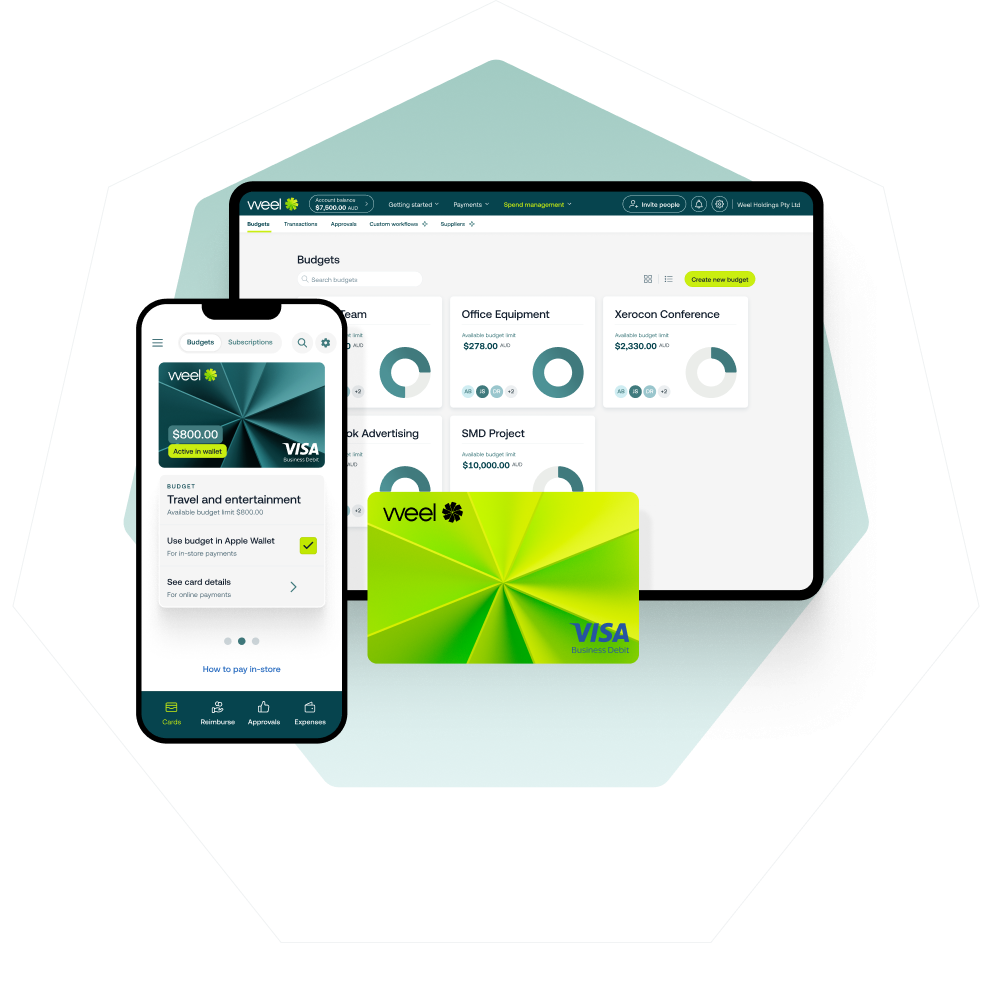
Weel's expense management software is built specifically for Australian businesses managing card expenses, approvals, and reimbursements at scale.
Finance teams issue virtual and physical corporate cards to their people with individual spend limits and category controls set upfront. Every card transaction is captured in real time, with receipt capture built into the workflow at point of purchase. There is no chasing required because the system closes the loop automatically.
Over 4,000 Australian businesses use Weel to manage their expenses. The data backs the outcome: over 90% of card expenses reach full manager approval, and 50% of card expenses are fully approved within 24 hours. For finance teams under pressure to close fast, that speed is material.
Approval workflows in Weel enforce company policy automatically. Multi-level approvals, spend thresholds, and out-of-policy flags are all configurable without code. When a transaction falls outside policy, it surfaces immediately rather than at the next review cycle.
Weel connects directly with Xero, MYOB, and other accounting platforms. Once an expense is approved, it syncs with the correct GL coding applied. The median time from card swipe to accounting sync is 2.3 days, and finance teams report significantly less time spent on manual reconciliation.
For reimbursements, Weel gives team members a clear submission path and gives finance ops a single queue to process. No email threads. No spreadsheet tracking. Every expense complete.
Conclusion
Expense management is not a back-office detail. For Australian businesses, it is the control layer that keeps financial data accurate, ensures ATO compliance, and gives leadership the confidence to make decisions on real numbers. When the process is manual, it creates cost and risk. When it is automated, finance teams get time back and the books close on schedule.
If your expense process still relies on spreadsheets, email approvals, or end-of-month receipt marathons, it is worth seeing what a purpose-built system looks like in practice.
Book a free demo at letsweel.com/demo