






Disclaimer: This article provides general information only and is not tax or financial advice. Tax obligations vary by business type and circumstance. We recommend consulting a registered tax agent or visiting ato.gov.au for guidance specific to your situation.
How to build an employee reimbursement policy that actually works in Australia
A reimbursement policy is not a nice-to-have. Without one, your finance team chases receipts, managers make inconsistent decisions, and the ATO has grounds to question your expense records. A well-written policy gives your whole organisation a single, enforceable standard, and it closes the gap between "we have a process" and "we actually follow it."
This guide covers what every Australian reimbursement policy must include, how to meet ATO substantiation requirements, when FBT applies, and how to make your policy stick beyond the first week it goes live.
What is an employee reimbursement policy?
An employee reimbursement policy is a formal document that sets out the rules for when and how your organisation repays people for work-related expenses they have paid out of pocket. It defines which expense categories are eligible, what documentation is required, how approvals work, and when payment will be made.
The policy applies to anyone in your organisation who incurs business expenses on behalf of the company, from your finance team approving corporate card transactions to your sales team paying for client dinners. It is the foundation of expense control: without it, every reimbursement request is a negotiation.
What should an Australian reimbursement policy include?
A policy that covers the basics will reduce confusion. A policy that covers the following elements will also protect you at tax time.
Eligible expense categories
Define exactly what is reimbursable. Common categories for Australian businesses include:
- Travel: Flights, accommodation, ground transport, tolls, parking
- Meals and entertainment: Client meals, team working lunches (note FBT implications, see below)
- Motor vehicle: Cents-per-kilometre claims or a log book-based method for private vehicles used for business
- Home office: Where a genuine working-from-home arrangement exists
- Professional development: Courses, conferences, memberships directly related to the role
- Equipment and supplies: Items purchased for legitimate business use
List non-reimbursable items too. Personal travel extensions, fines, alcohol (without a business purpose), gifts without prior approval, and first-class upgrades are common exclusions.
Spending limits
Set pre-approved thresholds by category and seniority. Expenses above threshold require manager or finance sign-off before they are incurred, not after. This is where most policies fall apart, approval after the fact rarely changes spending behaviour.
Timeframe for submission
Specify a maximum number of days from the date of the expense to the date of submission, 30 days is a standard default, though some organisations set 14 days for anything over a given dollar amount. Late submissions create reconciliation problems and can disqualify GST claims if tax invoices are missing or expired.
Record-keeping requirements
Good record-keeping for work-related expense claims generally requires written evidence. The ATO's guidance outlines what businesses should retain. For reimbursements, this means:
- Tax invoice or receipt showing the supplier's name, the amount (including GST), the date, and a description of the goods or services
- For motor vehicle claims using the logbook method, a valid logbook covering at least 12 continuous weeks
- For travel allowances, records of the dates, destinations, and business purpose of each trip
Records are generally required to be retained for five years – refer to the ATO's record-keeping guidance for details. Every reimbursement your organisation processes should be backed by documentation that would survive an audit.
Approval workflow
Define who can approve what. A standard two-level structure works for most organisations: direct manager up to a set dollar threshold, then Finance or the CFO above it. No one should approve their own expenses. The policy should name the backup approver when the primary is unavailable, otherwise one person's annual leave stalls the entire queue.
Payment timeframe
Commit to a payment cycle. Your team should know when to expect the money back in their account, whether that is the next payroll run, a weekly reimbursement batch, or within a specific number of business days. Ambiguity here erodes trust and increases the volume of follow-up queries your finance team has to manage.
Fbt considerations
Fringe Benefits Tax is a recurring compliance catch. Reimbursements are generally not subject to FBT because they compensate your team for expenses that are deductible to the employee, this may fall under what the ATO refers to as the "otherwise deductible" rule. Whether this applies depends on your specific circumstances – speak to a registered tax agent to confirm. But the rule only applies where the expense would have been deductible to the employee if they had incurred it themselves.
Entertainment expenses, gym memberships, and costs with a strong personal benefit component often fall outside the otherwise deductible rule and can attract FBT. Your policy should flag which categories require FBT review before approval.
ATO and FBT requirements
What the ATO requires for substantiation
The ATO's substantiation rules exist to prevent individuals from claiming personal expenses as business costs. For employers, the practical obligation is to collect adequate documentation before processing any reimbursement. A receipt alone is not always sufficient, the ATO expects to see business purpose clearly documented for travel, meals, and entertainment.
Where your team uses a cents-per-kilometre rate to claim motor vehicle expenses, no logbook is required up to 5,000 business kilometres per year. Above that threshold, a logbook is mandatory.
When reimbursements attract FBT
A reimbursement attracts FBT when it does not satisfy the otherwise deductible rule, that is, when the expense would not have been fully deductible to the employee if they had paid it themselves. Common triggers include:
- Meals and entertainment where there is no clear income-producing purpose
- Accommodation or travel with a private benefit component
- Expenses incurred by associates (family members, for example) of the employee
The FBT year runs from 1 April to 31 March. If your policy does not account for entertainment and travel categories that straddle personal and business use, you are likely carrying an FBT exposure you have not quantified.
The otherwise deductible rule
Where a reimbursement relates to an expense that would have been fully deductible to the employee, no FBT applies and no PAYG withholding is required. The employer does not include the amount in the employee's income statement. This is the most common situation for straightforward out-of-pocket expenses: a flight to a client meeting, a course registration, a business book.
For partial deductibility, the taxable value of the fringe benefit is reduced proportionally. Your policy should direct managers to escalate any expense with a mixed private-business character to finance for assessment before reimbursement is approved.
How to build a reimbursement policy that people actually follow
Writing a policy is the easy part. Getting your team to follow it consistently is the work.
Write it plainly. Every rule in your policy should be understandable to someone outside the finance team. If a team member in sales cannot read your reimbursement policy and understand what they need to do, the policy will not be followed.
Make the process fast. The single biggest driver of non-compliance is a slow or opaque reimbursement process. When your team does not know whether their submission was received, approved, or queued for payment, they stop submitting on time, or at all. A policy that commits to payment within a defined number of days changes behaviour.
Use automated reminders. Do not rely on your team to remember submission deadlines. Automated reminders at day 14 and day 25 after an expense is incurred reduce the volume of late submissions and keep your reconciliation clean.
Enforce it consistently. Policies that are applied differently across teams or seniority levels create resentment and erode trust. If the rule is 30 days, it is 30 days for everyone. Finance should have the authority to decline late submissions or require re-approval for expenses outside the approved categories.
Tie card access to compliance. For organisations using corporate cards or virtual cards, policy compliance can be built into the spend controls, category restrictions, merchant blocks, and pre-approved limits mean that out-of-policy spending is prevented rather than caught after the fact.
Common reimbursement policy mistakes
No pre-approval threshold. Approving large expenses after the fact is not approval, it is rubber-stamping. Set a threshold above which pre-approval is required before the expense is incurred.
Missing FBT guidance. Most small and mid-market policy documents ignore FBT entirely. Your team should not be making FBT calls at the point of submission. The policy should tell them which categories to flag.
No late submission rule. Without an explicit cut-off, every late submission becomes a negotiation. Define the cut-off, define the exception process, and enforce both.
Accepting scanned paper receipts with no audit trail. Records are generally required to be retained for five years – check the ATO's guidance for your specific obligations. Scanned receipts stored in email threads are not an audit-ready record-keeping system.
Single-approver bottlenecks. If the CFO is the only person who can approve travel above $500, every approval queue stalls during annual leave. Always define a backup approver.
How Weel automates reimbursement policy enforcement
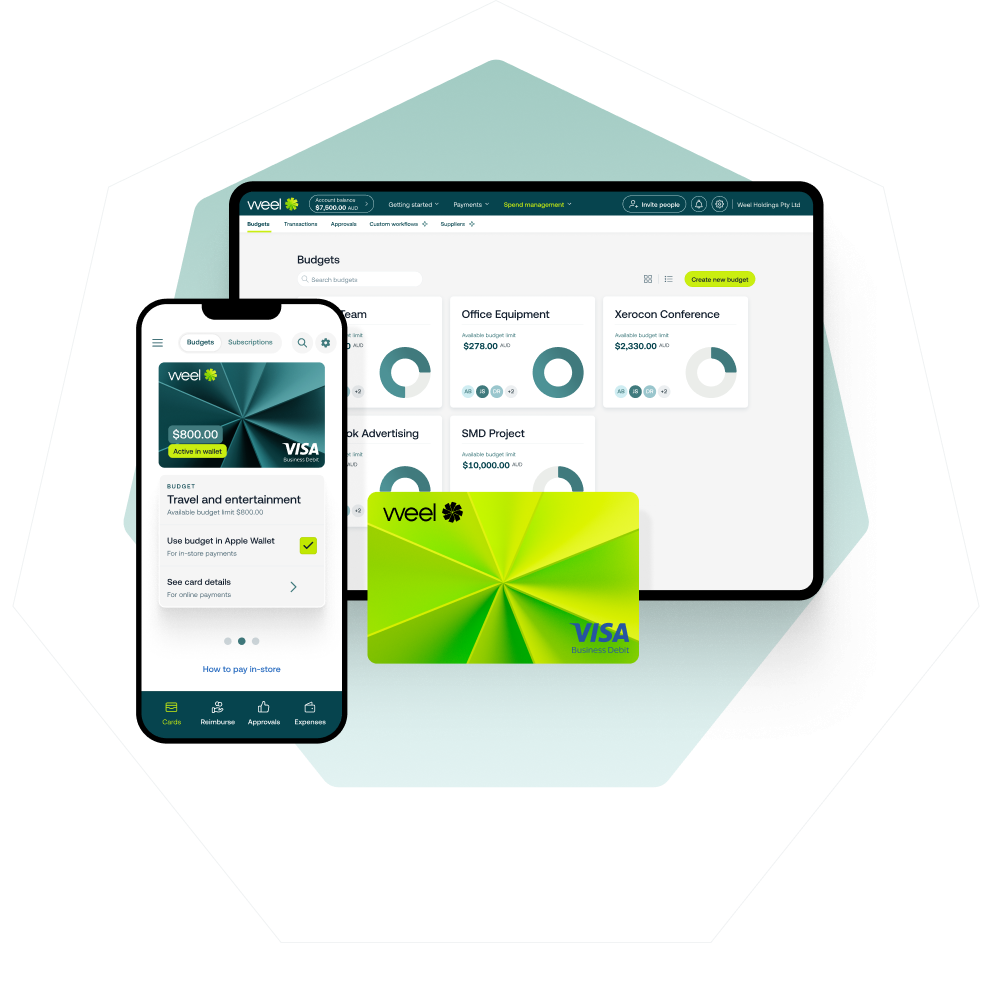
A reimbursement policy is only as strong as the system that enforces it. Weel gives your finance team the controls to make the policy automatic, not something the team has to remember and chase.
When a team member submits a reimbursement in Weel, the receipt is captured at the point of expense. Weel's OCR technology reads the receipt and populates the expense fields automatically, amount, date, merchant, and GST. The median time from expense to receipt capture is 4 hours, which means your reconciliation is not waiting on end-of-month submissions.
Every reimbursement moves through a configurable approval workflow. You set the thresholds and the approvers; Weel routes each request to the right person automatically. Approvers get notified, can approve on mobile, and the audit trail is complete. Over 90% of card expenses across the Weel platform reach full manager approval, a figure drawn from 3.9 million transactions.
Once approved, reimbursements do not sit in a queue. Weel processes payments directly: 50% of reimbursements are paid within 24 hours, and 95% are fully paid. Your team stops sending follow-up emails asking where their money is, and your finance team stops fielding them.
Weel is used by 4,000+ Australian businesses. The controls that used to require a dedicated finance team, policy rules, spend limits, approval chains, receipt capture, are built into the platform.
Every Expense Complete.
Book a free demo at letsweel.com/demo
Disclaimer: This article provides general information only and is not tax or financial advice. We recommend consulting a registered tax agent for advice specific to your business situation.


.jpeg)