



The Weel Australian AI Spending Index tracks how many businesses across Australia and New Zealand pay for AI tools, and which providers, using anonymised expense data from 4,000+ businesses on Weel. This edition covers July to September 2026: percentages are the share of businesses paying for each AI tool, and dollar figures are average monthly spend per paying business. Surveys measure intent - we measure what businesses actually pay for. All figures are Australian and New Zealand data, and we flag any US or survey figures we cite.
A lot has happened since our last update in July, when we said it could go two ways: Anthropic could overtake OpenAI, or OpenAI could strike back. We got both.
Last quarter Anthropic was at 17.0%, two points behind OpenAI. In August, more businesses on Weel paid Anthropic than OpenAI for the first time - a few months after the same crossover happened in the US. However, in September OpenAI took the lead back. Since July, neither has led by more than a point; businesses are yet to pick a winner.
Snapshot of findings
- 32.0% of businesses on Weel are paying for AI in September, up from 30.8% in June.
- August: Anthropic passed OpenAI for the first time, 19.0% to 18.7%.
- September: OpenAI back in front, 19.8% to 19.3%, adding more paying businesses than in any month of the index.
- Spend gap narrowing: Anthropic customers still spend far more per business, but the gap fell from 3.6x in June to under 3x in September.
- Paying for both: 34.8% of OpenAI and Anthropic customers now pay for both.
1. The August crossover: Anthropic passes OpenAI, three to four months after the US
Anthropic rose from 17.0% in June to 18.1% in July and 19.0% in August, while OpenAI slipped from 19.0% to 18.7%. For the first time, Anthropic was the most widely paid-for AI provider we track. On spend per business, it has led every month since March 2025.
For context: in January, Anthropic was at 5.4%, more than 13 points behind. It closed that gap in seven months.
The US got there first. In US business spending data, Anthropic passed OpenAI in April or May (depending on the release) and was still pulling ahead through August. Australia and New Zealand followed three to four months later, at much lower adoption - around 19% here, against 44% (Anthropic) and 40% (OpenAI) of US businesses in August.
2. OpenAI strikes back: a record September puts it back in front
In September, OpenAI rose to 19.8%, and Anthropic slowed to 19.3%. OpenAI added more paying businesses than in any month of the index - more than twice Anthropic's gain. US data, through August, shows no similar turn.
Our net-flow measure had run toward Anthropic for six months straight. In September it flipped to OpenAI - the first time since February, and the biggest swing in more than a year:
- Switchers: in July and August, about two businesses moved from OpenAI to Anthropic for every one going the other way. In September that reversed - for every two leaving OpenAI for Anthropic, about three went the opposite direction.
- Adders: in September, more than twice as many Anthropic customers added OpenAI as in August. More than half of them (54%) had dropped OpenAI for Anthropic earlier this year - they came back, but kept Anthropic.
- New payers: in September, businesses that started paying for either provider split almost evenly. In July and August, Anthropic won about three in five.
3. Hedging their bets: why paying for both is officially the new normal (34.8%)
Rather than picking one AI provider, more businesses are paying for both. Of businesses on Weel paying for OpenAI or Anthropic, 34.8% pay for both - more than either single-provider group: OpenAI only (33.3%) or Anthropic only (31.8%). At the start of the year, nearly four in five of them paid OpenAI alone.
Interestingly, in August Anthropic-only businesses outnumbered OpenAI-only for the first time. A month later, OpenAI-only was back in front. The three groups are close enough that one strong model release could reorder them.
4. The spend gap narrows: pricing shifts, product pushes, and what the data tells us
Last quarter we asked whether the spend gap would keep widening. It widened a little in July, then narrowed.
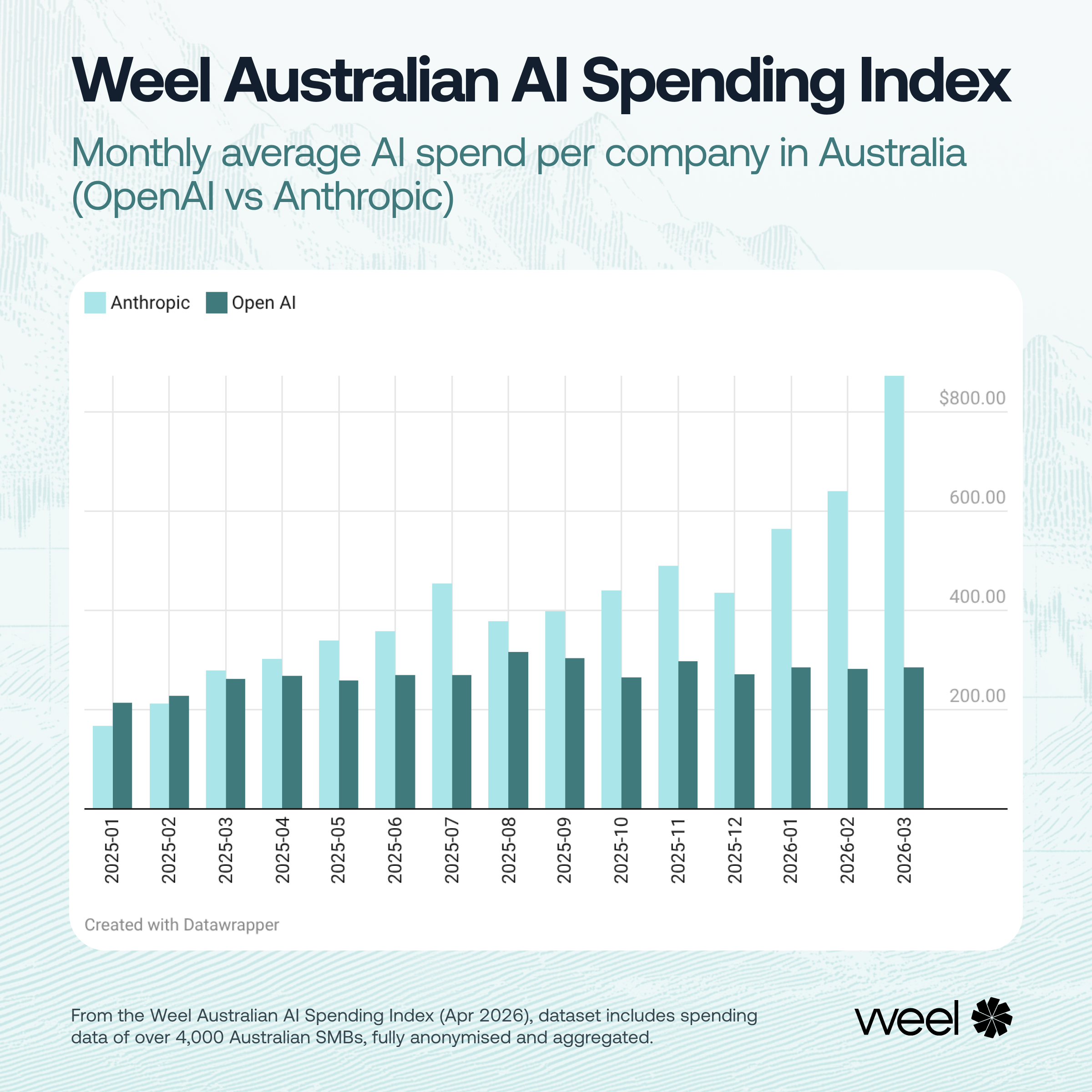
Average monthly spend per OpenAI customer rose from $298 in June to $407 in September - up more than a quarter, after over a year in a narrow band. Anthropic peaked at $1,172 in July and eased to $1,115. The gap fell from 3.6x to under 3x, though Anthropic customers still spend far more.
Total OpenAI spend on Weel grew on both fronts from August to September - ChatGPT subscriptions up 21%, and other billing lines, including API usage, up 30%.
We can't see in card data why any business switched, but possible explanations include:
- OpenAI's product push: its GPT-5.6 models and a new ChatGPT desktop app in July (chat, agents and Codex in one), a Premium ChatGPT Business seat with five times standard usage in late August, and GPT-6 models rolling out in September.
- Anthropic's pricing change: a promotion that included its top Fable 5 model in Pro plans and standard Team seats ended, so from late July those users paid for it with usage credits.
- Cheaper Anthropic models: two new, cheaper models, Opus 5 and Opus 5.5.
We'll need more time and data to determine causation.
5. Overall adoption reached 32% - so why is growth suddenly easing?
AI adoption among businesses on Weel reached 32.0% in September, up from 30.8% in June - a 1.2 point gain, against 3.3 points in Q2. The US slowed at the same time, so this looks like a global trend, rather than a local one. One quarter isn't a trend, so we'll see what Q4 shows.
US business spending data shows adoption there rose 5.4 points in Q1, 3.6 in Q2 and 1.2 in July and August. Unlike the provider race, where Australia trails the US by three to four months, the slowdown arrived in both markets together.
Commentators have floated a few explanations:
- ROI scrutiny: in late July OpenAI cut prices on two of its GPT-5.6 models, citing enterprises being "less inclined to deploy expensive models without a clear picture of the return on their investments".
- The safety debate: in September Anthropic's chief executive called for an industry-wide slowdown in new model releases, a call OpenAI's chief executive backed.
Neither can be confirmed from card data, and both would apply to the US as much as here.
Surveys put SME adoption higher - the National AI Centre's tracker at 44% (February) and NAB's SME survey at 40% (March quarter). But surveys capture what businesses say - intent and self-reported use, free tools included - while we count what they actually pay for, and there's a gap between the two. They also lag - the ABS's latest figures, released in June, describe 2024-25, and every survey reading predates both the crossover and OpenAI's comeback.
They do point the same way. NAB called SME adoption "finely balanced" and "yet to reach a clear tipping point" in the March quarter - our data now shows growth easing too. And across the National AI Centre's monthly surveys since 2024, close to half of SMEs agree AI is moving too fast to know when to invest. That may help explain why more businesses are paying for both.
6. Most industries kept climbing, but more slowly
AI adoption rose in 10 of the 13 industries we track, but more slowly than in Q2. Technology, Other Business Services and Manufacturing gained most; Education, Agriculture and Retail eased slightly.
The technology industry edged ahead of financial services, 55.6% to 53.6%. The two have traded the lead several times since late 2024, rarely more than a few points apart.
What we're watching
Last quarter we asked three questions, and said an Anthropic overtake was far from a foregone conclusion. Here's where they landed.
Does OpenAI hold its floor, or does Anthropic overtake it?
Both, a month apart. September's gain came from businesses adding OpenAI as well as switching to it, so it's too early to call a reversal. Both companies have also filed confidentially to list in the US (Anthropic, OpenAI) - Anthropic reportedly as early as November, while OpenAI's chief executive said in September, "I would say not 2026." Things are moving fast, and the winner is far from a foregone conclusion.
Does the spend gap keep widening?
No - it fell from 3.6x in June to under 3x in September. If OpenAI's spend per business keeps rising, it may keep closing.
Is paying for both now the default?
It's now the most common choice - 34.8% of businesses paying OpenAI or Anthropic pay for both, more than either single-provider group. For finance teams, that likely means managing two AI subscriptions instead of one.
New: does Australia keep following the US?
In September we moved toward OpenAI while the US, through August, was still moving toward Anthropic. If the US turns too, we may have caught it first. If not, it's a local shift.
AI vs SaaS
We've tracked AI against the top 20 SaaS tools in previous editions, and the trend continues - across all businesses on Weel the gap has narrowed to 8.2 points, and among technology-industry businesses AI is now 1.4 points behind. We'll update it in the next edition.
Limitations
Same caveats as every prior release, plus one addition:
- Company size: the data reflects Australian and New Zealand businesses using Weel, biased toward SME spending patterns.
- Scope: this is a leading indicator, not a comprehensive economic measurement.
- Coverage window: the series now spans late 2022 to September 2026.
- Bundled AI: Microsoft Copilot and Google Gemini can't currently be separated from broader subscription SKUs.
- New this quarter: coding agents like OpenAI's Codex bill through ChatGPT plans or the OpenAI API, so Codex growth sits inside the OpenAI numbers.
Stay updated
This index will continue to be updated quarterly as adoption accelerates and the dataset expands. The next scheduled coverage will be in early 2027.
For future analyses and upcoming reports from the Weel Data Research series, please subscribe to our newsletter.