





What is a business credit card?
A business credit card is a credit facility issued to a company, not an individual. It pays for business expenses and is repaid from business funds. Unlike a personal card used for work costs, it keeps company spend separate from personal finances. That separation matters for tax records and GST reporting, and for keeping clean documentation the Australian Taxation Office expects for GST reporting and record-keeping.
Most Australian banks and several fintech providers issue business credit cards. Options range from a single card tied to an owner's name to a full program with dozens of employee cards. Some come with individual spend limits and centralised reporting. The right setup depends on how your business actually spends, not which card has the best headline rewards rate.
Business credit cards in Australia generally fall into two categories. A charge card requires the balance paid in full each billing cycle, usually with no pre-set limit. A revolving credit card lets you carry a balance month to month, with a fixed limit and interest on anything unpaid. Most providers also offer virtual cards alongside physical ones. These suit online subscriptions or one-off supplier payments where a physical card isn't needed.
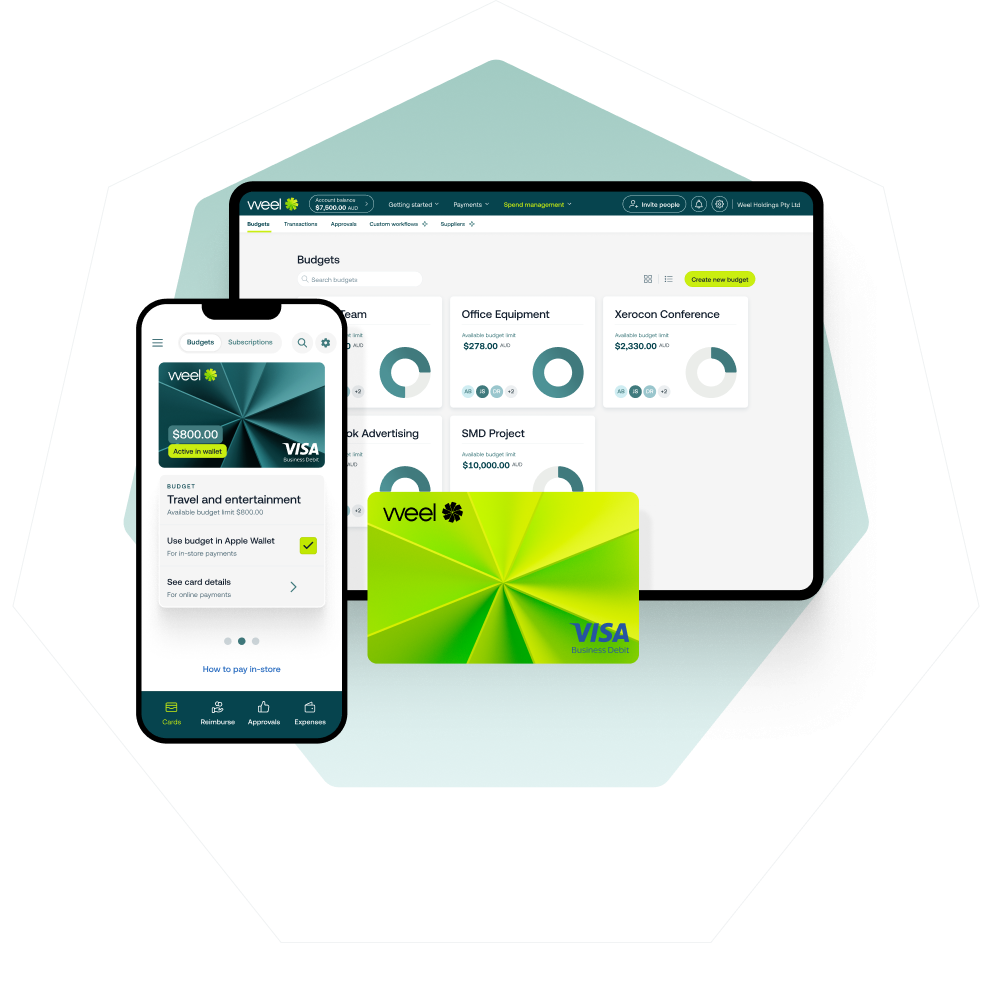
There's a third option worth knowing before you compare specific providers: a business debit card funded against a pre-set budget, rather than a credit facility at all. It doesn't extend credit or charge interest, because every dollar spent is money the business already has, not borrowed against a limit. What it does offer is the same real-time control and centralised reporting most businesses are really shopping a credit card for in the first place. Weel's own card falls into this category, not the charge or revolving-credit models above. If what you actually need is a revolving facility to manage cash flow timing, a debit-based card won't do that job. If what you need is control over who spends what without carrying company debt, it's worth weighing against the credit options above before you decide.
Work out how much control you actually need

Before comparing rewards rates or annual fees, answer one question. Does your business need real-time budget control as spend happens? Or is a single card with a monthly statement enough?
A sole trader with predictable costs doesn't need the same setup as a business with ten employees buying software, travel and supplies. As headcount grows, the real cost is rarely the card's annual fee. It's the hours your finance team spends chasing receipts and reconciling statements line by line. It's reissuing rules every time someone new joins the team.
If your business already relies on more than one or two cards, control becomes the deciding factor. That comes before any comparison of rewards or interest rates.
Picture two businesses spending roughly the same amount each month. The first hands out three physical cards and relies on staff to keep receipts and email a monthly summary. The second sets individual limits per cardholder. It requires a receipt and category before any transaction clears, with a real-time view of spend as it happens. Both spent the same money. Only one of them knows exactly where it went without a week of chasing at month end.
Decide how much rewards should matter
Rewards points and cashback are the easiest thing to compare. They're often the least important. A card with a $395 annual fee and generous points only pays off if your spend volume and redemption habits clear that cost. Run the numbers before the rewards rate decides anything.
For most growing businesses, the more valuable trade-off is rewards against control. A card program with real-time spend limits and instant card freezing prevents far more cost than any points program earns back. That's especially true once more than one person is spending on the business's behalf.
Businesses with high, predictable spend in a narrow set of categories, fuel, travel, software subscriptions, are the ones where rewards genuinely add up. Everyone else should weigh control higher than points.
Here's a quick way to check whether a rewards card pays for itself. A card charging a $395 annual fee needs to return at least $395 in redeemed value to beat a no-fee card outright. Say your business spends $8,000 a month on card purchases and earns one point per dollar, redeemable at roughly 0.7 cents each. That's close to $670 a year in rewards value, enough to clear the fee with room to spare. Drop that monthly spend to $3,000 and the same card only returns around $250 a year, less than the fee itself. Run this maths against your own spend before assuming a premium card is worth it. Weigh the time spent tracking and redeeming points against what it actually saves.
Understand how interest actually factors in
Interest rates matter far less than comparison tables suggest, provided your business pays the balance in full each cycle. Most business credit cards charge interest only on unpaid balances carried past the due date. A business that clears its statement every month rarely pays a cent of interest, regardless of the advertised rate.
The calculation changes for a business that regularly carries a balance. If cash flow means the card sometimes doesn't get paid off in full, the interest rate becomes one of the most important numbers on the page. It can cost far more over a year than any annual fee or rewards program is worth. In that case, prioritise the lowest ongoing interest rate over rewards entirely. Or look at a charge card structure that forces full repayment each cycle, removing the temptation to carry a balance at all.
Check how it fits your accounting software
A business credit card that doesn't sync cleanly to Xero, MYOB or NetSuite creates a second job. Someone has to manually re-enter transactions, match receipts to statement lines and correct GST codes by hand every month. This is the detail most comparison guides skip entirely.
Before choosing a card, confirm three things. Do transactions sync automatically, or require a manual export? Is GST coded correctly without your finance team touching it? Does the sync happen continuously, or only after your statement closes at month end? A card that "integrates with Xero" in its marketing but only offers a monthly CSV export isn't solving the problem you actually have.
Ask specifically what happens to a receipt once it's captured. Some providers stop at storing an image against the transaction. Your team still has to manually match it to the right expense category and cost centre later. Others code the GST, category and description automatically at the point of spend. The transaction lands in your accounting software ready for reconciliation, not as a pile of line items to sort through at month end. That difference alone can be the gap between a close that takes an afternoon and one that takes a week.
Match the card to your business stage
Sole trader or single-owner business: one card with a sensible limit and straightforward expense tracking is usually enough. Look for low fees and a clean mobile experience over a large rewards program. A fast, simple application process matters more here than a long list of card perks you're unlikely to use at this scale.
Growing team (5 to 50 people): this is where centralised control starts to matter. You need individual card limits per employee and real-time visibility into who is spending what. You also need an approval workflow that doesn't depend on someone manually checking a spreadsheet.
Multi-entity or multi-location business: look for consolidated reporting across entities and the ability to set different policies by team or location. Find a provider that can issue cards fast as new people join, not one with a multi-week application process for every new cardholder.
Decide how many cards you actually need and what policy governs them
Once you've worked out control, rewards and accounting fit, the next question is practical. How many cards, and who sets the rules on each one? A single shared card feels simple at first. It becomes a liability once more than one person needs to spend, since there's no way to see who made a given purchase without asking.
The safer default is one card per person who genuinely needs to spend on the business's behalf. Give each one its own limit set by role, rather than a single blanket limit shared across the team. A sales team member travelling regularly needs a different limit and category rules to someone buying office supplies once a month. Decide this upfront, rather than issuing identical cards to everyone and sorting out policy later.
It's also worth deciding how quickly a new card needs to be issued when someone joins the business. Decide how fast an existing card can be frozen if something looks wrong, too. Providers vary enormously here. Some take days to issue a physical card and have no way to instantly lock one. Others issue a virtual card in minutes and let you freeze it from a phone the moment you spot unusual spend.
Common mistakes when choosing a business credit card
The most common mistake is optimising for rewards before checking whether the card fits how the team spends money. A generous points program doesn't offset hours lost to manual reconciliation every month.
The second is assuming a card that works for a sole trader will still work once the business hires its fifth or tenth employee. Card programs that felt simple at a small scale often become the biggest source of manual admin as a team grows. Approvals, coding and reconciliation all scale with headcount.
The third is treating "accounting integration" as a single checkbox. Check exactly what syncs, how often, and whether GST coding happens automatically or needs a person to fix it every time.
The fourth is issuing identical cards and limits to everyone regardless of role. Months later, half the team has a limit too high for what they actually spend, and the other half is constantly asking for exceptions. Setting limits by role from the start avoids both problems.
How growing Australian businesses use Weel for business credit cards
Weel issues corporate cards with spend limits set before money moves, not after. Every transaction requires a receipt and category before it clears. Weel's AI agents complete the coding, GST and description on eligible transactions automatically, so expenses arrive in Xero, MYOB or NetSuite already coded and approved.

Across Weel platform data, half of all card transactions are fully approved within 24 hours. Over 90% reach full manager approval, covering the complete workflow from receipt to sign-off, not just the receipt capture step. More than 4,000 Australian and New Zealand businesses run their corporate cards through Weel today, from single-owner businesses through to multi-entity organisations issuing cards to dozens of people.
New cards issue in minutes rather than days, with limits set per employee from the start. Any card can be frozen instantly from the app the moment something looks wrong. Fast issuance, individual limits and instant control turn a card program from an admin burden into something your finance team barely has to think about once it's set up.
If you want to compare specific providers side by side, see our corporate card comparison. If your team is spread across locations or needs cards for a single supplier or project, our guide to virtual corporate cards covers that setup.
Conclusion
The right business credit card matches how your business spends money today, and how it's likely to grow. It isn't the one with the highest rewards rate. Work through control, cost and accounting fit first, and the comparison between specific providers gets a lot shorter. Most businesses spend more time picking a card than they do reviewing whether it's still the right fit a year later, so it's worth revisiting this decision as your team and spend grow, not just when the card first gets issued. There are dozens of business credit cards Australia banks and fintechs currently offer. Narrowing that list starts with the questions above, not a spreadsheet of every rewards rate on the market. See how Weel's cards close that loop automatically. Book a Weel demo.