




A prepaid card, a credit card and a business debit card look identical at checkout. Underneath, they run on three completely different fund mechanics. Most comparison guides skip straight past this and jump to which bank or provider to pick.
That's the wrong order. Once you know which mechanic actually fits how your business spends, the provider comparison gets a lot shorter.
What is a business debit card?
A business debit card draws directly from money the business already holds in a linked transaction account or a pre-set budget. There's no credit facility and no borrowing involved. Every dollar spent is a dollar the business has, not a dollar owed later.
That distinction changes how the card behaves day to day. Because a debit card can't extend credit, there's no interest charged and no repayment cycle to manage. Some business debit cards, including those from Australia's major banks like NAB, CommBank, ANZ and Westpac, are simply a card attached to an existing everyday transaction account.
Others are funded against a pre-set spend limit set before the card is used at all. That gives the business real-time visibility into what's been spent as it happens, rather than a statement that arrives weeks later.
Most business debit cards run on the Visa or Mastercard network, so they're accepted anywhere a credit card would be. The difference is invisible at the checkout. It shows up entirely in what happens behind the scenes, in how the transaction is funded and how much control the business has over it before the money moves.
Whichever type a business chooses, the Australian Taxation Office still expects the same standard of record-keeping for GST and deductions. Prepaid, credit and debit transactions all need to be traceable back to a genuine business expense. The difference is how much manual work that traceability costs each month, not whether it's required.
How a business credit card differs

A business credit card is a credit facility issued to the company. It's a revolving line of credit or a charge account, not money the business already holds. Every dollar spent is technically borrowed against a limit, then repaid on a billing cycle.
That structure has genuine upside. A business with uneven cash flow can use a credit card to smooth timing between paying suppliers and collecting revenue. Consistent, on-time repayment also builds a credit history tied to the business itself, which matters if the business wants to raise finance later. Rewards points and cashback programs are common on credit cards and rare elsewhere — a handful of debit products offer limited cashback, but it's the exception rather than the rule.
The trade-off is that a credit facility carries interest if the balance isn't cleared in full, and it usually requires a credit check on the business or its directors before approval. A business that regularly carries a balance needs to weigh the interest rate closely. One that never carries a balance rarely pays a cent of interest, but still takes on the credit check and approval process just to get the card.
How a prepaid business card differs
A prepaid business card sits closer to debit than credit, but with one key difference: it's loaded with a fixed amount in advance, rather than drawing from a live linked account. Once the loaded balance runs out, the card stops working until it's topped up again.
That makes prepaid the lowest-risk option of the three. There's no credit exposure, and the most a business can lose on any single card is whatever was loaded onto it. That's why prepaid cards suit capped, one-off spending well. Think of a contractor working a single project, a marketing budget for one campaign, or gifting a fixed amount to a team member without handing over ongoing account access.
The trade-off is reload friction. A prepaid card that runs dry mid-purchase needs manual topping up before it works again, which is a poor fit for regular, ongoing business spend across a growing team.
Prepaid vs credit vs business debit card, at a glance
Prepaid
Loaded with a fixed amount in advance, a prepaid card needs no credit check and charges no interest, and it won't build a business credit history. Spend is capped at whatever's loaded, which makes it best suited to one-off or capped spend.
Credit
A business credit card is funded by borrowing against a credit limit, so a credit check is required and interest applies to any balance left unpaid. It does build a business credit history, with spend governed by a set limit and billed monthly best suited to cash flow timing and rewards.
Business debit
A business debit card draws on money the business already holds, usually with no credit check and no interest charged, though it won't build a business credit history either. Spend is controlled before it happens, in real time, making it best suited to ongoing team spend, control and reconciliation.
Picture three businesses, each spending roughly $10,000 a month across their team. The first runs a credit facility and pays it off in full each cycle. It earns rewards, but someone still has to wait for the statement to close before reconciling a month of spend in one sitting.
The second runs prepaid cards for a handful of contractors. It caps risk neatly, but someone spends part of most weeks topping up cards that have run dry.
The third runs debit-funded cards with limits set per person in advance. Nobody waits for a statement or a reload. The transaction either fits the budget and clears, or it doesn't.
All three spent the same money. Only one of them knows exactly where it went without a week of admin at either end of the month.
When a credit card is the right call
A business credit card earns its place when cash flow timing genuinely matters. If revenue and supplier payments don't line up neatly, a short-term credit facility buys breathing room without disrupting the business day to day. It also makes sense for a business actively building a credit history ahead of a future finance application. The same goes for a business with high, predictable spend in categories like travel or fuel, where rewards genuinely add up over a full year.
None of that applies if the business already holds the cash it needs and simply wants control over who spends it. In that case, the credit facility is solving a problem the business doesn't have, while adding a credit check and an interest calculation the business didn't need either.
When a prepaid card is the right call
Prepaid earns its place for spend that's genuinely capped and short-lived. A single project budget for a contractor, a one-off campaign spend, or a gift card issued to someone outside the usual approval chain are all good fits. The fixed load amount caps risk to exactly that number, with nothing more exposed.
It's a poor fit for a growing team's everyday spend. Reloading a card every time it runs dry adds a manual step your finance team has to chase every week, for spend that's ongoing rather than one-off.
When a business debit card is the right call
A business debit card earns its place once control and reconciliation speed matter more than credit access or rewards. That's most growing businesses issuing more than one or two cards. The funding is real, not borrowed, and the limit is set before spend happens. That gives a finance team the same real-time visibility a credit facility promises, minus the credit check, the interest calculation and the monthly billing cycle sitting between the transaction and the books.
Which is right for your business?
Answer these questions before comparing specific providers. Does the business already hold the money it needs, or does it need to borrow against future revenue? Is the spend ongoing across a team, or capped to a single project or event? Does the business want to build a credit history, or does it already have financing sorted? Is the priority controlling spend as it happens, or smoothing cash flow timing? And will more than one person be issued a card, with someone needing to see all of it in one place?
A business answering "borrow against future revenue" and "smoothing timing" points toward credit. One answering "capped, one-off" points toward prepaid. A business answering "already holds the money" and "controlling an ongoing team" points toward debit.
How growing Australian businesses use Weel for business debit cards

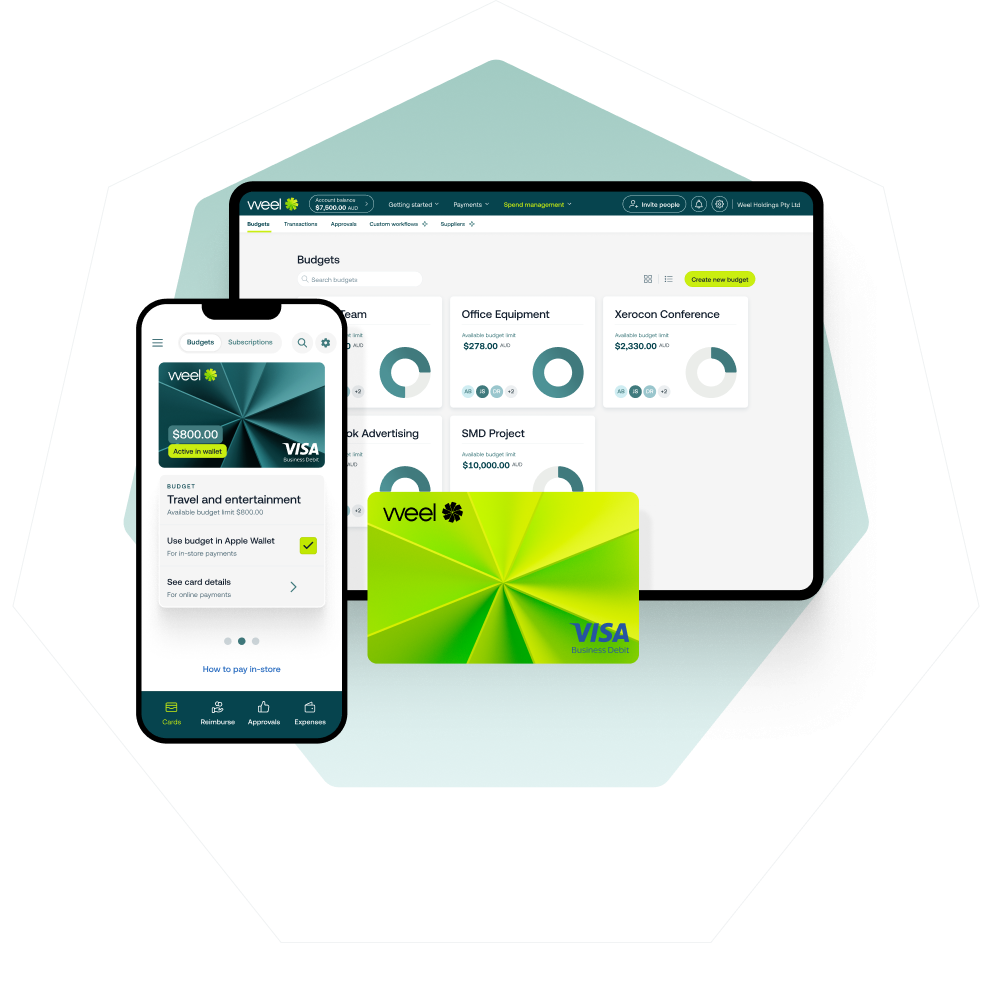
Weel issues debit-funded corporate cards against a pre-set budget, not a credit facility. Every transaction requires a receipt and category before it clears, and budget limits are set per person before a single dollar moves, not reviewed after the fact on a monthly statement.
Across Weel platform data, half of all card transactions are fully manager-approved within 24 hours, and over 90% reach full manager approval covering the complete workflow from receipt to sign-off. More than 4,000 Australian and New Zealand businesses run their card programs through Weel today.
Because there's no credit facility involved, there's no interest, no credit check on approval and no monthly billing cycle sitting between a transaction and the books. Cards issue in minutes with individual limits set from day one, and any card freezes instantly from the app the moment something looks wrong.
Transactions land in Xero, MYOB or NetSuite already coded, so your finance team spends month-end closing the books instead of reconciling a stack of statements against a card program nobody fully controlled.
If a credit facility genuinely fits your business, our decision framework for choosing a business credit card covers control, cost and accounting fit in more depth. If you want to compare specific providers side by side, our corporate card comparison does that directly.
Conclusion
Prepaid, credit and debit solve three different problems: capped one-off spend, cash flow timing, and ongoing team control. Work out which one your business actually has before comparing a single provider, since most growing teams find it's control and reconciliation speed, exactly what a debit-funded card program is built for. See how Weel's debit-funded cards close that loop automatically. Book a Weel demo.