



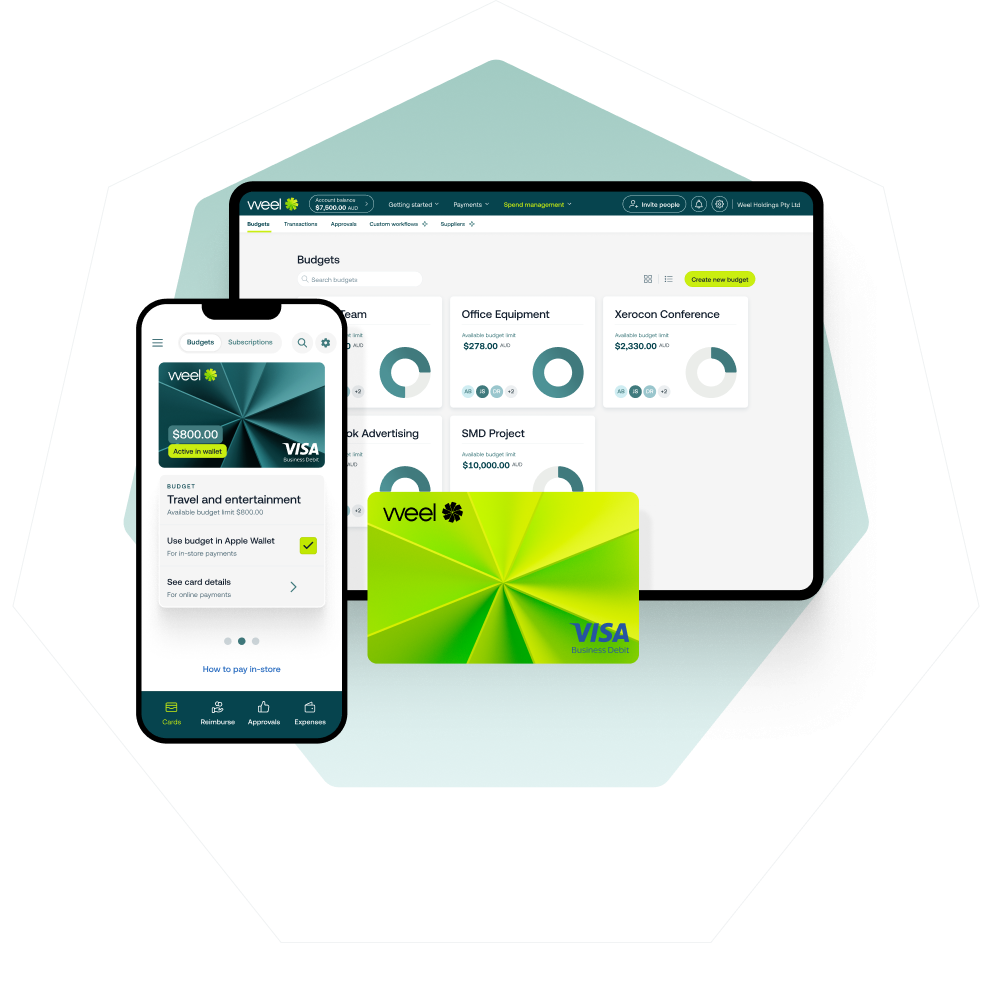



If you're running finance for a growing Australian business, a virtual credit card gives your team instant control over every dollar spent, without the admin overhead of traditional corporate cards. This guide covers how virtual cards actually work day-to-day, what makes them different from physical cards, and how to choose the right virtual card platform when your finance team is one, two, or three people.
What is a virtual credit card?
A virtual credit card is a digital card number you issue instantly from a platform, without waiting for a physical card to arrive in the post. Each card has its own 16-digit number, expiry date, and CVV. You create one in seconds, assign it to a specific person, project, or vendor, and set spend limits before anyone clicks "buy."
In Australia, virtual cards are issued on the Visa or Mastercard network, so they work anywhere those networks are accepted online. For in-store purchases, add the virtual card to Apple Pay or Google Pay and tap at any contactless terminal.
There are two main types. Multi-use cards stay active for ongoing spending (think recurring subscriptions or regular supplier payments). Single-use cards lock after one transaction, which makes them ideal for one-off purchases or free trials where you don't want surprise renewals.
For a full breakdown of what virtual corporate cards are and how they compare to physical cards, read our guide to virtual corporate cards. This article focuses on the practical side: how you'd actually use them and what to look for when choosing a provider.
How virtual cards work day-to-day for small teams

The difference between a virtual card platform and a traditional company credit card isn't just the format. It's the daily workflow. Here's what changes when a small finance team switches to virtual cards.
Issuing cards on demand
Your team needs a new card for a software subscription, a contractor's travel booking, or a one-off supplier payment. With a virtual corporate card, you issue one in under a minute. No procurement forms. No waiting days for a card in the post.
Instead of sharing one company card across the office (and spending hours untangling transactions later), you create a dedicated card for each purpose. Every transaction is pre-assigned to the right person and category from the start.
Setting spend limits and merchant locks
Every virtual card carries its own spend limit. Set a cap before the card goes live. If someone tries to spend above it, the transaction declines automatically.
Merchant category locks add a second layer. Lock a card to a specific vendor type (software, travel, office supplies) and it will only work at those merchants. No surprises on the statement.
For a team of one or two finance people, this replaces the need for a manual approval step on every purchase. The controls are built into the card itself.
Single-use cards for subscriptions and one-off payments
Single-use virtual cards close after one transaction. They're particularly useful for free trials (no risk of unwanted renewals), vendor deposits, or any purchase where you want a clean paper trail.
For subscriptions, issue a dedicated virtual card per vendor. If you cancel the subscription, freeze the card. No more charges slipping through after cancellation.
Real-time visibility across every card
Every transaction hits your dashboard the moment it clears. No waiting until month-end to find out who spent what. Your finance team sees spend as it happens, with the merchant name, amount, and category attached automatically.
This real-time view is the difference between reacting to spend at month-end and controlling it as it happens.
What to prioritise when choosing a virtual credit card in Australia

Not every virtual card platform is built for small finance teams. Some are designed for 50-person finance departments with dedicated card-ops people. Others are built for lean teams who need spend control without creating queues.
Here's a decision framework for what to look for when you're the person (or people) responsible for all of finance.
1. Setup speed and instant card issuance
How quickly do you go from sign-up to issuing your first card? For a small team, anything longer than a day is a red flag. The whole point of virtual cards is speed. If onboarding takes weeks, the card programme is already adding admin instead of removing it.
Look for providers that offer an online credit card issuance process with instant approval, not a paper-based application that takes a week to clear.
2. Controls without approval bottlenecks
A lean finance team needs spend controls that work without creating a queue. Look for:
- Per-card spend limits (not just account-wide limits)
- Merchant category restrictions
- Automatic policy enforcement at the card level
The goal: your team sets the rules once, and the platform enforces them on every transaction. No one waits on an approval chain for a $50 office supply purchase.
Across 4,000+ businesses on Weel, over 90% of card expenses reach full manager approval (90.5%, across 3.9M transactions). That figure reflects teams where controls are baked into the card, not layered on as a manual step.
3. Receipt capture and coding
This is the part that consumes small finance teams. If your team spends every Friday chasing receipts, your virtual card platform isn't doing its job.
Look for automatic receipt matching, mobile capture, and the ability to attach receipts at the point of spend. The ATO requires businesses to keep records of all business transactions, so a platform that captures and stores receipts automatically removes a significant compliance burden.
4. Accounting sync (Xero, MYOB, or your system of record)
The most important question for a small finance team: does this platform push coded, approved transactions directly into your accounting software?
If you're on Xero or MYOB, check whether the sync is one-way (card to accounting) or two-way. Two-way sync means your GL codes stay consistent across systems, and reconciliation happens continuously instead of in a monthly batch.
On Weel, the median time from card swipe to accounting sync is 2.3 days (across 2.5M exported transactions). That's not month-end reconciliation. That's reconciliation that's already done before you sit down to close the books.
5. Security and digital card controls
Look for SOC 2 Type II certification, PCI-DSS compliance, and two-factor authentication as baseline requirements. Beyond those, check whether you can freeze, cancel, or adjust a card's limits instantly from the platform.
For a side-by-side comparison of specific Australian providers and their features, see our corporate card comparison table.
Common mistakes small finance teams make with virtual cards
Sharing a single card across the team
One shared card number means one tangled transaction history. Every purchase lands under the same account, and someone has to sort through the statement line by line. Issue individual cards instead. Each person gets their own card, and every transaction is automatically attributed to the right team member.
Not setting merchant locks
Spend limits alone don't prevent off-policy purchases. A team member with a $500 limit on a travel card could spend it at a restaurant instead. Merchant category locks close that gap by restricting where the card works, not just how much it spends.
Ignoring the accounting integration
A virtual card platform that doesn't sync with your accounting software creates a separate data island. Your team ends up doing the same manual reconciliation work, just from a different source. Always check the integration before you sign up.
How Australian businesses use Weel for virtual cards
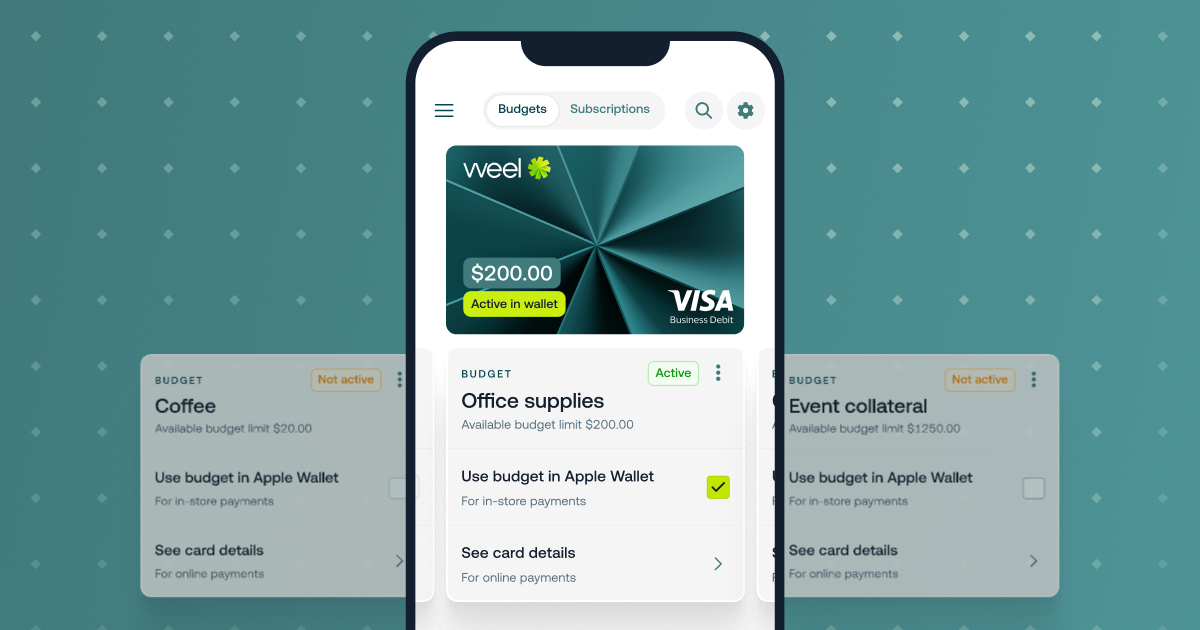
For a finance team of one, two, or three people, the daily reality of managing cards, receipts, and approvals is different from what a large finance department handles. You don't have a dedicated card-ops person. You don't have someone whose only job is chasing receipts.
Weel's virtual cards are built for that reality. Issue a new card in seconds, with spend limits and merchant locks already in place. Every transaction flows through a single dashboard with real-time visibility into who spent what, where, and why.
Here's how the Weel Loop works for virtual card spend:
- Card issuance: From weeks of requesting, approving, and posting a physical card to instant. New cards are ready in seconds.
- Spend controls: From manual policy documents and an honour system to per-card limits and merchant locks, enforced automatically.
- Receipts: From a Friday afternoon chase to captured at the point of spend.
- Approval: From email chains and reminders to auto-routed. Half of all card transactions are fully manager-approved within 24 hours.
- Accounting sync: From month-end batch reconciliation to continuous. Median time to accounting sync: 2.3 days.
Businesses using Weel's approval workflows reach 95% expense completion (94.8%, across 1.38M transactions from 951 businesses). That's a 7-point lift over businesses without structured approval workflows.
For the team running finance without a dedicated card-ops function, that's the difference between closing the month with confidence and closing it with crossed fingers.
Get started with virtual cards for your team
Virtual credit cards give small Australian finance teams real-time control over company spend, without the manual overhead of traditional card programmes. The right platform issues cards instantly, enforces controls automatically, and syncs every transaction to your accounting software without a month-end scramble.
If your team is still sharing one company card or chasing receipts every Friday, take a product tour of Weel to see how virtual cards work when everything closes automatically.