



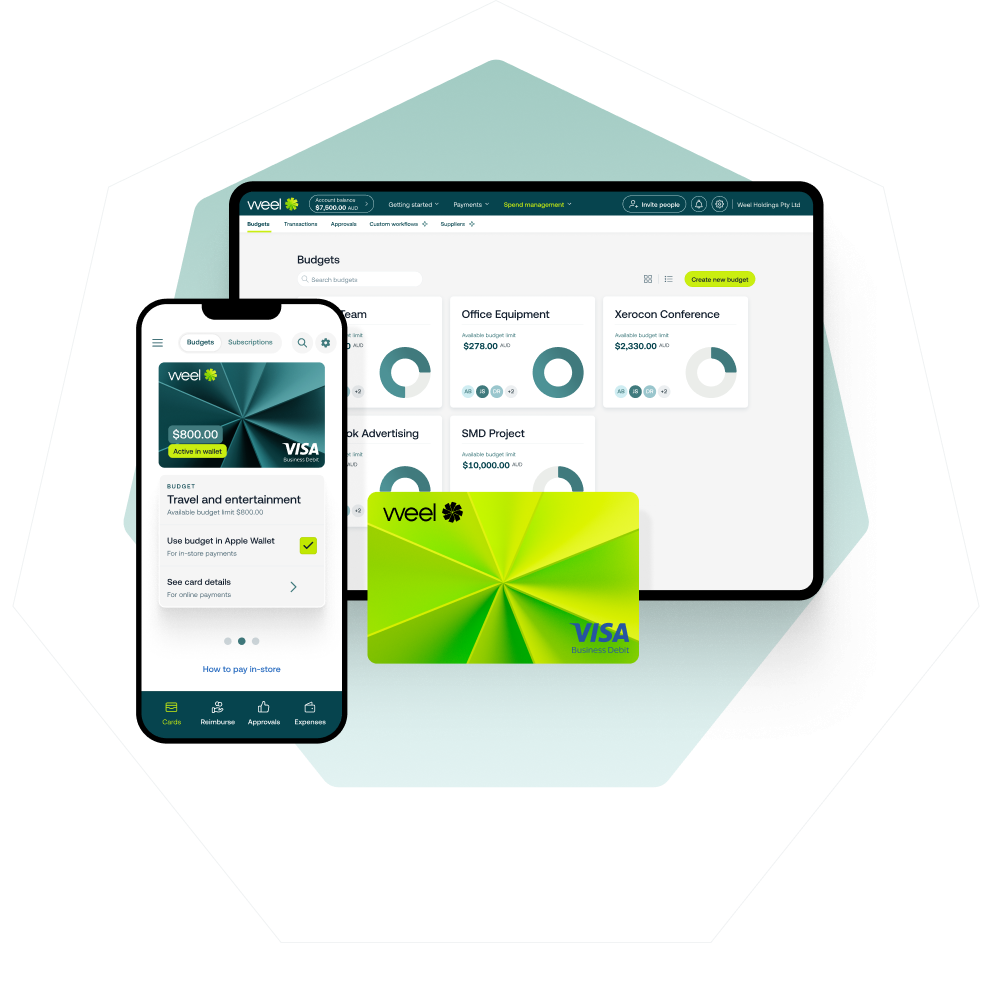



Not every virtual card provider delivers on all four of those things. Some issue a digital card number as an add-on to an existing corporate card programme, with visibility still running on the same monthly statement cycle as the physical card. Others treat the card, the policy, and the reconciliation as one connected system. This guide breaks down what actually matters for real-time tracking, how to test a provider against it, and where Weel fits.
What is a virtual corporate card?
A virtual corporate card is a card number issued digitally rather than printed on plastic. It sits inside a spend management platform, gets assigned to a person, team, or vendor, and can be created, limited, or shut down in seconds. Finance teams use virtual cards to control who can spend, how much, and where, without waiting for a physical card to arrive in the mail.
Unlike a shared company credit card number passed between people, a virtual card is typically issued per use case: one for a specific software subscription, one for a contractor, one for a marketing campaign with a fixed budget. Each card carries its own limit, its own category, and its own paper trail back to the person and purpose it was created for.
For Australian businesses, virtual cards usually run on the same card networks as physical corporate cards (Visa or Mastercard), so they work anywhere a card number is accepted online, and increasingly in person through mobile wallets.
Why real-time tracking is the real decision criteria

Most virtual card providers will claim visibility. Few deliver it in a form a finance manager can actually act on the moment spend happens. That gap is where an evaluation should start.
Real-time tracking sounds like one feature. It is actually four separate capabilities, and a provider can offer one without the others.
1. Transaction visibility
Does a transaction appear on a dashboard the moment it clears, or only after an overnight batch file updates? Some platforms post transactions live; others rely on end-of-day settlement, which means a finance manager is always looking at yesterday's spend, not today's.
2. Spend notifications
Does the platform alert the cardholder and the finance manager immediately when a transaction happens, gets declined, or breaches a limit? Notification speed decides whether unusual spend is caught in the moment or discovered weeks later in a statement review.
3. Live dashboards
Is spend data available in a dashboard that updates continuously, broken down by team, project, or cost centre? A live dashboard turns raw transaction data into something a finance manager can act on directly, without exporting anything to a spreadsheet first.
4. Reconciliation speed
How long does it take from transaction to a fully coded, approved, receipt-matched expense record? This is the criterion that most directly affects month-end close. A virtual card that shows a transaction instantly but takes two weeks to reconcile has only solved half the problem.
How virtual card providers compare on these criteria
Not every provider treats these four capabilities as connected. Some banks issue virtual card numbers as an add-on to an existing corporate card programme, with tracking still limited to the same monthly statement cycle as the physical card. The card is virtual in issuance only; visibility still runs on old rails.
Dedicated spend management platforms tend to separate on two things: whether policy and approval logic run automatically at the point of transaction, or get applied afterwards in a review cycle; and whether reconciliation happens inside the same system that issued the card, or in a separate expense tool that needs data imported or matched by hand.
The practical difference shows up in three places a finance manager should test directly, not take on faith:
- Time to see a transaction. Ask for a live demo and watch a test transaction post. Seconds and minutes are different from hours.
- Time to full approval. Ask what percentage of transactions get approved within 24 hours, not what the platform is capable of in theory.
- Time to close the books. Ask how reconciliation actually happens at month-end: automatically, or with a finance team manually chasing missing receipts.
A decision framework for finance managers

When evaluating a virtual corporate card for real-time tracking, run it against five questions:
- Does spend show up live, or on a delay? Confirm whether transactions post to a dashboard immediately or through a batch feed.
- Is policy enforced at the point of spend, not after? A card that blocks or flags a transaction against policy in real time prevents a problem. A card that flags it in a monthly report only documents one.
- Does approval routing happen automatically? Manual approval chains slow reconciliation and bury finance managers in follow-up. Automated routing by amount, category, or cost centre keeps approvals moving without a person pushing every transaction through by hand.
- Can cards be issued, limited, and shut down instantly? Real-time control over spend requires real-time control over the card itself, not a support ticket to a bank.
- Does the platform close the loop on reconciliation, or hand that work to a separate system? Check whether receipt matching, coding, and export to accounting software happen inside the same platform that issued the card.
A provider that scores well on all five gives a finance manager a live, accurate picture of company spend at any point in the month, not just at close.
How Weel stands out
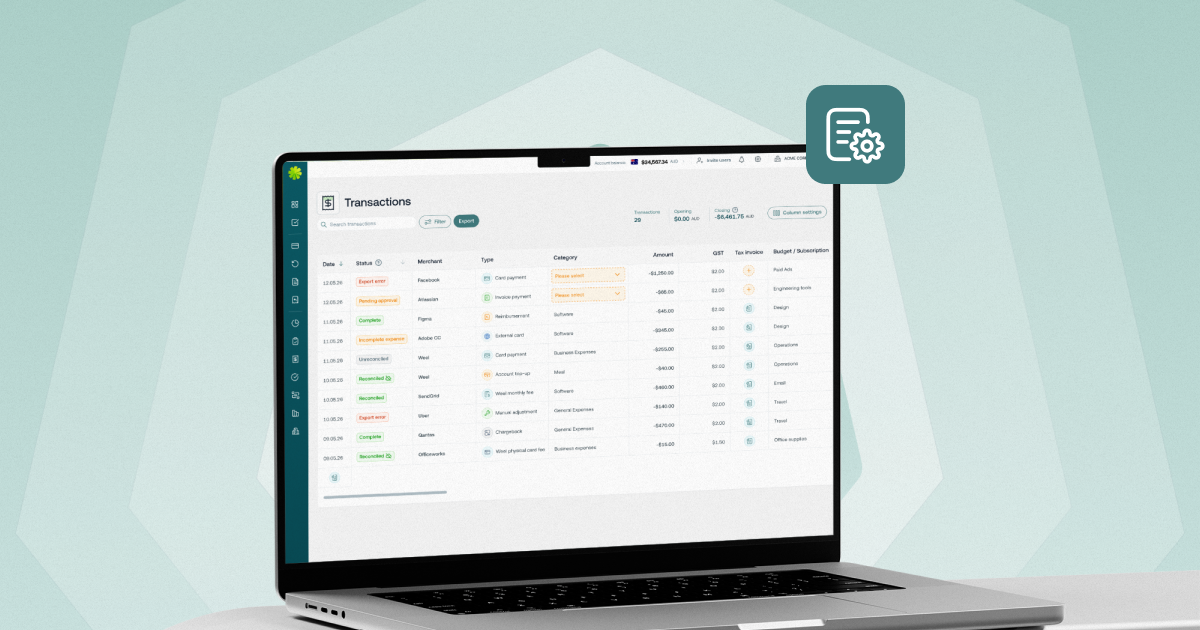
Weel's virtual cards run policy enforcement and approval routing in real time, at the point of transaction, not as a report generated after the fact. That structural difference is behind the numbers.
Across Weel's own transaction data: 44% of expenses are manager-verified within one hour of the transaction happening. Half of all card transactions (50.0% of all 3.9 million cleared transactions) reach full manager approval within 24 hours. Over 90% of card expenses (90.5%) reach full manager approval, and the median expense takes just 8 hours from transaction to approval.
That speed comes from one system issuing the card, applying the policy, and closing the reconciliation loop, not three systems that need to be reconciled against each other. Finance managers using Weel's corporate cards see spend the moment it happens, and finance teams pairing cards with expense management get receipts, coding, and approval status in one live view, not a separate export.
More than 4,000 businesses run their card spend through Weel on this basis: not a virtual card bolted onto an existing bank account, but a system built so real-time tracking is the default, not a feature request.
The bottom line
A virtual corporate card is only as good as the visibility and control it gives a finance manager the moment money moves. The right choice shows every transaction live, enforces policy automatically, routes approvals without manual chasing, and reconciles without a month-end scramble. Test any provider against those four things before signing. The marketing will all sound similar, but the transaction feed won't lie. Book a demo to see how Weel's virtual cards handle real-time tracking end to end.