






Disclaimer: This article provides general information only and is not tax or financial advice. Tax obligations vary by business type and circumstance. We recommend consulting a registered tax agent or visiting ato.gov.au for guidance specific to your situation.
Updated September 2026 - If your business still runs on personal cards and reimbursements, a corporate card gives you something personal cards never will: total visibility over every dollar your team spends. If you're searching for corporate credit cards, what you're usually after is tighter spend control, not necessarily a credit facility. Before you apply, you need to know what providers look for, what features actually matter for a growing SME, and how the application process works. This guide covers all of it, including whether a credit card is even the right funding model for your business.
What is a corporate card?
A corporate card is a payment card issued to a business, not an individual, that your team members use for company expenses. Unlike a personal credit card, the business owns the account, sets spending limits, and receives a single consolidated statement.
Corporate cards come in several forms:
- Charge cards, paid in full each billing cycle.
- Corporate credit cards, which draw on a line of credit extended by the bank and carry interest on any balance not paid off.
- Prepaid cards, loaded with a fixed balance in advance.
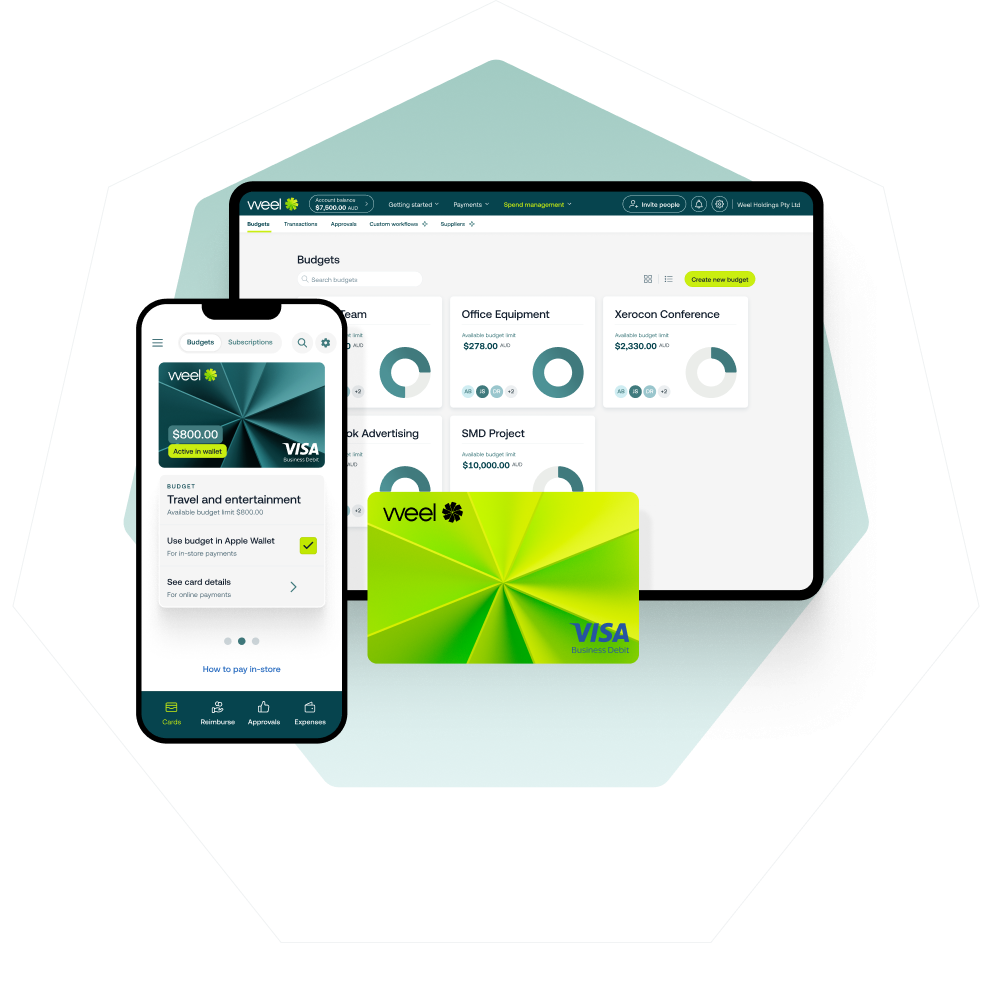
- Debit-based corporate cards, like Weel, which draw directly from the business's own bank account or a dedicated pre-funded balance rather than a credit line.
The key difference from using a personal card for business: with a corporate card, the company controls the spending parameters, sees transactions in real time, and owns the data. No waiting for people to submit receipts or claim reimbursements months later.
For a deeper look at how virtual cards work and when they make sense, see our guide to virtual corporate cards.
Corporate credit cards vs debit-based cards: which actually gives you control?
Which corporate card platform suits growing businesses needing tighter spend control?
Growing businesses don't need a credit facility to get tighter spend control. A debit-based corporate card platform like Weel gives real-time visibility, enforced approval workflows, and automatic receipt capture, without extending credit or adding debt risk to the business. On Weel, over 90% of card expenses reach full manager approval (90.5%), and half of all card transactions are fully manager-approved within 24 hours. Cards draw directly from the business's own balance, so there's no credit line to manage, no interest, and no debt sitting on the books.
A corporate credit card draws on a line of credit extended by a bank. The business spends first and repays later, which creates short-term float and often supports point-based rewards or travel benefits. It also creates real exposure: unpaid balances accrue interest, credit limits need managing, and the business carries debt every month the cards are in use.
A corporate debit card, and platforms like Weel that are built entirely on debit, draw from money the business already has. That's typically a connected bank account or a dedicated pre-funded balance. There's no credit line, no interest, and no debt sitting against the business.
What growing businesses are usually searching for when they look at "corporate credit cards" is approval controls before spend happens, real-time visibility, and automatic receipt capture. That control comes from the platform layer, not from the credit facility itself.
Rewards and short-term float are a genuine trade-off some businesses value. A business rewards credit card, or business credit cards with rewards points attached, suits a business whose spend is mostly travel or supplier payments on terms. But for a growing business whose main problem is a lack of visibility and control, taking on a credit facility isn't a prerequisite for solving it.
| Traditional bank credit card | Traditional bank debit card | Modern debit-based platform (e.g. Weel) | |
|---|---|---|---|
| Funding | Bank-extended credit line | Business's own bank account | Business's own funds, pre-funded balance |
| Debt/interest risk | Yes | None | None |
| Spend visibility | Monthly statement | Bank feed, after the fact | Real-time, per transaction |
| Approval controls | Manual, after spend | None built in | Enforced before spend clears |
| Receipt capture | Manual, chased after the fact | Manual, chased after the fact | Automatic |
| Accounting sync | Manual reconciliation | Manual reconciliation | Direct sync (median 2.3 days, spend to sync) |
| Card issuance | Slow, per-cardholder application | Usually tied to one account | Instant virtual cards, per team member |
For a fuller side-by-side breakdown of prepaid, credit, and debit business cards, see our guide to prepaid vs credit vs business debit cards.
Corporate card vs business credit card: what's the difference?
The terms get used interchangeably, but they serve different purposes.
A business credit card is typically issued to a sole trader, partnership, or small business owner. The business owner is personally liable for the balance. Credit limits are based on the individual's credit history. These cards are designed for businesses with one or two cardholders.
A corporate card is issued to the business entity itself. Liability sits with the company, not the individual. Credit limits are based on the company's financials, not the owner's personal score. Corporate cards are designed for multiple cardholders across teams, with centralised controls, spending limits per card, and consolidated reporting.
For growing SMEs, the distinction matters. If you have more than a handful of people making purchases, a business credit card creates a bottleneck: one card, shared credentials, no visibility into who spent what. A corporate card programme gives each person their own card with their own limits, while you retain complete control.
Commercial credit cards sit somewhere in between, often used for larger procurement purchases with extended payment terms.
What Australian SMEs need to be eligible for a corporate card
Eligibility varies by provider, but most corporate card issuers in Australia consider a common set of factors. (Note: this is general guidance only. Each provider sets its own criteria, and meeting these factors does not guarantee approval.)
Business structure and registration
Trading history
Revenue and financial position
Number of cardholders
What to check before you apply

Before choosing a provider, evaluate these five areas. The right corporate card for your business depends on more than the interest rate.
1. Spend limits and controls
Look for per-card spending limits that you set and adjust in real time. The ability to set limits at the individual card level (not just an overall account limit) gives you control over every transaction before it happens. Check whether the provider offers merchant category restrictions, so you can block spending at certain types of vendors entirely.
2. Approval workflows
If your team spends across multiple departments or projects, you need approval workflows that route spend requests to the right manager before the money leaves the account. Look for multi-level approvals (for example, purchases over $500 go to a senior manager) and delegation settings for when approvers are away.
Businesses using approval workflows reach 95% expense completion (based on Weel platform data from 1.38M transactions across 951 businesses); that is a 7-point lift over businesses without workflows.
3. Integration with accounting software
Your corporate card should sync directly with your accounting software: Xero, MYOB, QuickBooks, or NetSuite. Check whether the integration is a real-time two-way sync or a manual CSV export. Real-time sync means every transaction flows into your general ledger as it happens, cutting days off your month-end close.
Look for integrations that map GL codes, tax categories, and receipt images automatically, so your finance team is not re-entering data from card statements. A well-integrated expense management workflow turns your corporate card into a closed loop: spend, capture, approve, reconcile, done.
4. Virtual card issuance
If your team makes online purchases, pays for subscriptions, or manages ad spend, you need a provider that issues virtual cards on demand. Virtual cards give you a unique card number for each vendor or transaction, with spending limits locked to a specific amount. This eliminates the shared-card-number problem and gives you a clear audit trail.
For a full breakdown of virtual card features and use cases, see our guide to virtual corporate cards.
5. Receipt capture and expense completion
The card is only half the equation. Look for built-in receipt capture (ideally with OCR that reads and categorises receipt data automatically) and a clear workflow from transaction to manager approval to accounting export. If your team still needs to email receipts or fill in spreadsheets, the card saves time at the point of purchase but creates work everywhere else.
How to apply for a corporate card
The application process differs between traditional banks and fintech providers, but the typical steps are:
Step 1: Choose your provider and card type. Decide whether a charge card, credit card, or prepaid card suits your business. Use the evaluation criteria above to narrow your options. If you want to compare providers side by side, see our corporate card comparison.
Step 2: Gather your documentation. Most providers require:
Step 3: Submit your application. Bank-issued cards typically require an in-branch or phone application. Fintech providers usually offer an online application that takes 10 to 15 minutes.
Step 4: Verification and approval. Expect 1 to 5 business days for fintech providers, or 2 to 4 weeks for traditional banks. Some providers issue virtual cards immediately upon approval, with physical cards arriving within 5 to 10 business days.
Step 5: Set up your card programme. Once approved, configure your spending limits, approval workflows, and accounting integrations before distributing cards to your team. Getting the controls right before the first transaction means every expense is tracked and approved from day one.
Common mistakes SMEs make when choosing a corporate card
Choosing on interest rate alone. Interest rates matter for revolving credit cards, but if you pay your balance each billing cycle (as most corporate charge cards require), the rate is irrelevant. Focus on the features that save your finance team time: approval workflows, real-time reporting, and accounting integration.
Ignoring the receipt and reporting workflow. A card that captures transactions but leaves receipt collection and coding to your team creates a different kind of manual work. Look for providers where receipt capture, categorisation, and approval happen in one workflow.
Not checking integration depth. "Integrates with Xero" can mean anything from a basic CSV export to a real-time two-way sync with GL code mapping. Ask what the integration actually does before you sign up.
Defaulting to your existing bank. Your business bank may offer a corporate card, but bank-issued cards often come with minimum cardholder requirements, slower virtual card issuance, and limited spend controls compared to purpose-built corporate card platforms.
How Australian businesses use Weel for corporate cards
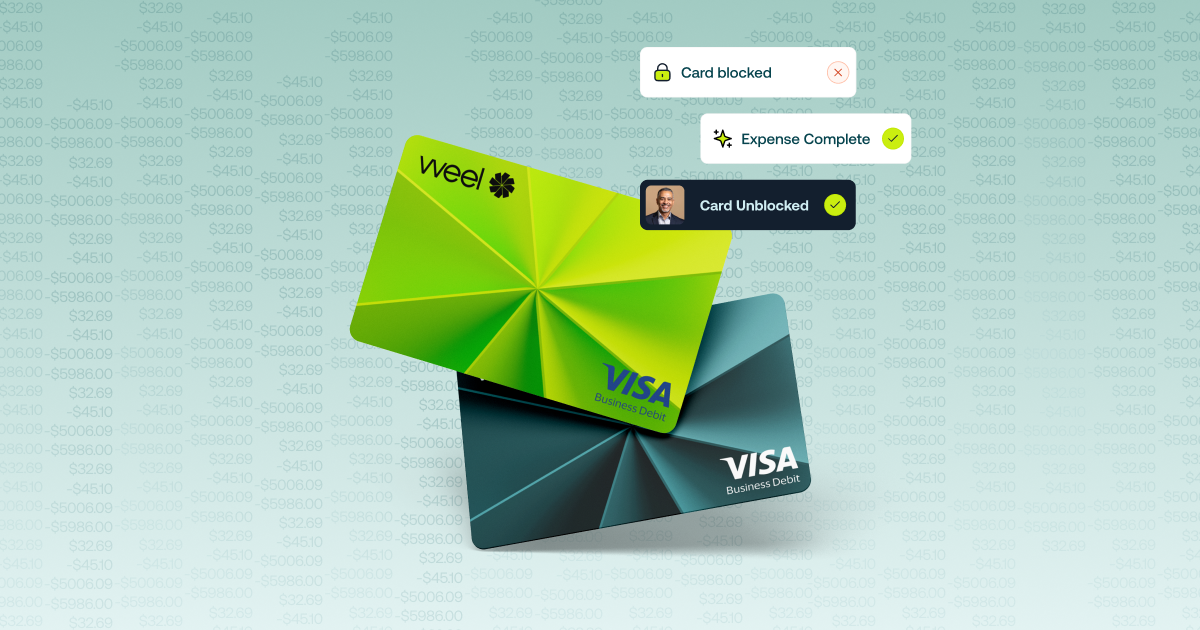
Over 4,000 Australian businesses use Weel to manage corporate card spending, from the moment a card is issued to the moment the transaction lands in their accounting software.
Here is what that looks like in practice. Your team gets physical or virtual corporate cards with individual spend limits you control in real time. When someone makes a purchase, Weel captures the receipt automatically and routes it through your approval workflow. Over 90% of card expenses reach full manager approval across the platform (based on 3.9M cleared transactions), and half of all card transactions are fully manager-approved within 24 hours.
Every transaction syncs directly to Xero, MYOB, QuickBooks, or NetSuite, with GL codes, tax categories, and receipt images attached. The median time from card swipe to accounting sync is 2.3 days across the platform (2.5M exported transactions).
For SMEs applying for their first corporate card, Weel removes the complexity that holds growing businesses back. No minimum cardholder requirements. No waiting weeks for bank approvals. Virtual cards issued instantly, physical cards in days. Every expense tracked, approved, and reconciled. Finance on Autopilot.
Book a demo to see how Weel gives your business complete control over every card expense.
Conclusion
A corporate card is one of the first financial tools a growing SME outgrows personal cards for. Knowing what to look for before you apply (eligibility, spend controls, approval workflows, accounting integration, and virtual card access) puts you in control from day one.
Start with the evaluation criteria in this guide. When you are ready to compare providers, see how Australia's top corporate cards stack up. And set up the right controls before your team's first transaction; that is the difference between a card that tracks spending and a card that completes every expense.