






Disclaimer: This article provides general information only and is not tax or financial advice. Tax obligations vary by business type and circumstance. We recommend consulting a registered tax agent or visiting ato.gov.au for guidance specific to your situation.
Managing employee expenses across a team is a different problem to managing a single reimbursement. When ten, twenty, or fifty people are spending on the business's behalf, across corporate cards, travel claims, out-of-pocket expenses, and supplier invoices, the risk isn't one forgotten receipt. It's the accumulated cost of missing policy controls, stalled approval chains, and spending patterns that nobody catches until month-end arrives.
Employee expense management is the system a finance team puts in place to control, approve, and get full visibility over how every person in the business spends. Done well, it sets clear rules before spending happens, routes every transaction through the right approval chain, and gives finance a real-time view of where money is going. This guide covers what employee expense management actually involves for a Finance Manager overseeing a team, the four pillars every effective system needs, the failure patterns that make month-end painful, and how modern tools handle the whole process automatically.
What is employee expense management?

Employee expense management is the process of controlling, recording, approving, and reconciling business spending made by your team. It covers every type of spend where an individual acts on the company's behalf: corporate card transactions, out-of-pocket reimbursements, travel bookings, and entertainment claims.
The critical distinction is that employee expense management is a system, not a folder. An expenses management system combines policy, approval workflows, and reporting to ensure every dollar spent by every person in your team is authorised, correctly coded, and reconciled without manual chasing.
For a Finance Manager overseeing a team, the challenge isn't any single expense. It's the aggregate: making sure everyone operates inside policy, that no claim slips through without the right approval, and that the month-end picture is accurate rather than assembled under pressure.
Why it matters for Finance Managers
Most businesses reach a point where "just send me the receipts" stops working. That point usually arrives well before it becomes obvious.
As headcount grows, so does the volume of claims. One person with a corporate card is manageable. Ten people spending across travel, meals, software subscriptions, and supplier invoices create a reconciliation job that consumes hours each week without a proper system. Without controls, out-of-policy spending goes unnoticed, approval chains break down, and month-end close stretches from days to weeks.
The cost is rarely dramatic. It accumulates quietly: time spent chasing receipts, errors caught too late to fix cleanly, and the nagging uncertainty that the numbers aren't quite right. The Australian Taxation Office also requires businesses to maintain accurate records for all GST claims and reimbursements, which means loose processes carry real compliance risk alongside the operational overhead.
The four pillars of effective employee expense management

1. Policy and spend limits
Every expense management system starts with a clear policy. For a Finance Manager, this means defining what the business will and won't reimburse, setting per-category spend limits, and making those rules visible to the team before they spend.
A well-structured expense policy covers:
- Approved categories (travel, meals, accommodation, equipment, client entertainment)
- Per-person and per-category spending limits
- Receipt requirements and submission timeframes
- Fringe benefits tax (FBT) treatment for entertainment and vehicle use
- What requires pre-approval versus what can be claimed automatically
Policy clarity prevents disputes and removes the awkward post-spend conversation when someone submits a claim that shouldn't have been made. It also creates the documented standard the ATO expects for GST compliance and audit readiness.
2. Approval workflows
A clear policy is only as good as the system that enforces it. Approval workflows route every expense through the right person before it's paid or coded to the ledger.
For teams with more than a handful of people, approval workflows need to account for:
- Multi-level approvals for higher-value claims
- Department or cost-centre routing, so approvals reach the correct manager
- Delegation rules when a manager is unavailable
- Automatic flagging of out-of-policy items for finance review
Businesses using structured approval workflows reach 95% expense completion rates, according to Weel platform data across 1.38 million transactions. That's a 7-point improvement over businesses with no workflows in place. That gap matters at month-end, when incomplete expenses create reconciliation gaps and delay the close.
3. Visibility and reporting
Once policy is set and approvals are flowing, the third pillar is knowing, at any moment, what your team has spent and what is still pending. Real-time spend visibility means you're not reconstructing the month from a batch of claims. You're watching it as it happens.
Useful expense reporting software gives a Finance Manager:
- Live spend by person, department, or cost centre
- Outstanding approvals and incomplete claims
- Budget versus actuals by category
- Audit trails showing who approved what and when
Spend analytics surface patterns that individual claim review misses. If one department consistently exceeds its travel budget, or a small number of people account for a disproportionate share of uncoded expenses, real-time expense report software makes that visible before it becomes a month-end crisis.
4. ATO compliance and record-keeping
In Australia and New Zealand, businesses must maintain records supporting all GST input tax credits and reimbursements. For corporate card spending, this means receipts showing the supplier, date, amount, and GST component, not just a bank statement line.
For travel and entertainment, FBT obligations apply when expenses benefit team members personally. A solid expense management system captures the right data at the point of spend, reducing the work of separating FBT-applicable items from ordinary business expenses at tax time. Maintaining complete digital records also protects the business if it's subject to an ATO review.
Common failure patterns when expenses aren't managed well
Most Finance Managers don't lose control of employee expenses all at once. The process degrades gradually, usually through one of four patterns.
No policy, or policy that nobody reads. Rules buried in a PDF nobody opens are as useful as no rules. Without policy visible at the point of spend, team members make their own judgement calls, and those judgements vary widely.
Approval chains that run through email. When approvals travel via email, they get lost, delayed, or handled inconsistently. There's no record of what was approved and when, and chasing outstanding items falls to finance.
Expenses submitted in batches at month-end. When team members hold claims until the last week of the month, finance receives everything at once and mistakes discovered late are harder to correct. Over 60% of receipts captured on the Weel platform are attached within 24 hours of the transaction, according to Weel platform data. That pattern shows what late submission costs in reconciliation time.
Visibility available only in hindsight. If the first time finance sees spending data is when the accounting export runs, there's no opportunity to intervene on out-of-policy items or close the month on time.
How modern employee expense management works
A modern expense management system replaces manual processes at every step. Rather than collecting receipts at month-end, it captures them at the moment of spend: via mobile app, corporate card swipe, or direct supplier integration. That makes it business expense tracking software with a complete audit trail, not a receipt folder with a spreadsheet attached.
The workflow:
- A team member makes a purchase (corporate card swipe, out-of-pocket claim, or supplier invoice)
- A receipt is captured automatically or via mobile app at the point of spend
- The system applies AI-assisted categorisation and coding against the expense policy
- The claim routes through the configured approval chain automatically
- Approved expenses sync directly to the accounting software: Xero, MYOB, or NetSuite
- Finance has a live view of approved, pending, and incomplete items throughout the month
Month-end becomes a confirmation exercise rather than a reconstruction job.
Corporate cards are central to this workflow. Finance sets per-person spend limits and approved categories directly on each card, so out-of-policy spending is stopped before it happens rather than discovered after the fact. Corporate expense management shifts from reactive to automatic.
How Weel gives finance teams control over employee spend
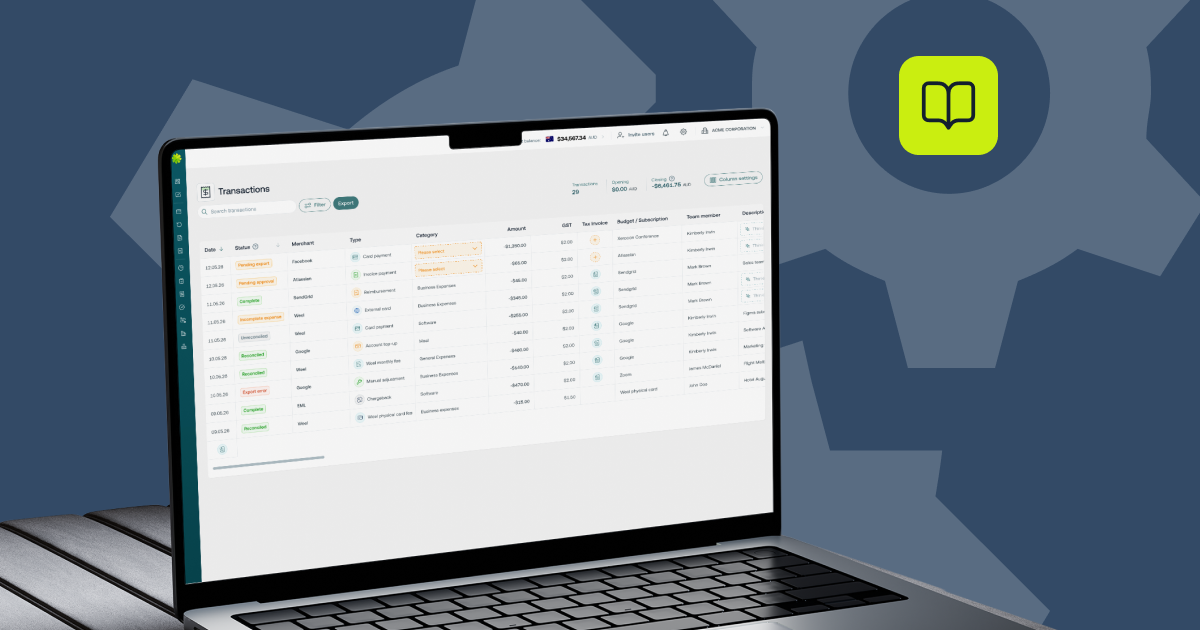
Weel is the expense management application used by 4,000+ businesses across Australia and New Zealand to manage corporate cards, expense approvals, reimbursements, and accounting reconciliation from a single platform.
Over 90% of card expenses on the Weel platform reach full manager approval, across 3.9 million cleared transactions. Half of all card expenses are fully approved within 24 hours. For teams using Weel's structured approval workflows, expense completion reaches 95%. Nothing falls through.
The Weel platform closes every part of the employee expense loop:
- Policy at the card level: per-person spend limits and category restrictions applied directly, so out-of-policy spending is prevented rather than corrected
- Automatic approval routing: claims route to the right approver instantly, with multi-level chains and delegation rules configured to match your team structure
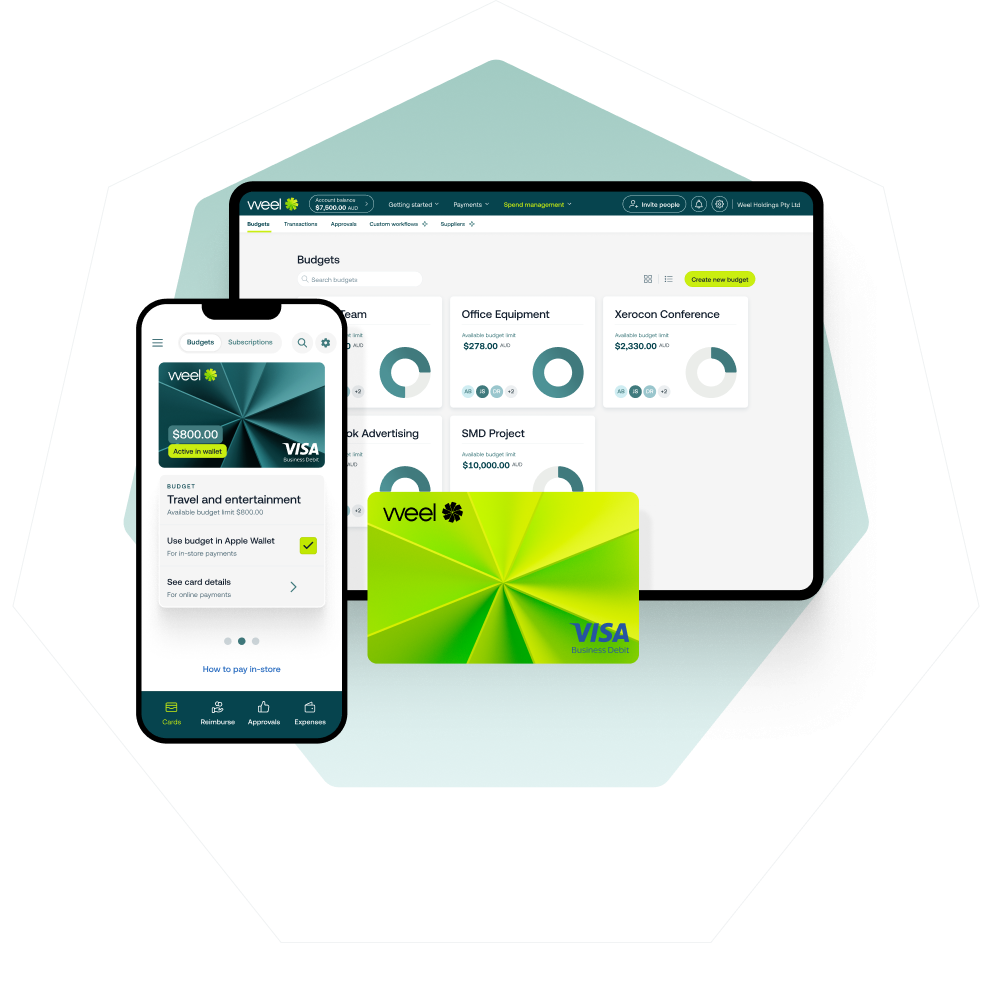
- Real-time spend dashboards: a live view of every transaction, pending approval, and budget position by person, department, or cost centre
- ATO-compliant receipt capture: receipts captured at the point of spend, with GST and FBT fields collected automatically
- Accounting sync: every approved expense syncs to Xero, MYOB, or NetSuite, with a median time from spend to accounting sync of 2.3 days across the platform
Expense Pain, Gone. Book a demo at letsweel.com/demo to see how finance teams close the month without the chase.
Conclusion
Employee expense management across a team comes down to four things working together: clear policy, structured approvals, real-time visibility, and complete record-keeping. The difficulty is executing all four consistently when dozens of people are spending on the business's behalf every day. A dedicated system does that automatically. If month-end is still a reconstruction exercise in your business, the loop isn't closed. Book a demo with us today to find out how we can close it.