






Disclaimer: This article provides general information only and is not tax or financial advice. Tax obligations vary by business type and circumstance. We recommend consulting a registered tax agent or visiting ato.gov.au for guidance specific to your situation.
A team member pays for a client lunch, intends to submit the receipt, and forgets. A manager approves in batches on Friday afternoon, if Friday isn't swallowed by something else. Finance waits for a full run of approvals before processing payment. The team member follows up three weeks later, politely at first.
None of this is anyone's fault. It's what happens when a process is assembled from email, spreadsheets, and goodwill rather than built from the ground up to close.
This guide covers what a functional expense reimbursement process looks like, what good record-keeping looks like for reimbursements, and how to tell when manual processing has outgrown your team.
What is an expense reimbursement?
An expense reimbursement is a payment made by a business to a team member who spent their own money on a legitimate business expense.
It's distinct from a corporate card transaction, where the business absorbs the spend directly, because the financial risk sits with the individual until the business repays them. That gap between spend and repayment is where friction, compliance risk, and team frustration accumulate.
Reimbursements remain a permanent part of most Australian businesses' financial workflows. Not every team member has a corporate card. Not every spend can be anticipated. Remote workers, field-based teams, and casual contractors all generate out-of-pocket expenses that need to flow back through finance accurately and quickly.
The goal of a reimbursement process is not just payment. It's closure. Every expense is documented, categorised, approved, paid, and reconciled. Nothing hangs open at month-end.
How most reimbursement processes break down
Manual reimbursement processes tend to fail at the same four points.
1. No written policy
Without a policy, team members guess what's reimbursable. Finance gets receipts for personal coffees, borderline entertainment, and expenses that require GST claims but lack the right documentation. Rejecting them after the fact damages trust. Approving them creates compliance exposure.
2. No submission standard
"Email me the receipt" produces a different result from every person on the team. Some send PDFs. Some send photos taken in poor lighting. Some describe the expense in the body of an email without attaching anything. Finance spends time chasing rather than processing.
3. Slow or batched approvals
When managers approve expenses weekly or fortnightly, a team member who spent money on Monday doesn't see repayment for three to four weeks. That's a real interest-free loan to the business, one no employment contract specifies and no team member signed up for.
4. Disconnected payment and sync
Even after approval, payment has to be initiated, processed, and then reconciled against the accounting system. Without automation, each of those steps is a manual task. Each is an opportunity for an entry to fall through the cracks before month-end.
The combined cost is significant. A Finance Ops person spending two hours per week chasing reimbursement submissions is losing 100 hours a year on a workflow that should run without intervention.
Record-keeping for reimbursements: what you need to know
Before building or overhauling a process, it's worth understanding the record-keeping obligations that generally apply to reimbursements. The specifics will depend on your circumstances — a registered tax agent can advise on what applies to your business.
GST claims
If your business is registered for GST, you may be able to claim input tax credits on business expenses, including those reimbursed to a team member. A valid tax invoice is generally required for purchases over $82.50 (GST-inclusive). For purchases under that threshold, a simpler receipt showing the supplier name, date, and amount is usually sufficient. Check the ATO's guidance or speak to your tax adviser to confirm what applies to you.
Receipts captured on a phone and never validated against the purchase record are not reliable for GST claims, particularly if the image is illegible or the supplier name is missing.
FBT and the "otherwise deductible" rule
Many business reimbursements may be exempt from Fringe Benefits Tax under what the ATO refers to as the "otherwise deductible" rule. Whether this applies in your situation depends on the nature of the expense and how your business is structured — speak to a registered tax agent to confirm.
Expenses with a private-use component — entertainment, travel that includes personal days, home office costs – can be more complex. Good documentation of the business purpose and any private-use apportionment is important. The ATO's FBT guidance covers this in detail.
Record retention
Under the ATO's record-keeping rules, records supporting GST claims and FBT purposes are generally required to be retained for five years. Storing a transaction entry is not the same as storing the original receipt — the receipt itself needs to be legible and retrievable.
For expenses where FBT may be relevant, records showing the nature of the expense, the business purpose, and any private-use apportionment are important to have. Your tax adviser can help you understand exactly what's required for your situation.
How to build a reimbursement process that closes every time
A functional process has five stages. Each one needs to be defined in writing before you have a process. Otherwise you have a vague expectation.
Stage 1: Policy
Define what is reimbursable, what is not, and what requires prior approval. At minimum, cover:
- Travel (flights, accommodation, taxis/rideshare, mileage)
- Meals and entertainment (distinguish client meals from team meals from solo working meals)
- Equipment and office supplies
- Training, conferences, and professional development
- Subscriptions and software
Set per-category limits. Require pre-approval for expenses above a threshold. State what receipts are required and in what format. Publish the expense policy where every team member can find it, not just in the induction pack they read once in week one.
Stage 2: Submission
Every reimbursement request needs a receipt, a category, a business purpose, and a date. Standardise the format. Whether you use a form, a spreadsheet, or dedicated software, every submission should answer the same four questions before it reaches a manager.
Set a submission deadline: within five business days of the expense is a reasonable standard for most businesses. Late submissions should not be processed in the same cycle as on-time ones. This creates a natural incentive for prompt submission without punishing legitimate delays.
Stage 3: Approval
Approval routing should go to the person who can confirm the business purpose, typically the direct manager, not Finance. Finance should not be the approval bottleneck; they are the payment executor.
Set a target approval time and hold managers to it. Three business days is a reasonable standard for most expense amounts. Expenses above a higher threshold (set in your policy) may warrant a second approval.
Stage 4: Payment
Payment should be processed in a defined cycle. Weekly is the standard that balances efficiency with team expectations. If your volume justifies it, real-time payment on approval is better.
Pay via direct bank transfer to the team member's nominated account. Do not pay via petty cash for anything that will be claimed as a GST credit. You need a transaction record.
Stage 5: Sync
Every approved, paid reimbursement needs to land in your accounting system with the correct GL code, cost centre, and GST treatment before month-end. If Finance is re-entering data from approved forms into Xero or MYOB manually, that step is where errors compound. Automate the sync or build a daily expense reconciliation check into the process.
How long should reimbursements take?
The honest answer is: faster than most businesses currently manage.
A team member who submits a receipt on Monday should expect payment by end of that week. That requires a submission-to-approval cycle of one to two business days and a payment run the same week.
Weel's reimbursement data across 107,000 reimbursements shows that 95% reach full payment. The median reimbursement is paid within one day of submission and approval. Over 80% are paid within a week.
That's the benchmark. If your current process takes three to four weeks from submission to payment, the gap between what your process costs your team and what it should cost them is measurable.
The slowest point in most manual processes is not payment. It's submission. Team members delay submitting because the process is effortful. When submission is a phone tap rather than an email thread, submission rates go up and payment cycles compress.
When to automate your reimbursement process
Manual processes work until they don't. The signals that yours has outgrown your team are consistent:
- Finance spends more time chasing submissions than processing payments
- Month-end close is held up by unreconciled reimbursements
- Team members follow up on payments more than once per month
- Managers batch-approve without reviewing individual receipts
- You've had an ATO audit question or GST claim rejected due to missing documentation
Expense automation doesn't replace judgment. It removes the friction that causes judgment to be bypassed. When submission is a single tap, capture rates go up. When approval routing is automatic, approval time goes down. When payment triggers a direct accounting sync, month-end is not a catch-up exercise.
What to look for in a reimbursement tool:
- Receipt capture at the point of spend: mobile OCR that extracts supplier, amount, date, and GST automatically
- Configurable approval workflows: route by amount, category, or department without Finance being the intermediary
- Direct accounting integration: two-way sync with Xero, MYOB, or NetSuite; not a CSV export
- Audit trail: every submission, approval, and payment timestamped and retrievable
- ATO-compliant storage: receipts stored in a format that satisfies five-year retention requirements
Weel reimbursements: from submission to payment in one day
Weel's reimbursement workflow is built to close every expense before month-end, not to approximate it.
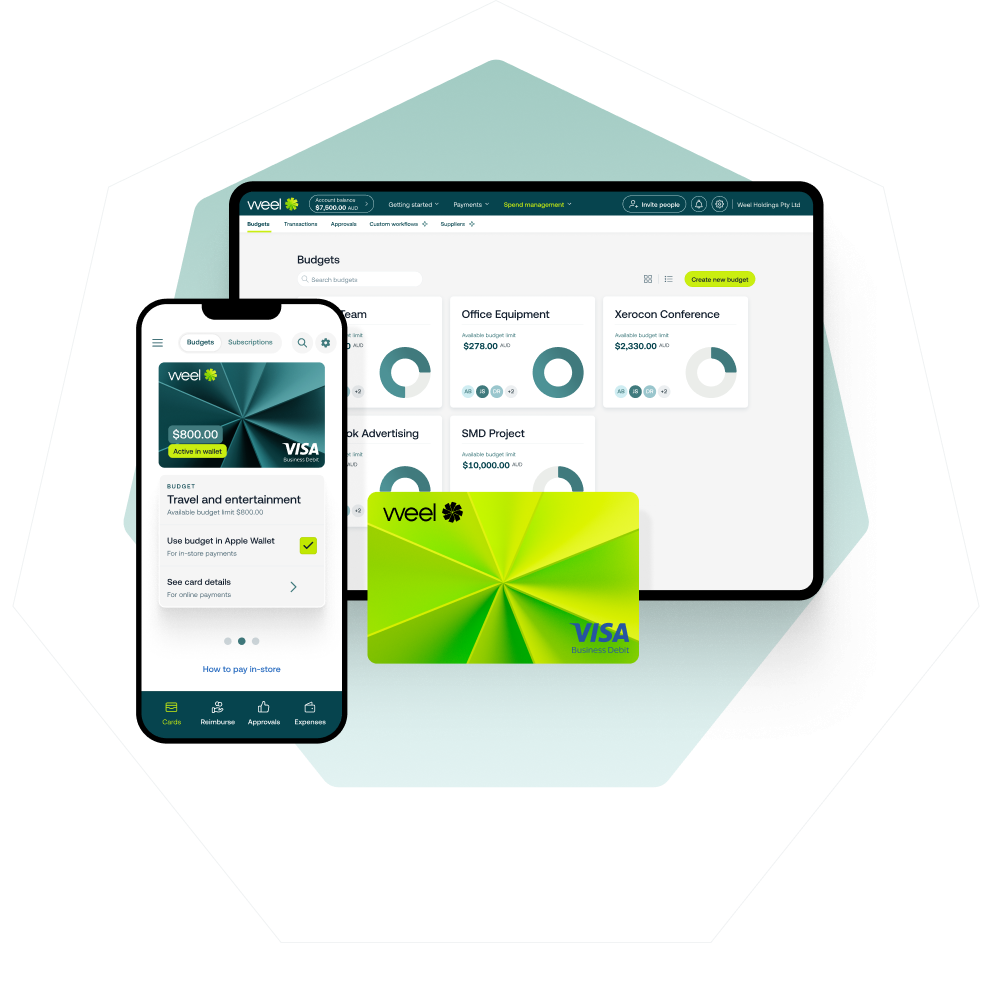
Team members submit expenses from their phone. Weel AI reads the receipt and fills in the details: supplier, amount, date, GST. The expense routes automatically to the correct approver based on your policy. Once approved, payment processes directly to the team member's bank account. The transaction syncs to Xero, MYOB, or NetSuite with the correct GL code, cost centre, and GST treatment, automatically.
Across 107,000 reimbursements processed on Weel, 95% reach full payment. The median reimbursement is paid within one day of approval. Over 80% are paid within a week.
No receipt-chasing. No manual re-entry. No month-end backlog.
See how Weel reimbursements work →
The bottom line
An expense reimbursement process fails when it relies on people remembering to do things. It works when every step, from submission through to accounting sync, has a defined owner, a defined format, and a defined timeline.
Get the policy in writing. Standardise submission. Route approvals to managers, not Finance. Pay weekly. Sync automatically.
If your current process can't reliably close every reimbursement before month-end, it's worth examining where it breaks, and whether the fix is a policy update or a tool change.


.jpeg)