





This article breaks down what AI can realistically automate in the finance function, what Australian finance teams should expect from the tools available now, and how to set clear expectations before you invest.
What is AI financial management?
AI financial management refers to the use of artificial intelligence, including machine learning, natural language processing, and pattern recognition, to automate, analyse, and improve financial processes inside a business. In practical terms, this means AI taking over tasks that previously required manual data entry, human review, or repetitive decision-making.
For Australian businesses, the relevant application areas span four main parts of the finance function:
- Expense capture and coding: AI reads transaction data and auto-populates category, description, and GST fields, removing the manual step entirely
- Approvals and policy enforcement: AI routes expenses through the right approval chain and flags policy breaches before they reach the approver
- Anomaly detection: AI identifies unusual spend patterns, duplicate entries, or out-of-policy transactions in real time
- Forecasting and financial analysis: AI aggregates spend data continuously to give finance leaders an accurate, up-to-date picture for planning
The distinction between AI and plain automation matters. Basic automation follows fixed rules: if X, then Y. AI adapts. It learns from historical data, improves its coding accuracy over time, and surfaces insights that a rules-based system would miss entirely.
Why AI financial management matters for Australian CFOs
Finance teams in Australia are under pressure from two directions at once: growing transaction volumes and flat headcount. The Australian Bureau of Statistics consistently reports rising business activity across services sectors, while finance teams remain lean. The result is more to process, with the same number of people.
Manual processes do not scale. When a finance team reaches a certain transaction volume, manual expense coding, receipt chasing, and month-end reconciliation become the bottleneck. AI financial management removes that bottleneck without adding headcount.
For CFOs specifically, the value is not just speed. It is certainty. When AI captures, codes, and routes every expense automatically, the close is not a scramble: it is a confirmation. The books close because the work was already done throughout the month, not because the team worked late on the last day.
The difference shows up in the numbers. According to Weel data, when Weel AI is active, 95% of expenses are fully manager-approved within 30 days, compared to 84.7% without AI. AI-powered expenses are also 13% more likely to be fully approved within a week (78% versus 69% without AI). That 10-percentage-point gap on 30-day completion is what a reliable close actually looks like.
What AI can automate in the finance function today
Expense capture and GST coding
The most immediate and measurable win from AI financial management is expense capture. When a team member makes a purchase on a corporate card, AI reads the merchant data and transaction amount, and auto-populates category, description, and GST status. The person spending does not need to touch it.
This is not theoretical. Weel AI auto-populates category, description, and GST on transactions. When it is active, Weel data shows expense completion rates lift to 99%, versus 90% without AI. The reason is straightforward: when the hard part is already done, people complete the process.
For a Finance Manager, this changes the conversation entirely. Instead of chasing your team for receipts and coding, the data arrives complete. The role shifts from data entry supervisor to data quality reviewer.
Approval routing and policy enforcement
Approval workflows have always been the weak link in expense management. A well-designed policy is useless if it is not enforced consistently at the point of approval. AI closes that gap.
Modern AI Agents do not just route expenses. They check every submission against policy before routing. An out-of-policy spend is flagged immediately, the appropriate approver is notified, and the audit trail is created automatically. Nothing falls through because an approver was unavailable or the policy was unclear.
With Weel's approval workflows in place, businesses reach 95% expense completion, which is 7 points higher than businesses operating without structured workflows. When AI drives that process, both the completion rate and the speed increase.
Anomaly detection and fraud signals
Duplicate invoices, split transactions designed to avoid approval thresholds, unusual merchant categories for a given cost centre: these are patterns that are invisible in a spreadsheet but obvious to a trained model. AI financial management systems scan every transaction against historical norms and flag deviations for review.
This is where AI in finance delivers a disproportionate return for Australian SMBs. Larger enterprises have dedicated compliance teams watching for fraud signals. Growing businesses do not. AI levels that playing field by running the same checks, on every transaction, in real time.
Financial forecasting and spend analytics
AI is increasingly applied to the forecasting layer of expense management. Rather than pulling data manually at month-end, AI aggregates spend continuously, categorises it consistently, and surfaces trends that a Finance Manager can act on during the month rather than after it.
This is meaningful for cash flow management, budget tracking, and board reporting. When spend data is complete and coded correctly throughout the month, a forecast produced mid-month is actually reliable. Without AI, the data is too incomplete to trust until the close is done.
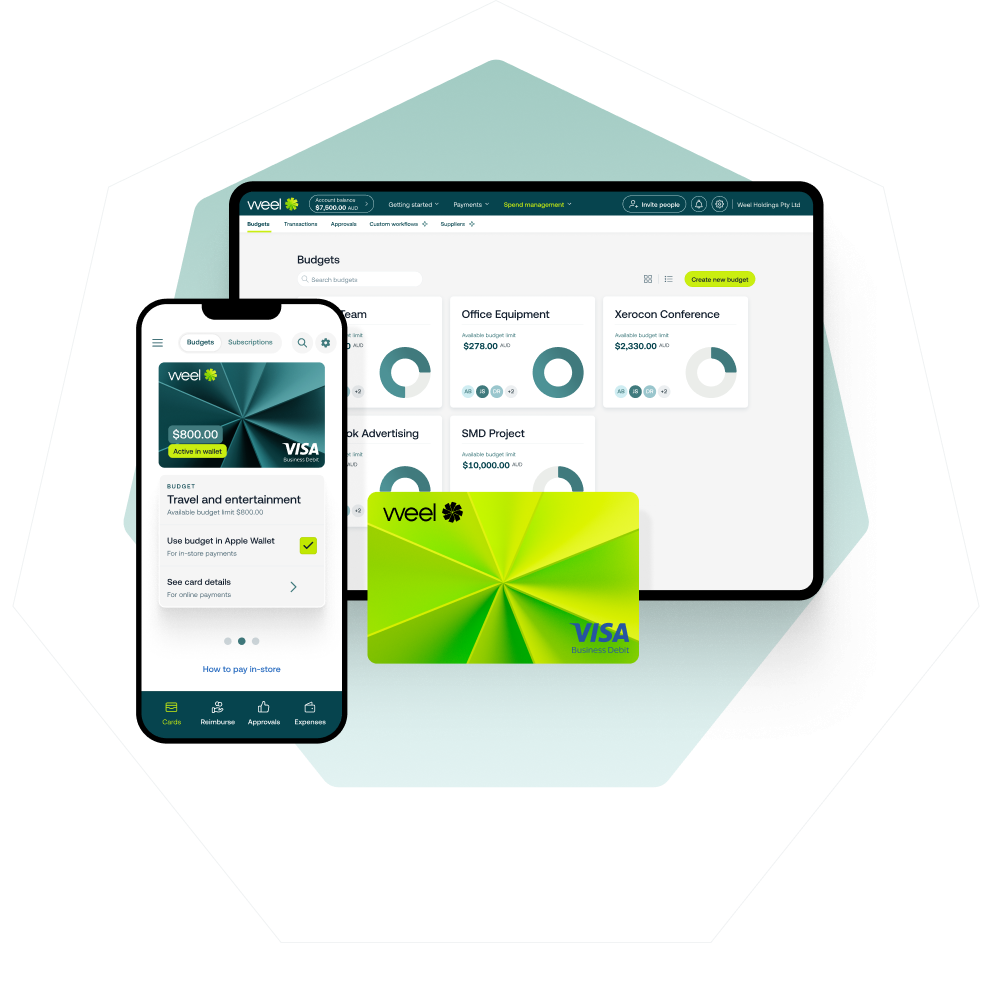
Weel's Budgets feature gives finance teams real-time visibility into spend against budget, a practical application of this principle that requires no manual data aggregation.
What to realistically expect from AI in finance tools
AI financial management tools are not all built the same. The gap between what vendors promise and what finance teams actually experience is wide. It is worth setting clear expectations before you commit.
What AI does well today:
- Coding and categorisation of high-volume, structured transaction data (card spend, invoices with consistent formats)
- Pattern recognition across large datasets (anomaly detection, duplicate detection)
- Routing decisions based on rules and historical patterns (approvals, escalations)
- Real-time data aggregation for dashboards and reporting
Where AI still requires human judgment:
- Complex supplier negotiations and contract decisions
- Unusual or one-off transactions without historical context
- Strategic financial planning that requires board-level context
- Tax and compliance advice
The honest framing for any CFO evaluating AI financial management tools is this: AI is exceptional at removing the high-volume, low-judgment work from your team's plate. It does not replace financial expertise. It gives your finance team the data and the time to apply that expertise where it matters.
How Australian finance teams use Weel for AI financial management
Over 4,000 Australian businesses use Weel to manage company spending. For CFOs and Finance Managers, Weel's AI capabilities address the specific parts of the finance function where manual processes create the most drag.
When Weel AI is active, expenses arrive already coded. The category is set, the GST is flagged, the description is populated. The AI Agents route every expense through the correct approval chain, enforce policy at the point of submission, and flag anomalies before they become problems. The result is a finance function where the month-end close is not an event: it is a formality.
The Weel loop works like this:
- A team member makes a purchase on a Weel corporate card
- AI immediately auto-populates coding, category, and GST
- The expense routes automatically to the correct approver
- Policy is checked in real time: out-of-policy items are flagged before approval
- Data syncs to Xero, MYOB, or NetSuite continuously, not at month-end
According to Weel data, 50% of all card transactions are fully manager-approved within 24 hours. The median approval time is 8 hours. For a CFO who has spent years chasing month-end compliance, these numbers represent a different way of running the finance function entirely.
To see how Weel AI works in practice, book a free demo.