




Choosing the right expense management software is one of the highest-leverage decisions a finance manager makes. The wrong platform means more hours chasing receipts at month-end. The right one means every expense is coded, approved, and synced to your accounting software before you even ask.
This guide compares the leading options available to Australian businesses in 2026, what each does well, who it suits, and what to look for before you commit.
What is expense management software?
Expense management software is a digital platform that captures, categorises, approves, and reconciles business spending. It replaces the manual cycle of paper receipts, spreadsheet expense reports, email approval chains, and manual bank reconciliation.
A modern expense management system covers the full spend loop: a team member makes a purchase, the receipt is captured (by photo or automatically), categorised against your chart of accounts, routed through an approval workflow, and exported to your accounting software. The best platforms close that loop without anyone needing to follow up.
For Australian businesses, this also means handling GST coding correctly and maintaining records that satisfy ATO record-keeping requirements for business expenses. Platforms that automate GST capture and produce audit-ready exports save significant work at tax time.
What features should you look for?
The features that matter most depend on your team size and how complex your spend is. Here are the ones that separate capable platforms from basic ones.
Receipt capture and OCR. AI-powered OCR extracts merchant name, amount, and date from a receipt photo automatically. This removes the need for manual data entry and reduces coding errors. Look for mobile app receipt scanning that works offline.
Approval workflows. Multi-level approvals and approval routing let you enforce spend policy without chasing managers by email. Dynamic approvals route transactions to the right approver based on amount, category, or department.
Real-time reporting and spend analytics. Real-time visibility means you know what's been spent before month-end, not after. Budget tracking, cost centre tracking, and drill-down reporting by project or department are critical for finance teams managing multiple cost centres.
Accounting integrations. For Australian businesses, Xero and MYOB are the most important integrations. Mid-market teams on NetSuite need confirmed two-way sync and GL code mapping. Bank reconciliation should happen automatically, not as a manual export.
Reimbursements. Teams that pay out of pocket need a fast, traceable reimbursement process. Look for direct entry batch payments (the standard ANZ bank file format) and clear audit trails on every reimbursement submitted.
Policy enforcement and compliance. Out-of-policy flagging at point of spend stops problems before they start. GST auto-classification and audit-ready exports reduce your workload when preparing BAS or responding to ATO queries.
How to choose based on your business size
The right expense management application depends heavily on your team size and transaction volume.
Under 50 employees. You need something fast to set up, easy for non-finance team members to use, and tightly integrated with Xero or MYOB. Receipt scanning, reimbursements, and basic approval workflows matter most. Pricing should scale with usage, not lock you into enterprise contracts.
50-200 employees. At this size, manual processes start breaking. You need multi-level approval hierarchies, per-team budget controls, and real-time reporting that shows you where spend is going before the month ends. Integration reliability becomes critical, a sync that fails at month-end is a serious problem.
200+ employees. Mid-market and enterprise teams need role-based access, separation of duties, SSO, and potentially SCIM for user provisioning. Multi-entity support matters if you operate across multiple ABNs or subsidiaries. The accounting integration needs to handle high transaction volumes with two-way sync and GL coding.
The leading expense management software options for Australian businesses
1. Weel
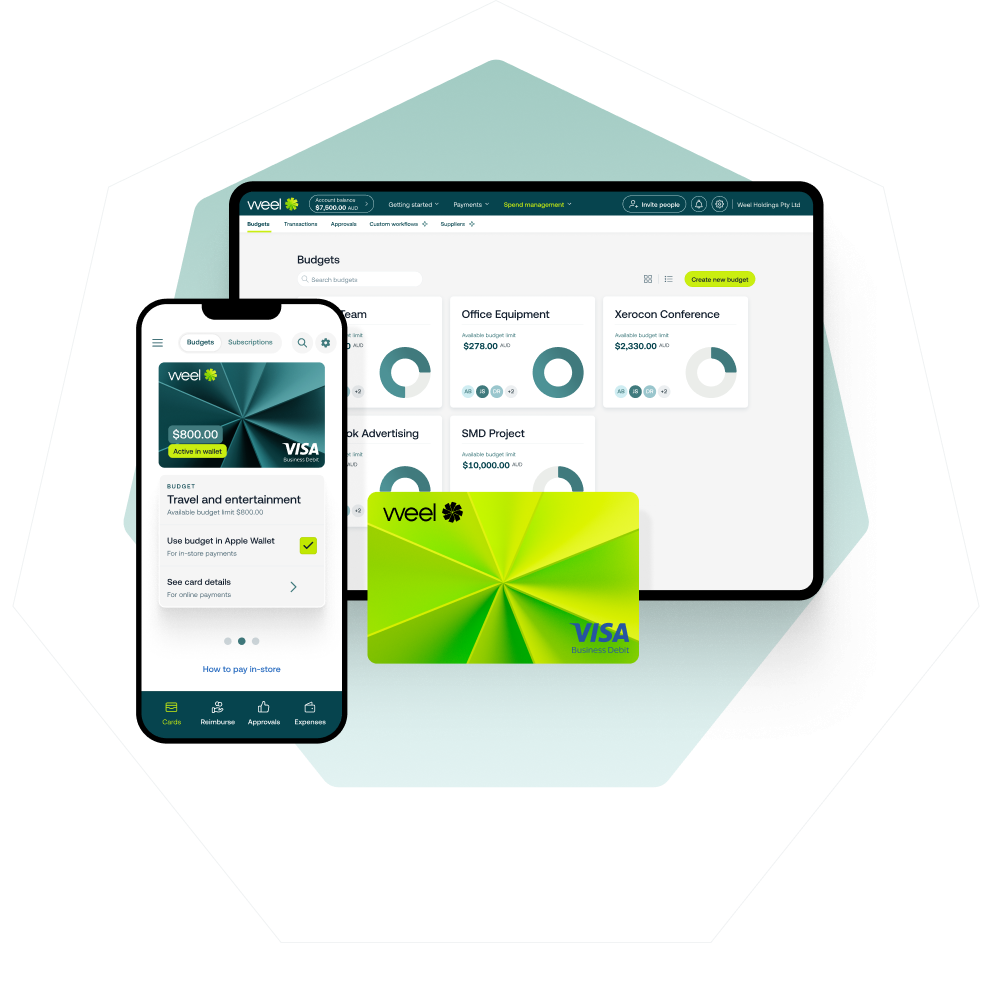
Weel is an Australian expense management platform built for businesses from 20 to 1,000+ employees. It covers the full expense loop: corporate cards with real-time spend controls, AI-powered receipt scanning, approval workflows, and direct accounting sync with Xero, MYOB, and NetSuite.
What sets Weel apart is verified completion data. Across 3.9 million card transactions from 4,000+ Australian businesses, over 90% of card expenses reach full manager approval. Half of all expenses are fully approved within 24 hours, and 44% are manager-verified within 1 hour. These are not marketing estimates, they are measured outcomes from real business spending on the platform.
Weel also handles reimbursements with the same efficiency: 95% of reimbursements are fully paid, with half paid within 24 hours of submission.
Best for: Australian businesses that want a single platform for corporate cards, expense tracking, approvals, and accounting sync, with real data on how well it actually works.
Limitations: Built specifically for the Australian and New Zealand market; not suited to businesses with significant operations outside these regions.
2. SAP Concur
SAP Concur is a global enterprise expense management system with a local Australian presence. It covers expense reports, travel booking, invoice processing, and AP automation in one platform, with integrations across major ERPs.
Best for: Large enterprises already on SAP with complex travel and expense workflows across multiple countries.
Limitations: Implementation timelines and total cost of ownership are significant. Pricing is typically complex. For SMBs and mid-market teams, the feature set exceeds what most businesses need at that scale.
3. MYOB Expenses
MYOB's built-in expense management application is well-suited to businesses already using MYOB for accounting. It covers receipt capture, GST coding, and reconciliation within the MYOB Business platform.
Best for: Small businesses using MYOB as their primary accounting software who want expense management without adding another tool.
Limitations: Limited approval workflow capability. Not suited to businesses on Xero or NetSuite. Lacks the reporting depth that growing businesses need.
4. Expensify
Expensify is a US-based expense tracking platform with a well-regarded mobile app and broad integrations. It is popular with teams that have simple expense reporting needs and want a fast setup.
Best for: Small teams with straightforward per-employee expense reporting and no complex approval requirements.
Limitations: No Australian-specific compliance features. GST handling requires manual configuration. Pricing is in USD, which may affect cost predictability for Australian businesses.
5. Airwallex Expenses
Airwallex's expense management module sits within its broader business account platform, combining multi-currency cards with expense tracking and approval workflows. It suits businesses with international spend requirements.
Best for: Australian businesses with significant international operations or multi-currency spending that want cards and expense management in one place.
Limitations: Expense management is a secondary feature within a broader payments platform. Teams that need deep approval workflows or advanced reporting may find a dedicated expense management tool a better fit.
How Australian finance teams use Weel to close the expense loop
The gap between "expense management software" and "every expense actually complete" is where most platforms fall short. Receipts are submitted but not approved. Expenses are approved but not reconciled. Month-end arrives and the finance team is still chasing.
Weel is built around closing that loop entirely. Here is what the process looks like in practice:
A team member spends on their Weel corporate card. The receipt is captured automatically via the mobile app within a median of 4 hours. AI-powered OCR populates the merchant, amount, and GST classification. The expense is auto-routed through the relevant approval workflow, no manager reminders needed. When approved, it syncs directly to Xero, MYOB, or NetSuite, with GL code mapping applied. Median time from card swipe to accounting sync: 2.3 days.
Businesses using Weel approval workflows reach 95% expense completion, 7 percentage points ahead of businesses without structured workflows. "Every Expense Complete" is not a tagline. It is a measurable outcome.
For finance managers preparing for ATO review or simply wanting confidence at month-end, the combination of real-time spend visibility, automated policy enforcement, and audit-ready exports makes Weel the platform designed specifically for this outcome.
Curious to see how Weel can fit within your organisation's finance operations? Book a demo today.
How to evaluate expense management software: five questions to ask
Before committing to a platform, run through these questions with each vendor.
1. What is the actual completion rate on your platform? Not "how fast can receipts be submitted", how often do expenses reach full approval? Ask for real data.
2. How does the Xero or MYOB integration work? Is it a one-way export or a two-way sync? Does it handle GL code mapping, tracking categories, and tax rates automatically?
3. How are reimbursements processed? What is the average time from submission to payment? Does the platform support direct entry (ABA file format) for Australian bank payments?
4. What approval workflow options are available? Can you set multi-level approvals, approval delegation, and out-of-policy flagging without needing a developer?
5. What does setup actually take? Most platforms claim fast setup. Ask for a realistic timeline and what resources your team will need to commit.
Conclusion
The best expense management software for your business is the one your team actually uses, and that closes the loop without manual follow-up. For Australian businesses prioritising real-time spend visibility, accounting integration, and month-end confidence, the shortlist is short.
Weel is built specifically for Australian finance teams that want every expense complete, not just submitted. To see exactly how it works for a business like yours, book a demo today