





Business expense management is one of the most time-intensive responsibilities a finance team carries, and when it breaks down, the whole close slows with it. This guide covers how Australian businesses build the policies, controls, and tools that keep every expense tracked, approved, and closed on time.
Whether you're setting up your first expense policy or replacing a process that's no longer keeping pace, here's what a complete expense management system looks like in practice.
What is business expense management?
Business expense management is the process of tracking, approving, and reporting on money spent by employees or teams on behalf of a business. It covers everything from a $15 parking receipt to a $3,000 interstate travel claim, and all the approvals, coding, and reconciliation that sits between the spend and the accounting entry.
At its core, expense management answers four questions:
- Who spent it? Individual accountability at the point of spend.
- What was it for? Category, project, or cost centre coding.
- Was it approved? Policy compliance and manager sign-off.
- Is it reconciled? Matched to a receipt, coded to the general ledger, and exported to accounting software.
For Australian businesses, there's a fifth question the ATO adds: can you prove it? The ATO's record-keeping requirements mean businesses must keep receipts and documentation for most expenses, which makes a structured expense management process a compliance necessity, not just an operational preference.
Why expense management matters at scale
In a business with fewer than ten people, expense management is usually informal. One person holds the card, everyone knows the budget, and receipts land in an email thread. It works, until it doesn't.
The problems surface quickly as teams grow. Cards get shared across departments. Receipts go missing for days or weeks. Finance only sees what's been spent when the bank statement lands. Month-end becomes a chase rather than a close.
At that point, informal processes create three distinct risks:
Visibility gaps. Without real-time spend data, finance teams can't see budget burn until it's too late to act. A team that's overspent on a project can't be course-corrected if the expenses don't surface until month-end reconciliation.
Compliance exposure. Missing receipts, uncoded transactions, and un-approved expenses create audit risk. For businesses with GST obligations or grant compliance requirements, substantiation gaps are a material problem.
Manual overhead. Chasing receipts, re-keying data, and chasing managers for approval are all non-value work that compounds every month. Finance teams that carry this manually don't scale.
The core components of a business expense management system
A functioning expense management system has five components. Most businesses already have some version of each, the question is whether they're connected.
1. Expense policy
An expense policy sets the rules: what's covered, what's not, what limits apply, and what documentation is required. A good policy is specific enough to prevent abuse but simple enough that people actually follow it.
Common elements in an Australian business expense policy include:
- Spend category limits (meals, travel, accommodation, equipment)
- Receipt requirements, including minimum amounts that require documentation
- Approval thresholds, who approves what
- Reimbursement timelines, when people can expect to be paid back
- Out-of-policy escalation, what happens when someone submits a claim that breaks the rules
Without a written policy, approvers make inconsistent decisions and employees don't know where the line is.
2. Expense capture
Receipts need to be captured at the point of spend, not reconstructed a week later. Modern expense capture uses AI-powered receipt scanning, a mobile app that reads a receipt via OCR (optical character recognition), auto-populates the amount, date, and merchant, and codes the category automatically.
This matters because the biggest failure point in expense management isn't approval, it's the initial capture. The median time from spend to receipt submission on the Weel platform is just 4 hours across millions of transactions. That speed is only possible when capture is frictionless.
3. Approval workflows
An approval workflow routes each expense to the right approver automatically, based on rules you set. A $200 team lunch might need only a direct manager. A $5,000 equipment purchase might need the CFO. Multi-level approvals for larger or out-of-policy claims keep controls consistent without putting every decision in one person's inbox.
Good approval workflows include:
- Approval hierarchies, who approves based on amount, category, or cost centre
- Delegation, out-of-office cover so approvals don't stall
- Out-of-policy flagging, automatic alerts when a claim breaks a policy rule
- Separation of duties, the submitter and approver should never be the same person
Businesses using structured approval workflows on the Weel platform reach 95% expense completion, 7 points higher than those without formal workflows. Nothing falls through the cracks.
4. Reimbursements
Where corporate cards aren't used, employees pay out-of-pocket and submit for reimbursement. The reimbursement process needs to be fast and reliable, otherwise people stop submitting, stop using their own funds, and start finding workarounds.
Fast reimbursement is a signal of a well-run finance function. Across the Weel platform, 50% of reimbursements are paid to employees within 24 hours of submission, and over 80% within a week. When reimbursements are slow or inconsistent, it creates friction that erodes confidence in the process.
5. Accounting integration and reconciliation
Every approved expense needs to reach the accounting software accurately and on time. Manual re-keying between systems creates errors and delays. A direct integration with Xero, MYOB, or NetSuite means expenses sync automatically, with the right GL codes, GST treatment, and cost centre mapping, so the close happens continuously, not in a sprint at month-end.
The median time from card spend to accounting sync on the Weel platform is 2.3 days. That's the difference between a close that's already done and one that starts from scratch.
Common challenges with expense management in Australia
Even businesses with mature processes run into recurring friction. These are the most common:
Receipt compliance gaps. Even in businesses with clear policies, a meaningful share of expenses arrive without receipts. Chasing receipts manually consumes finance team time and creates a bottleneck before every close. Over 90% of card expenses on the Weel platform reach full manager approval, but that completion rate only holds when receipt capture is built into the spend moment itself, not left as an afterthought.
Approval bottlenecks. When approvals depend on a manager being available, they stall. A well-designed approval workflow routes to a delegate automatically when the primary approver is unavailable.
Month-end crunch. When expenses arrive late and reconciliation is manual, month-end becomes a known pain point. Finance teams that carry this manually spend days doing work that should have been done continuously.
Decentralised teams. Businesses with multiple locations, departments, or projects need expense tracking that respects cost centre boundaries without adding admin overhead. Budget tracking and cost centre tracking across locations require a system that can handle the complexity.
Growing headcount. Manual expense management doesn't scale. A process that works for 20 people breaks at 80. The volume of transactions, the number of approvers, and the complexity of policy enforcement all compound as the business grows.
How modern expense management works
The shift from manual to modern expense management isn't just about speed, it's about closing every loop. Modern cloud-based expense management automates the steps that create the most friction:
- Auto-categorisation assigns expense categories from receipt data, reducing manual coding
- AI-powered OCR extracts merchant, amount, date, and GST from a photo of a receipt
- Policy enforcement at the point of submission, not after the fact, means out-of-policy claims are flagged before they reach the approver
- Automatic approval routing sends each expense to the right person without manual triage
- Real-time reporting gives finance visibility into spend as it happens, not at month-end
- Direct accounting integration exports approved expenses with full GL coding and bank reconciliation data
The result is a system where expenses are captured at spend, approved on the same day, and reconciled to the books in days, not weeks.
How Australian businesses use Weel for expense management
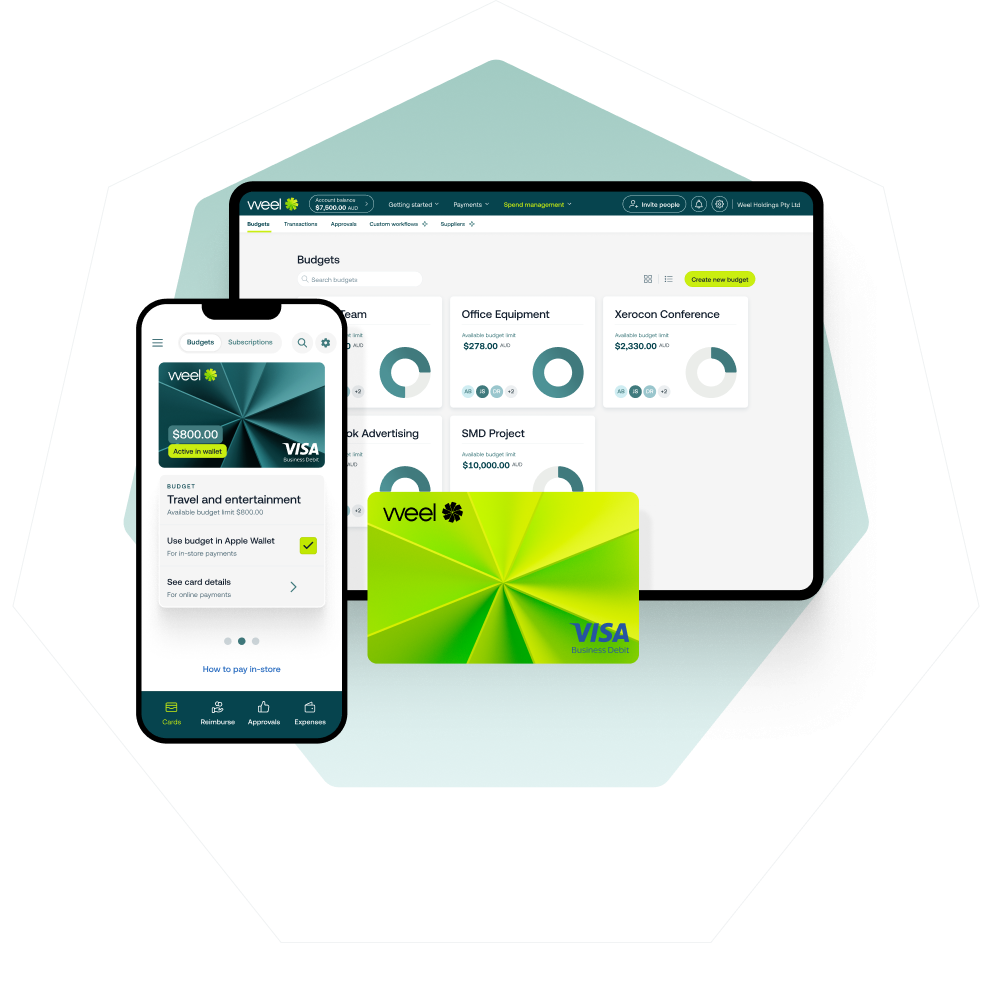
Weel is a cloud-based expense management platform used by 4,000+ Australian businesses to close the loop on every expense, from receipt to reconciliation.
The Weel expense management platform automates the steps that consume the most finance team time. AI-powered receipt scanning captures and codes expenses at the point of spend. Approval workflows route each claim to the right approver automatically. And direct integrations with Xero, MYOB, and NetSuite mean the accounting sync happens in real time.
The numbers reflect the system working: over 90% of card expenses on Weel reach full manager approval. 44% are manager-verified within 1 hour. The median approval time across the platform is 8 hours, across 3.9 million cleared card transactions.
For finance teams running corporate cards, Weel's approval and policy controls enforce spend limits, category restrictions, and approval hierarchies at the card level. Spend controls and transaction-level controls mean policy enforcement happens at the moment of spend, not in a reconciliation review a week later.
When Weel AI is active, the completion rate lifts to 99% of expenses reaching full manager approval, and AI-assisted expenses are 13% more likely to be fully approved within a week. The close happens, and it stays complete.
Every expense complete. That's what a finished expense management system looks like.
Conclusion
Business expense management is the system that sits between a spend and a closed set of books. When it's working, finance teams don't chase receipts, approvals don't stall, and month-end is a confirmation rather than a scramble. When it's not, the gaps show up as missing documentation, delayed closes, and budget blind spots.
Building a complete system means connecting the five components, policy, capture, approvals, reimbursements, and accounting integration, into a loop that closes automatically. For Australian businesses dealing with growing headcount, decentralised spending, or month-end pressure, that loop is the difference between control and chaos.
Want practical guides for Australian finance teams delivered to your inbox? Subscribe to the Weel newsletter for monthly insights on expense management, month-end close, and spend visibility.