





Disclaimer: This article provides general information only and is not tax or financial advice. Tax obligations vary by business type and circumstance. We recommend consulting a registered tax agent or visiting ato.gov.au for guidance specific to your situation.
Running finance for an Australian not-for-profit is not the same as running finance for a business. You are managing multiple funding sources simultaneously. Each grant has its own eligible expense categories, its own acquittal deadline, and its own funder expectations. The ATO wants GST compliance. The ACNC wants financial statements. Your funders want proof every dollar went where it was supposed to go.
Most expense management content is written for businesses with one P&L and a single bottom line. This guide is written for the finance person juggling three grants, two programs, a volunteer reimbursement queue, and an acquittal due in six weeks.
Why expense management is different for NFPs
A for-profit business tracks expenses to understand profitability and control costs. An NFP tracks expenses to demonstrate accountability: to funders, to the ACNC, to the ATO, and to the community the organisation serves.
That difference has real operational consequences.
When a grant-funded NFP makes a purchase, the finance team needs to know:
- Which grant or program does this expense belong to?
- Is this expense type allowable under the funding agreement?
- Is there a receipt that proves what was spent and when?
- Does the receipt show the supplier's ABN and GST amount for ATO purposes?
- Will this transaction be traceable in the acquittal report?
A team member buying supplies for a community program using a shared corporate card answers none of those questions automatically. Finance has to chase the receipt, work out the right cost centre, code it correctly, and file it somewhere it will still be findable in twelve months when the acquittal is due.
Multiply that by every program, every team, every grant. The administrative load becomes the job.
The compliance stack: ACNC, ATO, and your funders
Australian NFPs face three overlapping layers of compliance, and each one creates specific requirements for how expenses must be captured and documented.
ACNC financial reporting. Registered charities must submit annual information statements and, depending on size, reviewed or audited financial statements. Medium charities ($500K–$3M turnover) require reviewed accounts. Large charities (over $3M) require a full audit. In both cases, expenses must be traceable, categorised, and supported by documentation.
ATO requirements. Under Australian tax rules, businesses generally need to ensure a tax invoice or receipt for each claimable expense, showing the supplier's ABN, GST amount, date, and a description of what was purchased. Even where your services are GST-free (as many NFP services are), you may still be able to claim input tax credits on eligible purchases, but only if the documentation is there.
Funder acquittal requirements. Government grants, philanthropic grants, and corporate partnerships each come with their own reporting requirements. Most require a formal acquittal: a structured report demonstrating that grant funds were spent on approved activities, with supporting documentation. Missing receipts, miscoded expenses, or expenses that cannot be tied to the right funding source can result in funding clawbacks or reduced future grants.
None of these three layers cancels the others out. The finance team is managing all three simultaneously.
The grant acquittal problem
Most acquittal problems do not start at acquittal time. They start months earlier, when expenses are captured inconsistently.
The common failure points:
Miscoded transactions. A purchase goes through on a shared card. Finance does not know which program it belongs to until they track down the person who made it. That person cannot remember. The expense gets coded to general operating costs. The grant is short on evidence. The acquittal becomes a gap-filling exercise.
Missing receipts. A team member makes a purchase in the field: at a hardware store, a catering supplier, a community venue. The receipt gets lost, left in a car, or simply not captured. Without a receipt showing ABN and GST, the expense cannot be claimed and the documentation trail has a hole.
Spreadsheet reconciliation. Many NFPs still manage grant acquittals in spreadsheets, manually matching bank transactions to expense categories and cross-referencing receipts stored in email folders or physical files. At month-end, this is hours of work. At acquittal time, it becomes days.
The result is that the acquittal report, which should be a byproduct of good day-to-day expense management, becomes a separate project every time.
Program-level budget tracking: the missing piece
The fix is not a new spreadsheet. It is expense management that assigns every transaction to the right funding source at the moment of spend.
When each program or grant has its own budget, its own virtual card, and its own cost centre in the accounting system, the acquittal report becomes a filtered export. Every transaction is already coded. Every receipt is already attached. Finance does not chase; Finance closes.
This is what program-level budget tracking means in practice:
- A support worker running a community program uses a card assigned specifically to that program's budget
- Spending limits are set to match the grant's allowable expense types and amounts
- Receipts are captured on mobile at the point of purchase
- Transactions sync to the accounting system with the correct GL code and cost centre
At the end of the grant period, the finance manager runs a report filtered by program. The acquittal documentation is already there.
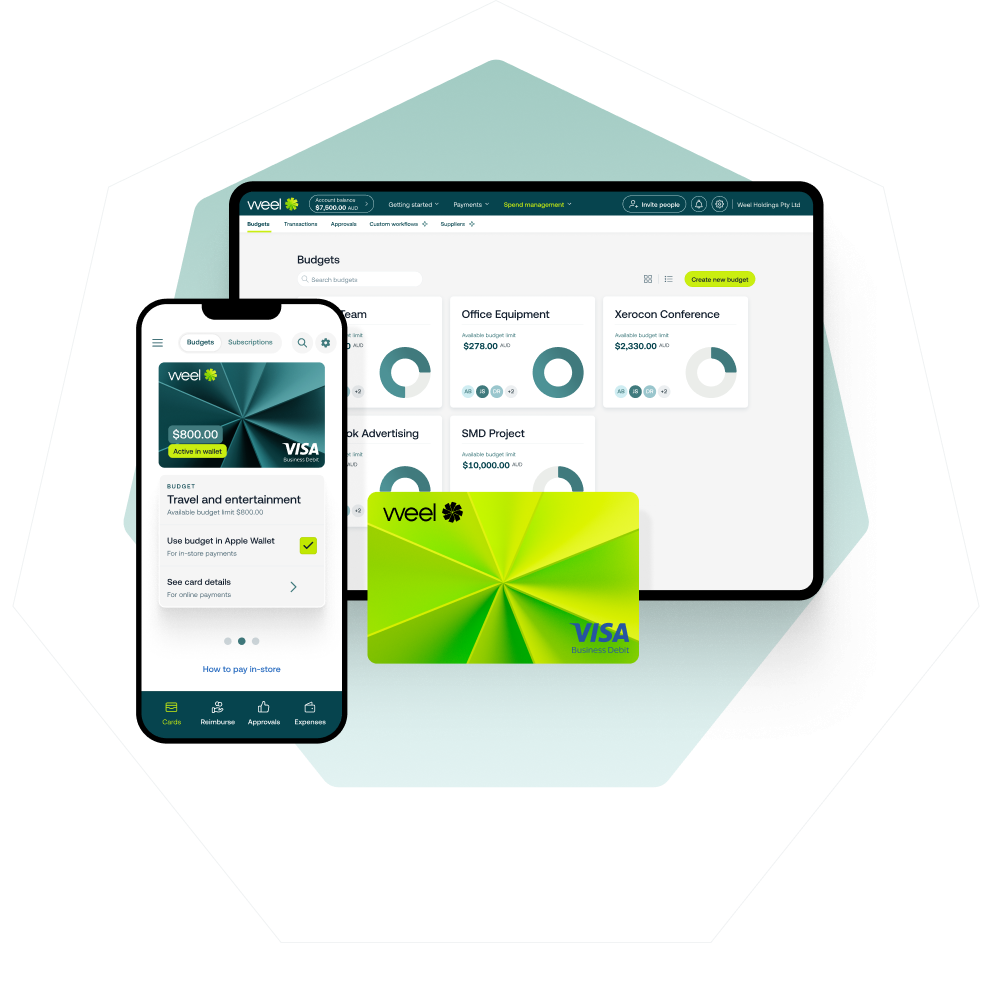
How Weel gives NFP finance teams total spend visibility
Weel is built for organisations that need to manage spend across multiple teams, locations, and cost centres. That describes most mid-sized Australian NFPs exactly.
With Weel, NFP finance teams get:
Virtual and physical cards by program
Issue virtual cards assigned to specific programs, grants, or locations. Set spend limits by category or amount. Every transaction is tagged to the right cost centre from the moment it is made. No retroactive coding required.
Mobile receipt capture
Weel AI captures receipt data at the point of purchase, including supplier ABN and GST. Across all transactions, the median time from spend to receipt capture is four hours. Over 90% of card expenses reach full manager approval, meaning the documentation trail is complete, not chased down at month-end.
Real-time budget tracking
Finance managers see every transaction as it happens, against the budget assigned to each program or grant. No waiting for a bank statement. No end-of-month surprises.
Accounting sync
Weel syncs directly with Xero and MYOB, with GL codes and cost centres mapped. The median time from spend to accounting sync is 2.3 days. By the time the acquittal report is due, the data is already in the accounting system, already coded, already reconciled.
Reimbursement management
For team members who spend their own money on program activities, Weel manages expense reimbursements with a complete approval trail. 95% of reimbursements are fully paid, with every transaction traceable back to the program it served.
For NFP finance teams who have spent years chasing receipts and rebuilding grant records from fragments, Weel closes the loop.
5 tips to building an audit-ready expense process
Start with a written expense policy
Every NFP needs a clear expense policy that defines what is an allowable expense, what the approval process is, and what documentation is required. A policy reduces ambiguity for team members and gives finance a consistent standard to enforce. Weel's expense policy template is a practical starting point.
Define program codes before the grant starts
Before spending begins on a new grant, set up the cost centre or project code in the accounting system. Map it to the relevant card or budget in Weel. When the first transaction happens, it already has a home.
Capture receipts at the point of spend
Do not rely on team members to submit receipts days later. The further from the transaction, the more likely the receipt is lost. Weel's mobile app captures the receipt the moment the purchase is made.
Set approval workflows by program
Multi-level approval workflows mean no expense is finalised without review from the right person. For grant-funded programs, approval workflows also create an audit trail showing that spend was authorised.
Reconcile monthly, not annually
One of the most consistent pieces of advice from NFP accounting specialists is to reconcile grant expenditure monthly, not just at acquittal time. Monthly reconciliation catches miscoded transactions and missing documentation while they are still fixable. An annual reconciliation turns minor errors into major problems.
Check your reimbursement policy is current. For teams building a structured process from the ground up, see our guide to building a reimbursement process that closes every claim. If team members are spending personal funds on program activities, a clear reimbursement policy defines what is claimable, what evidence is required, and how quickly they will be paid.
For more on Weel's NFP-specific expense management, see Weel for not-for-profits or book a demo today.
This article is general information only and is not tax advice. We recommend consulting a registered tax agent for advice specific to your business.