




What is travel expense management?
Travel expense management is how a business tracks, approves, and reconciles the money people spend while travelling for work: flights, accommodation, meals, and the smaller costs that come with being away from the office. For most Australian SMBs, this isn't a constant, enterprise-scale travel program. It's a handful of people, a few times a year, submitting a cluster of expenses that all land in the same week.
That's exactly why it gets messy. A finance team that reconciles routine spend cleanly every month can still lose a week chasing three people who went to a conference in Melbourne, because travel expenses arrive in a batch, from unfamiliar merchants, often without a receipt attached until someone asks twice.
In Australia, travel expense management also touches GST. Business travel costs generally attract GST credits when they're for a business purpose and properly documented, which makes clean, timestamped records more than a tidiness exercise (see the ATO's guidance on GST). Getting the receipt at the point of spend, not two weeks later from memory, is what makes that claim defensible.
Why travel expense management matters for Australian SMBs
When travel expense management runs on memory and photographed receipts, the cost shows up at month-end, not on the trip. A cluster of unreconciled transactions from three different cities adds days to a close that should already be finished.
The real risk isn't the dollar amount. It's the gap between when the spend happens and when finance can see it. Without live visibility, an out-of-policy hotel booking or a personal meal on the company card doesn't surface until someone reviews the statement weeks later, by which point it's too late to correct course.
Employee expense management usually runs smoothly for routine, in-office purchases. Travel is where it breaks, because the volume, the unfamiliar merchants, and the days away from the desk all arrive at once.
For SMBs preparing for their first proper audit, or simply trying to keep clean records of business expenses every month, travel spend is often the one category that doesn't sit cleanly in the system. It's not that the amounts are large. It's that the paper trail is inconsistent: one person keeps a photo, another emails a PDF, a third can't find the receipt at all.
Across Weel's platform, median time from a card swipe to accounting sync sits at 2.3 days. For travel spend specifically, that gap is what separates a close that's calm and complete from one that's still chasing three people for receipts.
The three stages of travel spend, and the one that breaks
Travel expense management covers more than the flight and the hotel. Splitting it into three stages makes the gaps easier to spot.
Pre-trip costs
Flights, accommodation, and conference tickets are usually booked ahead of time, often on a company card or through a travel agent invoice. These are the easiest to control, because someone approves them before the money moves.
On-the-road spend
Meals, ground transport, parking, and incidentals are where travel expense management usually breaks down. They're unplanned, they happen across multiple days, and they're the transactions most likely to arrive without a receipt.

Post-trip reconciliation
Once someone's back at their desk, every one of those transactions needs a receipt, a category, and manager sign-off before it can be coded to the right cost centre. This is the stage that eats a finance team's week if it hasn't been handled in real time.
Why manual travel expense management breaks down
If your team is managing travel expenses with a spreadsheet and a shared inbox for receipts, you already know where this goes. Someone forgets to forward a hotel invoice. Someone else pays for a client dinner on a personal card and waits weeks for a reimbursement. A finance manager ends up cross-referencing bank statements against a folder of photos that may or may not be complete, exactly the kind of ambiguity a clear expense reimbursement policy is meant to close off.
None of this is a discipline problem. It's a systems problem, the same one expense automation solves for routine spend. Manual travel and expense management asks people to remember receipts days after the moment has passed, then asks finance to reassemble the trip from whatever shows up. None of it requires buying a separate piece of expense software just for the days people travel, or standing up new expense management systems on top of what's already in place. Every extra day between the spend and the record is a day finance can't see what's actually happening.
How modern travel expense management works, without a dedicated travel platform
Most Australian SMBs don't need a travel booking platform, an approval hierarchy for flights, or a corporate travel manager. They need the same control they already have over everyday spend, extended to the days someone is out of the office.
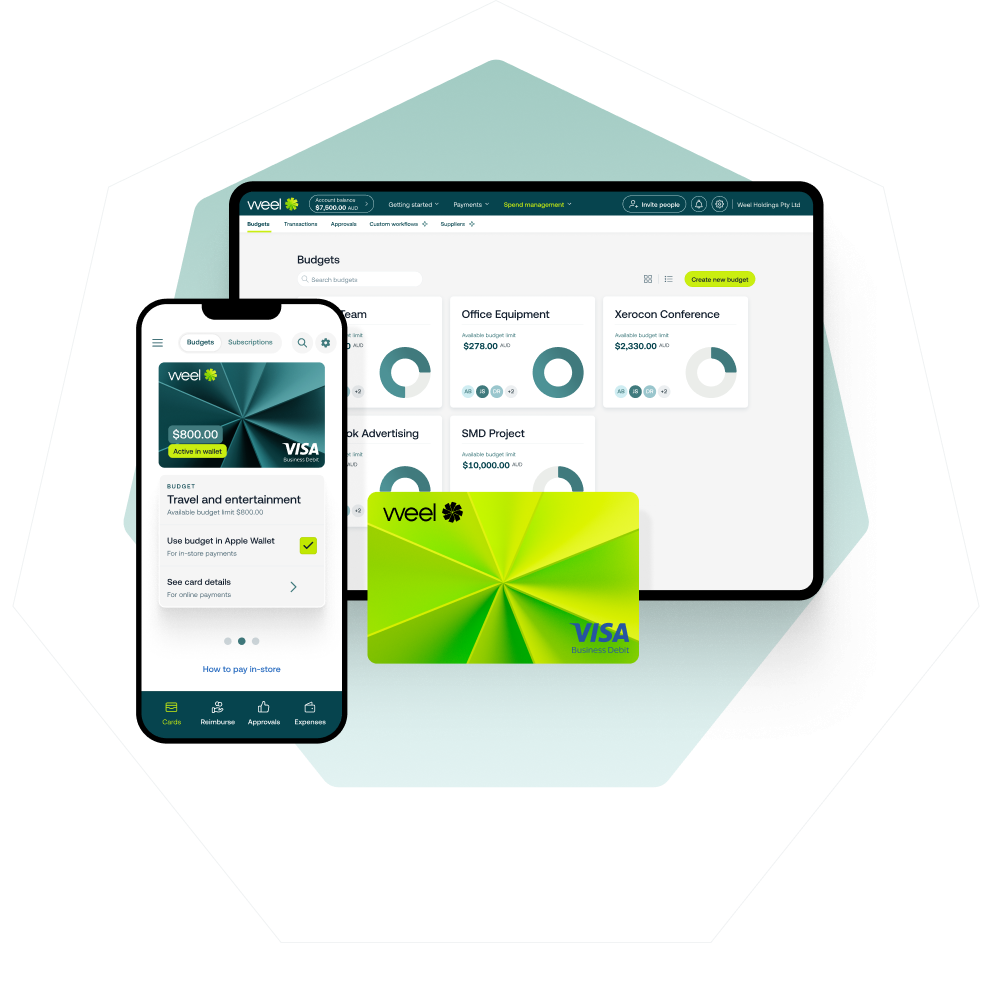
That starts with a spend limit set before the trip, not a policy checked after it. A manager issues a virtual card with a travel budget attached, so the limit is enforced at the point of sale, not flagged in a report two weeks later.
This also means finance doesn't have to choose between control and trust. A spend limit set at $400 for two nights in Brisbane doesn't require a manager to review every coffee and cab fare individually. It just means nothing above that ceiling clears without a conversation first. Real-time reporting shows exactly what's been spent against a travel budget while the trip is still happening, not three weeks after the invoice arrives.
From there, real-time visibility does the rest. Finance can see a transaction the moment it happens instead of waiting for a statement, and the receipt is captured automatically at spend rather than chased afterwards. Travel expense management stops being a special process and becomes an extension of the budget controls already in place for every other cost centre.
How Australian businesses use Weel for travel expense management

Weel treats travel spend the same way it treats every other expense: budgeted before it happens, captured automatically when it does, and reconciled without anyone chasing a receipt.
Before a trip starts, a manager issues a virtual or physical Weel card with a spend limit attached to that trip or that person. The limit is enforced in real time, so there's no post-trip conversation about an out-of-policy charge, because the card simply won't authorise it.
Once the trip is underway, every transaction captures its receipt automatically and routes to the right cost centre. Across Weel's platform, over 90% of card expenses reach full manager approval — a benchmark that applies across every spend category, travel included.
That's the shift: the old loop had a manager reconciling a stack of travel receipts a week after everyone got home. The Weel loop has every transaction coded, approved, and synced to Xero, MYOB, or NetSuite before the trip is even over. Teams using Weel for travel expense management aren't running a second system alongside their everyday spend controls. It's the same budgets, the same cards, the same real-time visibility, just applied to the days someone happens to be out of the office.
Conclusion
Travel expense management isn't a separate problem finance teams need a separate platform to solve. It's the same discipline already applied to everyday spend: budgets set before the money moves, visibility in real time, and receipts captured at the point of spend rather than chased afterwards. Get that right, and the only thing left to do after a trip is close the books.
See how Weel gives your team real-time control over travel spend, with budgets set before anyone leaves the office. Book a free demo.